Free practice
10 Math Kangaroo Practice Problems (Grades 7-8)
Ten original Math Kangaroo-style problems for 7th and 8th graders, from warm-ups to the hardest 5-point kind, with every answer explained.
Math Kangaroo full prep and practice guides: 1–2 3–4 5–6 7–8
Free practice, other grades: 1–2 3–4 5–6
Other contests, grades 7–8: MOEMS Div M AMC 8
Printable PDF: all 10 problems with room to work, then every answer explained.
On this page · 3 sections
Ten original practice problems for the Math Kangaroo Levels 7–8 paper, written by us at real contest difficulty. Every one has a worked solution, with the most common wrong answer and why it tempts.
The Math Kangaroo paper for Levels 7–8 has 30 problems in 75 minutes, worth 3, 4 or 5 points each, and a wrong answer costs nothing, so answer every one. On the real paper you choose from five answers; here you write your own, so there is nothing to guess from. The set climbs like the real one: three warm-ups, four contest-level problems, then three of the hardest kind. Give yourself about 40 minutes, then read every solution, including the ones you got right.
The 10 problems
Problem 1
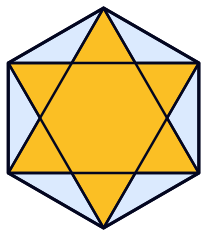
The regular hexagon has an area of 54 cm². Joining every second corner gives two triangles, which together make the shaded star. What is the area of the star?
Problem 2
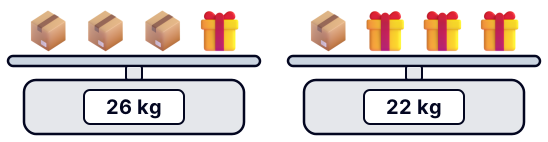
Each scale shows the total weight of the things on it. All the packages weigh the same, and all the gifts weigh the same. How heavy is one package?
Problem 3
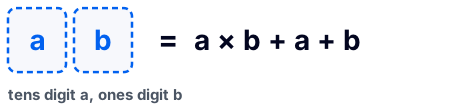
A two-digit number is equal to the product of its two digits plus the sum of its two digits. How many two-digit numbers have this property?
Problem 4
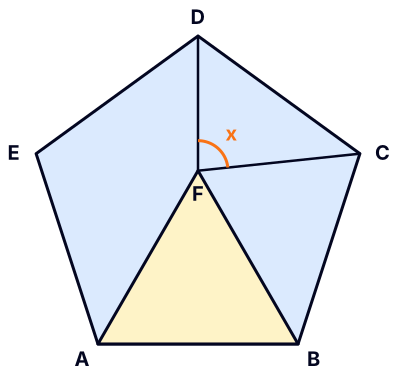
ABCDE is a regular pentagon. Triangle ABF is equilateral, and F is inside the pentagon. What is the size of angle CFD, marked x?
Fact: The five angles of any pentagon add up to 540°.
Problem 5
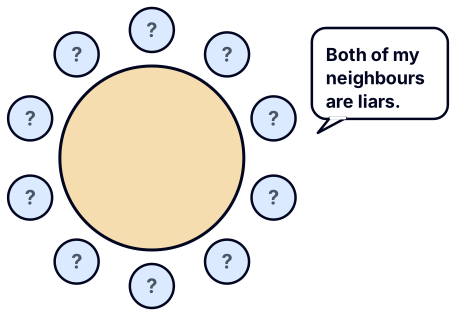
Ten people sit around a round table. Each of them is either a knight, who always tells the truth, or a liar, who always lies. Every one of them says: “Both of my neighbours are liars.” What is the smallest possible number of knights at the table?
Problem 6
How many squares have all four corners on dots of this grid? Squares of every size count.

Problem 7
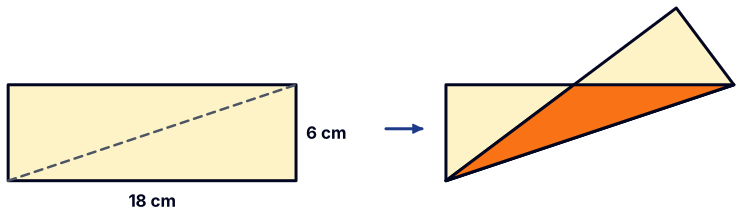
A strip of paper 18 cm long and 6 cm wide is folded along a diagonal, as shown. What is the area of the shaded part, where the paper is two layers thick?
Problem 8
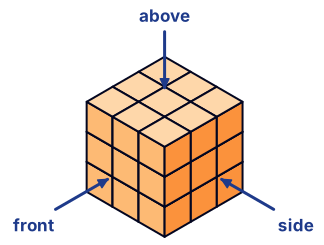
A 3 × 3 × 3 cube is made of 27 small cubes. Mia takes away as many small cubes as she can, but looking from the front, from the side and from above she must still see a full 3 × 3 square. The cubes that are left stay exactly where they were. How many small cubes can she take away?
Problem 9
★ Challenge. Two straight lines, each from a corner of the triangle to the opposite side, cut it into four parts. The areas of three of the parts are shown in cm². What is the area of the shaded part?
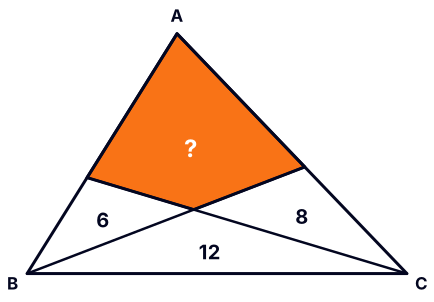
Trick: Two triangles with the same height compare in area exactly as their bases do.
Problem 10
★ Challenge. Eight cups stand upside down on a table. In one move you turn over exactly three of the cups, any three you like. What is the smallest number of moves after which all eight cups stand the right way up?

Solutions
Problem 1
Problem 1: Answer 36 cm²
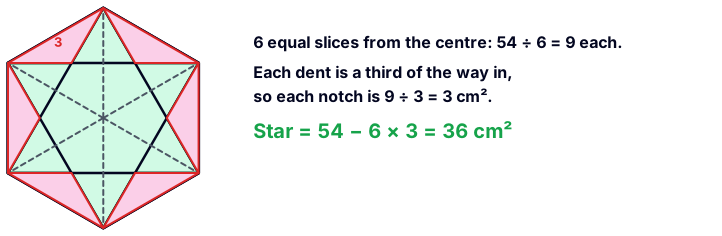
Cut the hexagon into 6 slices of 9 cm²; each white notch has the same base as a slice and a third of its height, so it is 3 cm², and the star is 54 − 6 × 3 = 36 cm².
Why it works: lines from the centre to the corners cut a regular hexagon into 6 equal triangles, 54 ÷ 6 = 9 cm² each. Next to each side of the hexagon the star leaves a white notch. Its inner corner lies one third of the way from the side to the centre (the star’s lines cut each other into three equal parts), so the notch has the same base as the slice and a third of its height: 3 cm². Check: the star is also 12 small equilateral triangles out of 18 that fill the hexagon, and 12/18 of 54 is 36. Common wrong answer: 27 (taking one big triangle, half the hexagon, as the star), or 54 (counting both triangles in full, so the middle is counted twice).
Problem 2
Problem 2: Answer 7 kg
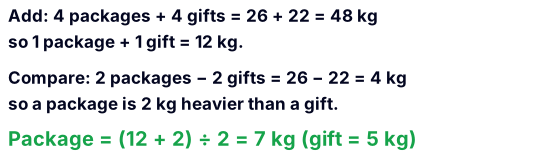
Add the scales: 4 packages + 4 gifts = 48 kg, so one of each is 12 kg; compare them: 2 extra packages for 2 gifts add 4 kg, so a package is 2 kg heavier; the package is 7 kg.
Why it works: each scale alone has two unknowns. Adding the scales gives equal numbers of packages and gifts, so it tells you the weight of one pair. Comparing them tells you the difference: the left scale has two more packages and two fewer gifts, and is 4 kg heavier. A pair weighs 12 kg and one part is 2 kg more than the other: 7 and 5. In algebra: 3p + g = 26 and p + 3g = 22 give p + g = 12 and p − g = 2. Check: 3 × 7 + 5 = 26 and 7 + 3 × 5 = 22. Common wrong answer: 6 (half of 12, as if the two things weighed the same), 5 (the gift), or 4 (just 26 − 22).
Problem 3
Problem 3: Answer 9 numbers
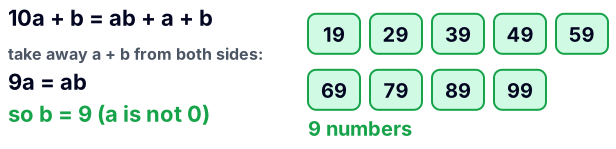
Write the number as 10a + b: then 10a + b = ab + a + b gives 9a = ab, so the ones digit is 9, and all of 19, 29, …, 99 work.
Why it works: a two-digit number with digits a and b is worth 10a + b, not “a b”. Taking a + b from both sides leaves 9a = ab, and since a is not 0 we can divide by it: b = 9. Any tens digit from 1 to 9 works, so there are nine numbers. Check: 47 is not one (4 × 7 + 4 + 7 = 39), but 49 is (4 × 9 + 4 + 9 = 49). Common wrong answer: 1 (finding only 99 by trying and stopping), or 10 (also counting 09, which is not a two-digit number).
Problem 4
Problem 4: Answer 84 degrees
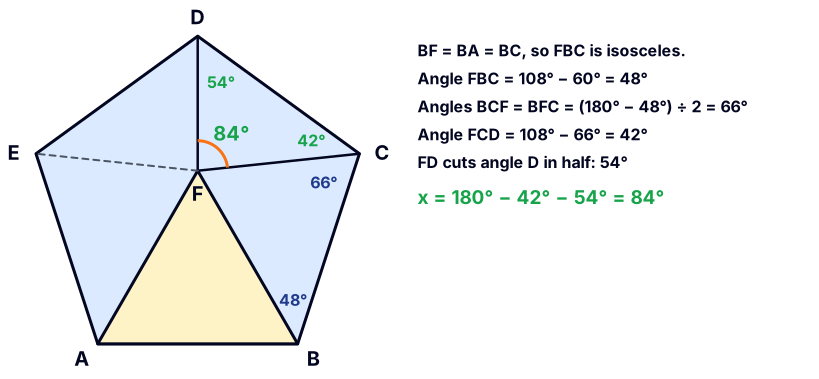
BF = BC, so triangle FBC is isosceles with top angle 108° − 60° = 48° and base angles 66°; then angle FCD = 42°, angle FDC = 54°, and x = 180° − 42° − 54° = 84°.
Why it works: every angle of a regular pentagon is 540° ÷ 5 = 108°. The key is spotting equal sides: BF equals AB (equilateral triangle), and AB equals BC (regular pentagon), so triangle FBC has two equal sides. The picture is symmetric about the line through D and the middle of AB, and F lies on that line, so FD cuts the 108° angle at D into two 54° angles. Check: by the same symmetry angle DFE is also 84°, and around F: 60 + 66 + 66 + 84 + 84 = 360. Common wrong answer: 72 (guessing the pentagon’s turning angle), or 66 (stopping at the base angle of triangle FBC).
Problem 5
Problem 5: Answer 4 knights
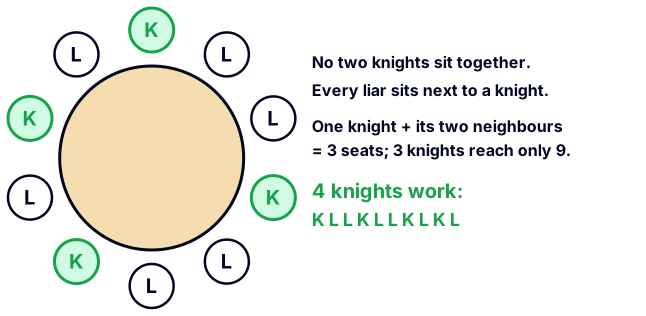
Every liar must sit next to a knight, and one knight has only two neighbours, so 3 knights reach at most 9 of the 10 seats; 4 knights work: K L L K L L K L K L.
Why it works: a knight tells the truth, so both of its neighbours are liars. A liar’s claim is false, so at least one of its neighbours is a knight. Each knight “looks after” itself and its two neighbours, 3 seats, and with 3 knights at least one of the 10 seats is a liar with no knight beside it. All liars is impossible too: then every claim would be true. Check the arrangement: each K sits between two Ls, and each L touches a K. Common wrong answer: 5 (alternating K L K L…, which is the largest number, not the smallest), or 3 (dividing 10 by 3 and rounding down).
Problem 6
Problem 6: Answer 20 squares
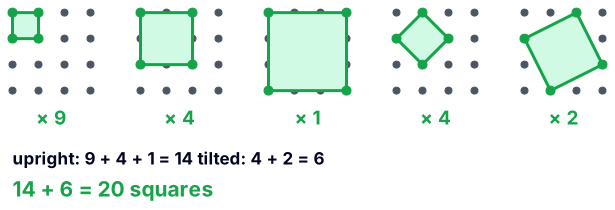
Upright squares: 9 + 4 + 1 = 14. Tilted squares: 4 with sides going 1 across and 1 up, and 2 with sides going 1 across and 2 up. 14 + 6 = 20.
Why it works: sort squares by the step along one side. An upright square of side 1, 2 or 3 fits in 9, 4 or 1 places. A tilted square sits snugly inside an upright box: a side “1 across, 1 up” needs a 2 × 2 box (4 places), and a side “1 across, 2 up” needs a 3 × 3 box, which holds two such squares, one leaning each way. A side “2 across, 2 up” or longer would need a box bigger than the grid. Check: every square has corners on the edges of its box, so no square is missed or counted twice. Common wrong answer: 14 (forgetting the tilted squares), or 19 (finding only one of the two leaning squares in the big box).
Problem 7
Problem 7: Answer 30 cm²
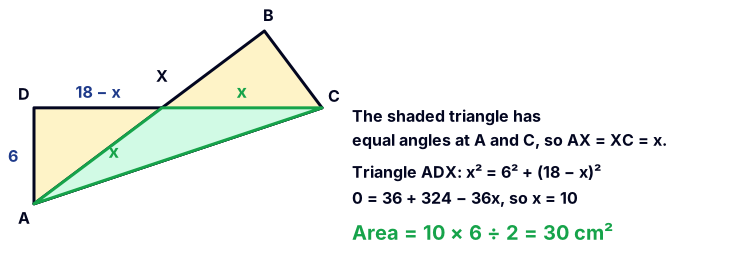
The overlap is an isosceles triangle (AX = XC = x), so Pythagoras in triangle ADX gives x² = 6² + (18 − x)², x = 10, and the area is 10 × 6 ÷ 2 = 30 cm².
Why it works: folding copies angle BAC onto the other side of the diagonal, and angle BAC also equals angle ACD (alternate angles, since AB is parallel to DC). So the shaded triangle AXC has equal angles at A and C, and AX = XC. Call that length x; then DX = 18 − x, and triangle ADX has a right angle at D. Expanding: x² = 36 + 324 − 36x + x², so 36x = 360. The shaded triangle has base XC = 10 on the top edge and height 6. Check: AX = √(6² + 8²) = 10 = XC. Common wrong answer: 54 (half the strip, as if the whole flap overlapped), or 36 (the 6 × 6 square at the end of the strip, as if the overlap were a square).
Problem 8
Problem 8: Answer 18 cubes
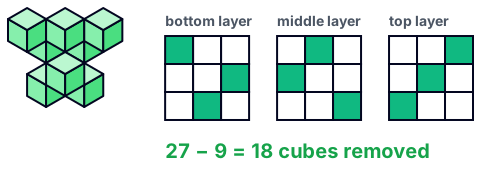
Each of the 9 squares in the front view needs its own cube, and 9 well-placed cubes are enough, so 27 − 9 = 18 can go.
Why it works: from the front, each of the 9 squares you see is a line of 3 cubes going straight back; the lines share no cubes and each needs one, so at least 9 stay. Nine are enough: give each layer one cube in every row and column, shifting the pattern between layers as in the picture. Check: every line front-to-back, side-to-side and top-to-bottom then meets exactly one cube. Common wrong answer: 8 (removing only the cubes hidden behind the three visible faces), or 9 (the cubes that stay, not those taken away).
Problem 9
Problem 9: Answer 19 cm²
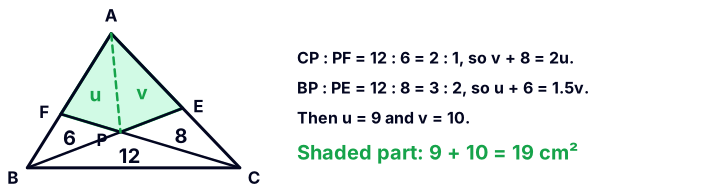
Join A to P: the ratios 12 : 6 and 12 : 8 give v + 8 = 2u and u + 6 = 1.5v, so u = 9, v = 10 and the shaded part is 19 cm².
Why it works: triangles with the same height compare like their bases. BPC and BPF share a height from B, so CP : PF = 12 : 6 = 2 : 1; triangles CPA and FPA share a height from A, so (v + 8) : u = 2 : 1 too. Likewise BP : PE = 12 : 8 = 3 : 2 gives (u + 6) : v = 3 : 2. Put v = 2u − 8 into 2(u + 6) = 3v: u = 9 and v = 10. Check: 10 + 8 = 2 × 9. Common wrong answer: 14 (6 + 8, as if the shaded part matched the side triangles).
Problem 10
Problem 10: Answer 4 moves
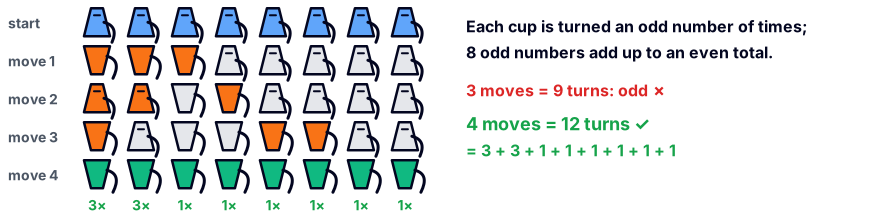
Each cup needs an odd number of turns, so the total is even: 9 turns (3 moves) can never work, 12 turns (4 moves) can.
Why it works: a cup that ends the right way up has been turned 1, 3, 5, … times, and eight odd numbers add up to an even number. But 3 moves make 3 × 3 = 9 turns, an odd number, so 3 moves are impossible (and 2 moves cannot even reach every cup). With 4 moves (12 turns), turn two cups three times and six once: cups 1, 2, 3; then 1, 2, 4; then 1, 5, 6; then 2, 7, 8. Check: every cup is turned an odd number of times. Common wrong answer: 3 (8 ÷ 3 rounded up, without checking that 3 moves can work), or 8 (one cup at a time, ignoring “exactly three”).
More Math Kangaroo practice for Grades 7-8
Our Math Kangaroo Prep Guide for Grades 7–8 has topic-by-topic explanations, many more original problems and a full practice test, with a free sample to try first. For practice at every level, the format and the time limit, see our Math Kangaroo practice tests and questions page, and for the season plan, how to prepare for Math Kangaroo.
This guide is not affiliated with or endorsed by Math Kangaroo USA or Kangourou sans Frontières. “Math Kangaroo” is a trademark of its respective owners.