
Free practice
MOEMS Practice Problems: Division M (Grades 6-8)
Ten original MOEMS Division M olympiad problems, two olympiads' worth, with every answer explained and the strategy behind it.
MOEMS full prep and practice guides: Division E Division M
Free practice, other divisions: Div E
Other contests, grades 6–8: Math Kangaroo 5–6 Math Kangaroo 7–8 Noetic 6 CML AMC 8
Printable PDF: all 10 problems with room to work, then every answer explained.
On this page · 3 sections
Ten original practice problems for the MOEMS Division M olympiads, written by us at real olympiad difficulty. Every one has a worked solution that names the strategy behind it and the most common wrong answer.
A MOEMS Division M olympiad has 5 problems and about 30 minutes, with 1 point for each correct answer, and you write every answer yourself. These 10 problems are two olympiads’ worth, ramped: they start at the level of an olympiad’s problem 2 and climb to its hardest problem 5. No calculator; try each one for real before you turn to the answers.
The 10 problems
Problem 1
Ava and Raj start together at the start line of a 400 m track and run in opposite directions. Ava runs 3 m per second and Raj runs 5 m per second. How many times do they pass each other during the first 7 minutes? (The start does not count.)
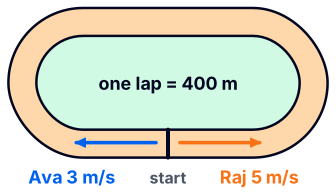
Watch out: They can pass each other anywhere on the track, not only at the start line.
Problem 2
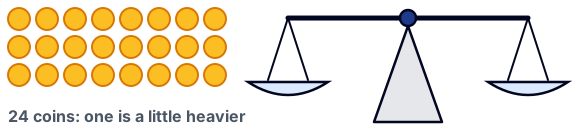
24 coins look the same, but one is a little heavier; the others all weigh the same. Using a two-pan balance, what is the fewest number of weighings that is sure to find the heavier coin?
Problem 3
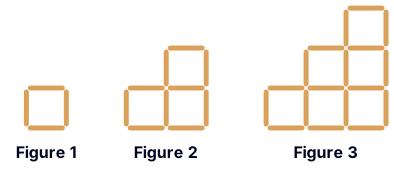
The toothpick staircases below are Figures 1, 2 and 3. Each new figure adds a column on the right that is one square taller than the column before it. Which figure uses exactly 270 toothpicks?
Problem 4
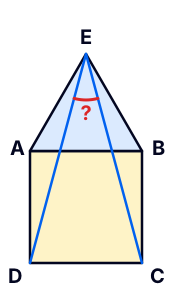
ABCD is a square. Triangle ABE is equilateral and sits on top of side AB, outside the square. Segments ED and EC are drawn. What is the measure of angle DEC?
Problem 5
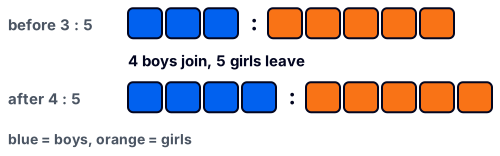
In a chess club, the ratio of boys to girls is 3 : 5. Then 4 boys join the club and 5 girls leave it. Now the ratio of boys to girls is 4 : 5. How many members does the club have now?
Problem 6
The product 1 × 2 × 3 × 4 × … × 80 of all the whole numbers from 1 to 80 is a huge number. How many zeros are at the end of it?

Fact: Every zero at the end of a product comes from one 2 × 5 = 10.
Problem 7
Two fair six-sided dice are rolled. What is the probability that the larger of the two numbers rolled is 4? (For a double, such as 4 and 4, the larger number is 4.) Give a fraction.

Problem 8
The numbers 1, 2, 3, 4 and 5 are written on a board. In one move, you erase any two numbers a and b and write the single number a + b + ab in their place. After four moves only one number is left. What is that number?

Problem 9
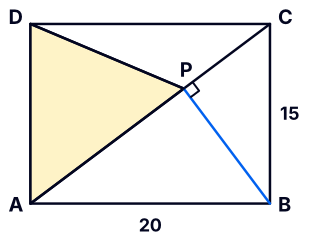
★ Challenge. In rectangle ABCD, AB = 20 and BC = 15. Point P is on the diagonal AC, and segment BP is perpendicular to AC. What is the area of triangle APD?
Problem 10
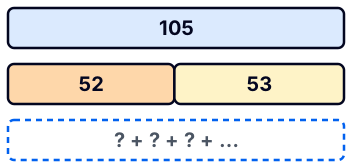
★ Challenge. The number 105 can be written as a sum of two or more consecutive positive whole numbers, for example 105 = 52 + 53. In how many different ways can this be done? (Count 52 + 53 as one of the ways.)
Solutions
Problem 1
Problem 1: Answer 8 times
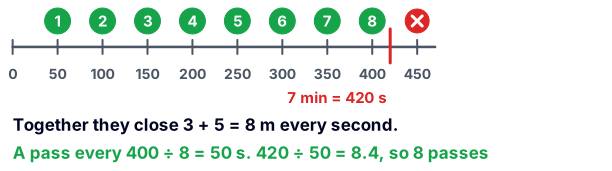
Running toward each other, they close 8 m every second, so they pass once every 400 ÷ 8 = 50 seconds.
Why it works: the strategy is relative speed. Between two passes, Ava and Raj together cover exactly one lap, 400 m, whatever point of the track they meet at, and together they cover 3 + 5 = 8 m each second. So the passes come at 50 s, 100 s, 150 s, and so on. Seven minutes is 420 s, and 420 ÷ 50 = 8.4, so 8 passes happen in time and the 9th (at 450 s) is too late. Check: at 400 s Ava has run 1200 m (3 laps) and Raj 2000 m (5 laps), so both are back at the start line together, the 8th pass. Common wrong answer: 1 (counting only the times they meet back at the start line, which happens once, at 400 s), 9 (rounding 8.4 up, or counting the start), or 4 (using the difference 5 − 3, which is right only when they run the same way).
Problem 2
Problem 2: Answer 3 weighings
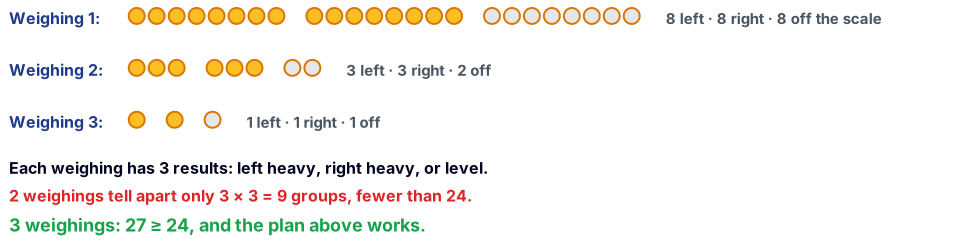
Each weighing has 3 results, so 2 weighings can only tell 9 groups apart; 3 weighings (27 ≥ 24) can, by splitting into three groups each time.
Why it works: the strategy is use every outcome: a weighing says “left heavier”, “right heavier” or “level”, and “level” is information too, because then the heavy coin is off the scale. So split into three groups, not two. Weighing 1: 8 against 8, with 8 off; the heavy coin is in whichever group the result points to. Weighing 2: from those 8, put 3 against 3 with 2 off. Weighing 3: from the 3 (or 2) left, put 1 against 1. Two weighings are not enough: they have only 3 × 3 = 9 possible result pairs, and 24 coins need 24 different answers. Check: 3 weighings give 27 result triples, enough for 24 coins. Common wrong answer: 5 or 4 (halving each time: 24, 12, 6, 3, then more), or 2 (not counting the results: 9 < 24).
Problem 3
Problem 3: Answer Figure 15
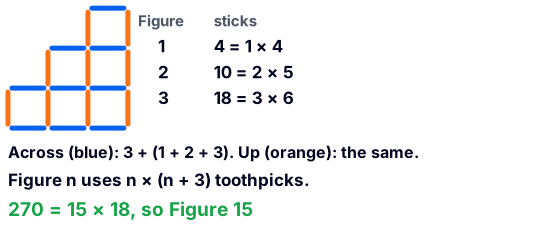
The counts are 4, 10, 18 = 1 × 4, 2 × 5, 3 × 6, so Figure n uses n × (n + 3) toothpicks, and 270 = 15 × 18.
Why it works: the strategy is find the rule, then explain it. Counting gives 4, 10, 18; the jumps are 6 and 8, so they grow by 2 each time, and writing each count as a product shows n × (n + 3). To be sure the pattern keeps going, count the sticks in two directions: in Figure n the across sticks are n on the bottom plus 1 + 2 + … + n in the rows above, and the up sticks are the same number. That is 2n + n(n + 1) = n(n + 3). Now find two numbers 3 apart whose product is 270: 15 × 18. Check: the 15th figure has 15 + 120 = 135 sticks each way, and 2 × 135 = 270. Common wrong answer: 45 (dividing 270 by 6, as if each figure added the same number of sticks), or 16 or 17 (guessing near the square root of 270 without checking).
Problem 4
Problem 4: Answer 30°
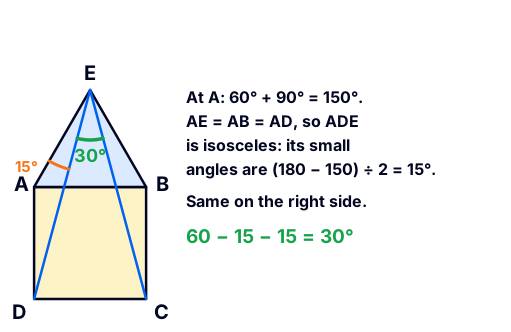
AE = AB = AD, so triangle ADE is isosceles with a 150° top angle; its other angles are 15°, and 60 − 15 − 15 = 30°.
Why it works: the strategy is look for equal sides, then chase angles. The triangle and the square share side AB, so AE, AB and AD are all the same length. At A the angles add up: 60° from the triangle and 90° from the square make angle DAE = 150°. Triangle ADE has two equal sides, so its two other angles are equal: (180 − 150) ÷ 2 = 15° each. The same happens on the right in triangle BCE. Angle AEB is 60°, and taking away the two 15° slivers leaves angle DEC = 30°. Check: in triangle DEC the angles at D and C are 90 − 15 = 75° each, and 75 + 75 + 30 = 180. Common wrong answer: 60 (assuming DEC is the triangle’s angle at E), or 15 (giving the sliver angle instead of what is left).
Problem 5
Problem 5: Answer 63 members
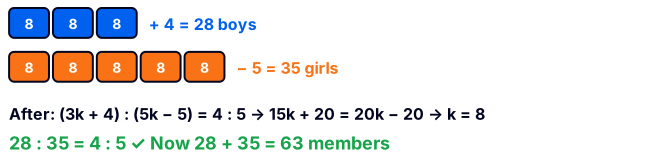
Call one part of the old ratio k: then (3k + 4) : (5k − 5) = 4 : 5, which gives k = 8, so 28 boys and 35 girls now.
Why it works: the strategy is give the ratio a unit. A ratio 3 : 5 means 3 equal parts of boys and 5 of girls, each part k people, so there were 3k boys and 5k girls. After the changes, 5 × (3k + 4) = 4 × (5k − 5), so 15k + 20 = 20k − 20 and k = 8. Before: 24 boys and 40 girls (64 members). Now: 28 boys and 35 girls, 63 members. Check: 28 : 35 is 4 : 5 (both divide by 7), and 64 + 4 − 5 = 63. Common wrong answer: 64 (the number before the changes), 72 (finding k = 8 but using it with the new ratio: 32 + 40), or 9 (treating the ratio numbers 4 and 5 as people).
Problem 6
Problem 6: Answer 19 zeros
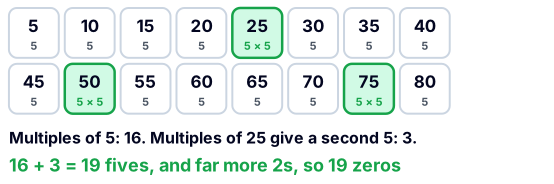
Each zero needs a 2 × 5, and 5s are scarcer than 2s: 16 multiples of 5, plus one more 5 each from 25, 50 and 75, make 19.
Why it works: the strategy is break into primes and count the scarce one. A zero at the end is a factor 10 = 2 × 5, so the number of zeros is the number of 2 × 5 pairs in the product. Even numbers give far more 2s than there are 5s, so count the 5s: every 5th number gives one (80 ÷ 5 = 16), and every 25th gives a second (25, 50, 75: 3 more). 125 is past 80. Check with a smaller case: 1 × 2 × … × 10 = 3,628,800 has 2 zeros, and 10 ÷ 5 = 2. Common wrong answer: 16 (forgetting that 25, 50 and 75 each hold two 5s), or 8 (counting only the multiples of 10).
Problem 7
Problem 7: Answer 7/36
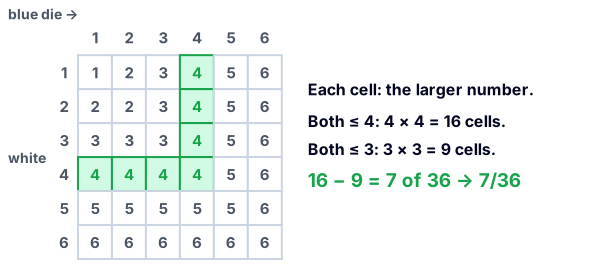
Of the 36 equally likely rolls, both dice are 4 or less in 4 × 4 = 16 and both are 3 or less in 3 × 3 = 9; the larger is exactly 4 in 16 − 9 = 7.
Why it works: the strategy is count with a table, then use “at most” minus “at most one less”. Treat the dice as different (white and blue), so all 36 ordered rolls are equally likely. The rolls with larger number 4 form an L in the table: (4, 1), (4, 2), (4, 3), (1, 4), (2, 4), (3, 4) and (4, 4). The trick 4² − 3² finds the L without listing it, and it works for any maximum. Check: the L has 3 + 3 + 1 = 7 cells. Common wrong answer: 1/6 (the chance one die shows 4), 4/36 or 1/9 (counting (4, 1) and (1, 4) as one roll), or 8/36 (counting (4, 4) twice).
Problem 8
Problem 8: Answer 719
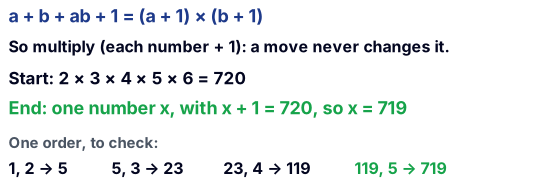
a + b + ab + 1 = (a + 1)(b + 1), so the product of all the “numbers + 1” never changes: 2 × 3 × 4 × 5 × 6 = 720, and 720 − 1 = 719.
Why it works: the strategy is find an invariant, something no move can change. The question gives no order of moves, which hints that the order doesn’t matter. Adding 1 to the new number gives a + b + ab + 1 = (a + 1)(b + 1): the move replaces the two factors a + 1 and b + 1 with their product. So the product of (each number + 1) over the whole board stays 2 × 3 × 4 × 5 × 6 = 720. At the end the board has one number x with x + 1 = 720, so x = 719. Check one order: 1 and 2 give 5; 5 and 3 give 23; 23 and 4 give 119; 119 and 5 give 719. Common wrong answer: 15 (just adding the numbers), 120 (multiplying them), or 720 (forgetting to take away the 1).
Problem 9
Problem 9: Answer 96 square units
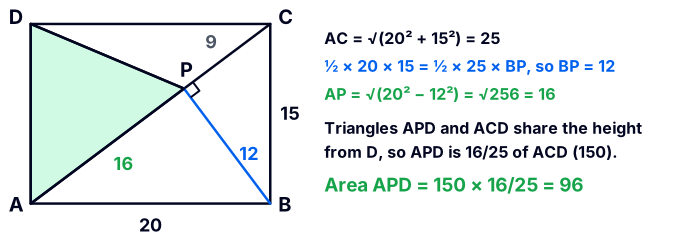
BP = 12 (area two ways), so AP = 16, and APD is 16/25 of triangle ACD: 150 × 16/25 = 96.
Why it works: three moves in a row. Pythagoras: AC = √(20² + 15²) = 25. Area two ways: ½ × 20 × 15 = 150 = ½ × 25 × BP, so BP = 12, and then AP = √(20² − 12²) = 16. Same height, compare bases: triangles APD and ACD share corner D and have bases AP and AC on one line, so their areas are in the ratio 16 : 25, and ACD is half the rectangle. Check with coordinates: P = (12.8, 9.6), so APD has base AD = 15 and height 12.8: ½ × 15 × 12.8 = 96. Common wrong answer: 75 (P taken as the midpoint of AC), 54 (triangle BPC), or 150 (all of ACD).
Problem 10
Problem 10: Answer 7 ways
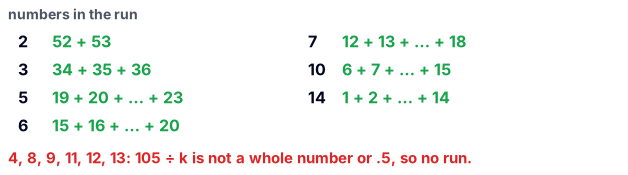
A run of k numbers adds to k × (its middle), so the middle, 105 ÷ k, must be whole or end in .5.
Why it works: the strategy is use the middle (the average). Odd k: the middle is whole, so k divides 105: k = 3, 5, 7 (15, 21, 35, 105 would start at 0 or below). Even k: the middle ends in .5, so 210 ÷ k is odd: k = 2, 6, 10, 14 (30, 42, 70, 210 would start at 0 or below). Check: each odd divisor d of 105 gives the run length “the smaller of d and 210 ÷ d”: 3, 5, 7 → 3, 5, 7; 15, 21, 35, 105 → 14, 10, 6, 2; 1 → the lone number 105, which doesn’t count. Common wrong answer: 3 or 4 (only odd or only even counts), or 8 (counting 105 alone).
More MOEMS Division M practice
Our MOEMS Division M prep guide teaches the strategies behind these problems, with many more original problems and a free sample to try first. Practice for the other division: Division E. For how the olympiads work, see our MOEMS practice problems overview.
This guide is not affiliated with or endorsed by Math Olympiads for Elementary and Middle Schools (MOEMS®). “MOEMS” is a trademark of its respective owners.