Free practice
Noetic Math Contest Practice Problems: Grade 4
Ten original Noetic-style problems for grade 4, at real contest difficulty, with every answer explained for parents.
Noetic full prep and practice guides: 2 3 4 5–6
Free practice, other grades: 2 3 5 6
Other contests, grade 4: Math Kangaroo 3–4 MOEMS Div E CML
Printable PDF: all 10 problems with room to work, then every answer explained.
On this page · 3 sections
Ten original practice problems for the Grade 4 Noetic Learning Math Contest, written by us at real contest difficulty. None comes from a real Noetic test. Every one has a worked solution, with a note for you on the most common wrong answer.
The Grade 4 Noetic test has 20 problems, and you get 45 minutes. You write each answer yourself (there are no choices to pick from), and a wrong answer costs nothing, so always write something. Most problems need two or three steps, and the last few need a clever idea. Try every problem on your own before you look at the answers.
The 10 problems
Problem 1
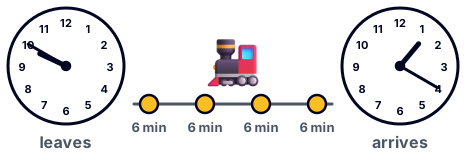
A train leaves the station at 9:50 a.m. and arrives at 1:20 p.m. on the same day. On the way, it stops at 4 stations for 6 minutes at each one. For how many minutes is the train moving?
Problem 2
Four equal squares are put together to make this L-shape. The perimeter of the L-shape is 50 cm. What is the area of the L-shape?
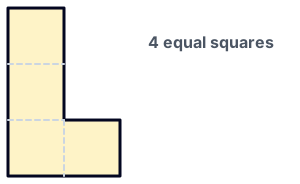
Tip: Go around the outside edge with your pencil and count the sides.
Problem 3
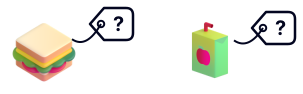
A sandwich costs $2.75 more than a juice box. Together, the sandwich and the juice box cost $4.25. How much does the sandwich cost?
Problem 4
Ms. Lopez has 36 star stickers and 48 pencils. She fills gift bags so that every bag gets the same number of stickers and the same number of pencils, with nothing left over. She makes as many bags as she can. How many items (stickers and pencils) are in each bag?

Problem 5
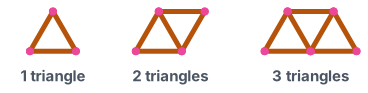
Tia makes a row of triangles with toothpicks. The picture shows rows of 1, 2 and 3 triangles. Using only her 60 toothpicks, she makes one long row in the same way. What is the largest number of triangles this one row can have?
Problem 6
Amy and Ben collect shells. One-quarter of Amy’s shells is the same number as one-third of Ben’s shells. Together they have 56 shells. How many shells does Amy have?

Problem 7
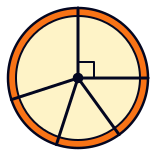
Raj cuts a round pizza into 5 slices. Every cut goes from the center to the edge. One slice has a square corner (a right angle) at the center. Three slices are all the same size, and the last slice is twice as big as each of them. What is the angle at the center of the biggest slice?
Problem 8
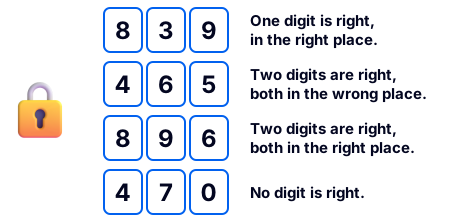
Leo’s lock opens with a 3-digit code, and its three digits are all different. Leo tried four codes. Next to each one is a note about its digits. What is the code?
Problem 9
★ Challenge. Zoe paints each of the 4 panes of this window red, blue or yellow. Two panes that share a side must be different colors. She does not have to use all three colors. Two ways are different if any pane gets a different color. How many different ways can she paint the window?
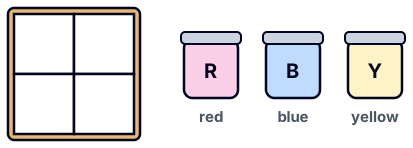
Trick: Start with one corner pane.
Problem 10
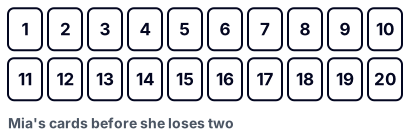
★ Challenge. Mia has 20 cards numbered 1 to 20. She loses two cards whose numbers are next to each other, like 6 and 7. The numbers on the cards she still has add up to 185. What is the bigger number on the two lost cards?
Solutions
Problem 1
Problem 1: Answer 186 minutes
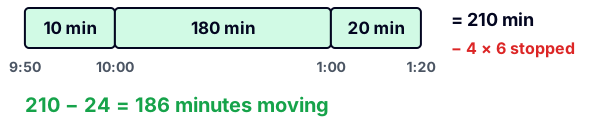
Jump to easy times: 9:50 to 10:00 is 10 minutes, 10:00 to 1:00 is 3 hours (180 minutes), 1:00 to 1:20 is 20. That’s 210. Take away the stops, 4 × 6 = 24: 186!
For the grown-up: times that cross noon are easiest to count in jumps to round times, never by subtracting the clock numbers. The trip is 3 hours 30 minutes = 210 minutes, and the train stands still for 4 × 6 = 24 of them. Check: 186 + 24 = 210, and 9:50 plus 210 minutes is 1:20. Common wrong answer: 210 (forgetting the stops), 200 (taking away 4 + 6 = 10 instead of 4 × 6), or 346 (subtracting 950 from 1320 as if an hour had 100 minutes).
Problem 2
Problem 2: Answer 100 square cm
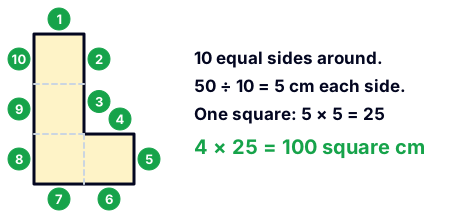
Count the sides around the outside: 10. 50 ÷ 10 = 5 cm, so each square is 5 × 5 = 25. Four squares: 100!
For the grown-up: the perimeter only uses the outside edges; the sides where two squares touch are inside the shape and don’t count. Going around the L there are 10 square-sides, so each side is 5 cm. Area is the four squares: 4 × 25 = 100 square cm. Check: the L’s outline is 5, 10, 5, 5, 10, 15 cm, and 5 + 10 + 5 + 5 + 10 + 15 = 50. Common wrong answer: 25 (one square only), 50 (mixing up perimeter and area), or a messy decimal from counting 8 or 16 sides (a side length that won’t come out whole is a sign of a miscount).
Problem 3
Problem 3: Answer $3.50

Take away the extra $2.75: $4.25 − $2.75 = $1.50 pays for 2 juices. One juice is $0.75. The sandwich is $0.75 + $2.75 = $3.50!
For the grown-up: “$2.75 more than” means the sandwich is a juice plus $2.75. Remove the extra from the total and what is left is two equal juice prices. Drawing the two bars makes this visible. Check: $3.50 + $0.75 = $4.25, and $3.50 − $0.75 = $2.75. Common wrong answer: $2.75 (reading “costs $2.75 more” as “costs $2.75”), $1.50 (forgetting to halve), or $0.75 (the juice, not the sandwich).
Problem 4
Problem 4: Answer 7 items

The number of bags must go into both 36 and 48. The biggest number that does is 12. Each bag: 36 ÷ 12 = 3 stickers and 48 ÷ 12 = 4 pencils, so 7 items!
For the grown-up: “the same in every bag, nothing left” means the number of bags is a factor of 36 and of 48; “as many as she can” picks the greatest common factor, 12. Check: 12 bags × 7 items = 84 = 36 + 48. Common wrong answer: 12 (the number of bags, not what is in one), 84 (all the items), or 14 (using 6 bags, a common factor but not the greatest: 6 stickers + 8 pencils).
Problem 5
Problem 5: Answer 29 triangles
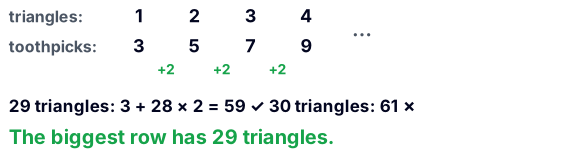
The first triangle takes 3 toothpicks, and each new one takes only 2 more: 3, 5, 7, … 29 triangles use 3 + 28 × 2 = 59. 30 would need 61, too many!
For the grown-up: neighbouring triangles share a toothpick, so after the first triangle every new one costs 2, not 3. Count from the picture: 3, 5, 7. A row of n triangles uses 2n + 1 toothpicks, and 2 × 29 + 1 = 59 is the largest that fits in 60 (one is left over). Check: 2 × 30 + 1 = 61 > 60. Common wrong answer: 30 (60 ÷ 2, forgetting the first triangle needs 3), 20 (60 ÷ 3, as if no toothpicks were shared), or 59 (the toothpicks used, not triangles).
Problem 6
Problem 6: Answer 32 shells
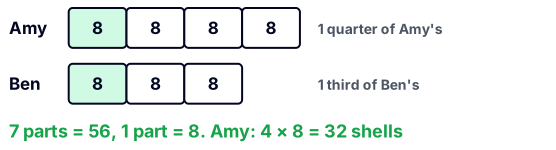
Cut Amy’s shells into 4 equal parts and Ben’s into 3. One part of each is the same size. 4 + 3 = 7 parts make 56, so a part is 8. Amy has 4 × 8 = 32!
For the grown-up: “one-quarter of Amy’s equals one-third of Ben’s” says the two collections are built from the same size of piece: Amy has 4 pieces and Ben 3. That turns the problem into sharing 56 into 7 equal parts. Check: a quarter of 32 is 8, a third of 24 is 8, and 32 + 24 = 56. Common wrong answer: 24 (Ben’s shells: the child with the bigger fraction has fewer, which feels backwards), 28 (splitting 56 in half), or 8 (one part).
Problem 7
Problem 7: Answer 108°
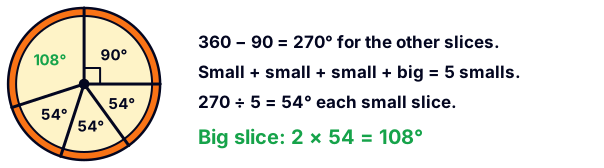
All the way round is 360°. Take away the right angle: 270° is left. The big slice is worth 2 small ones, so 270° is 5 small shares: 270 ÷ 5 = 54°. The big slice is 2 × 54 = 108°!
For the grown-up: two ideas: the angles round the center make a full turn of 360°, and “twice as big” lets you count the big slice as two small ones, so the 270° left after the right angle splits into 3 + 2 = 5 equal shares. Check: 90 + 54 + 54 + 54 + 108 = 360. Common wrong answer: 54 (the small slice, not the big one), 135 (270 ÷ 2, sharing between “small” and “big” as if there were only two slices), or 67 or 68 (270 ÷ 4, forgetting the big slice counts twice).
Problem 8
Problem 8: Answer 856
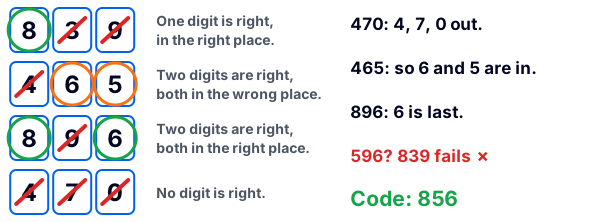
Start with “no digit is right”: 4, 7 and 0 are out, so 465 means 6 and 5 are in the code. In 896, two digits are in place; 8 and 9 can’t both be, so 6 is last. Then 839 says 8 is first: 856!
For the grown-up: start with the clue that says the most (470: nothing right) and carry each new fact to the next clue. With 4 out, 465’s two right digits are 6 and 5. The code needs room for 6 and 5, so 896 can’t have both 8 and 9 in place: 6 is in place, last, with 8 first or 9 in the middle. 596 fails 839 (its 9 would be right but misplaced), so the code is 856. Check all four notes against 856. Common wrong answer: 596 (skipping the check with 839), 865 (465 says 5 is not last), or 896 (thinking “two right” means the code is almost that guess).
Problem 9
Problem 9: Answer 18 ways
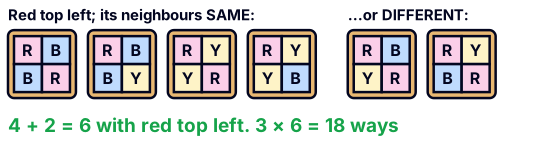
Paint the top left red. Its two neighbours both avoid red. If they match, the last pane has 2 choices (4 ways). If they differ, it must be red (2 ways). 6 ways, and the same for blue and yellow: 18!
For the grown-up: the four panes form a ring (each touches two others), so a plain 3 × 2 × 2 × 2 = 24 overcounts and 3 × 2 × 2 × 1 = 12 undercounts. Split by cases at the last pane: it touches the top right and bottom left. If those two match, the last pane may be the first color or the third color; if they differ, only the first color is left. That gives 2 × 2 + 2 × 1 = 6 for each color of the first pane. Check: the picture shows all 6 with red top left. Common wrong answer: 24 (ignoring the last pane’s second neighbour), 12 (assuming the last pane always has one choice), or 6 (forgetting the first pane can be any of the three colors).
Problem 10
Problem 10: Answer 13
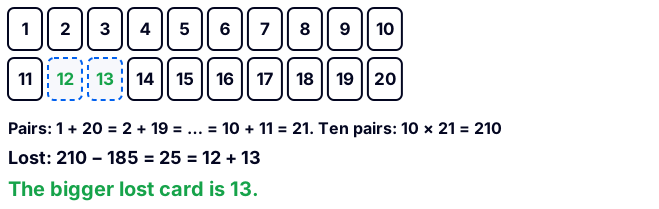
Pair the cards: 1 + 20, 2 + 19, … 10 + 11 are ten pairs of 21, so all 20 cards make 210. The lost cards make 210 − 185 = 25. Two numbers next to each other that make 25: 12 and 13!
For the grown-up: the clever step is the pairing: adding 1 to 20 one by one is slow and error-prone, but the smallest and largest always make 21, and there are 10 such pairs. Once the two lost cards are known to total 25, “next to each other” means two numbers about half of 25 each, 12 and 13. Check: 210 − 12 − 13 = 185. Common wrong answer: 25 (the total of the lost cards, not a card), 12 (the smaller card), or a wrong total such as 200 or 220 from adding 1 to 20 by hand, which leads to 8 or 18.
More Noetic practice for grade 4
For more at this level, our Noetic Grade 4 prep guide has 16 chapters, 200 original problems and two full practice tests, with a free sample to try first. Practice for the other grades: Grade 2 · Grade 3 · Grade 5 · Grade 6. For the format, the awards and a four-week plan, read our Noetic Learning Math Contest preparation guide.
This guide is not affiliated with or endorsed by Noetic Learning. “Noetic Learning Math Contest” is a trademark of its respective owners.