
Free practice
Noetic Math Contest Practice Problems: Grade 2
Ten original Noetic-style problems for grade 2, at real contest difficulty, with every answer explained for parents.
Noetic full prep and practice guides: 2 3 4 5–6
Free practice, other grades: 3 4 5 6
Other contests, grade 2: Math Kangaroo 1–2 CML
Printable PDF: all 10 problems with room to work, then every answer explained.
On this page · 3 sections
Ten original practice problems for the Grade 2 Noetic Learning Math Contest, written by us at real contest difficulty. None comes from a real Noetic test. Every one has a worked solution, with a note for you on the most common wrong answer.
The Noetic test has 20 problems like these, and you get 45 minutes. Most take two or three small steps, so read each word and draw what the story says. Try every problem on your own before you look at the answers.
The 10 problems
Problem 1
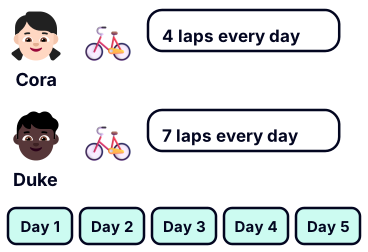
Cora and Duke start riding their bikes on the same day. Every day, Cora rides 4 laps around the park and Duke rides 7 laps. After 5 days, how many more laps has Duke ridden than Cora?
Problem 2
Isla buys a cupcake for 65¢. She pays with a $1 bill. She gets all of her change in nickels. How many nickels does she get?

Fact: One dollar is 100¢. A nickel is 5¢.
Problem 3
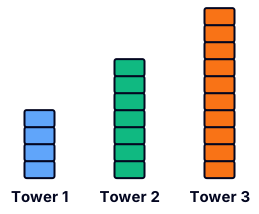
Greta builds towers of blocks. Each tower has the same number of blocks more than the tower before it. The picture shows Towers 1, 2 and 3. Which tower has 25 blocks?
Problem 4
June 1 is a Thursday. Finn’s birthday is on the third Tuesday of June. What is the date of Finn’s birthday?

Problem 5
Ada, Beto and Cora each own one of these: a kite, a drum or a teddy bear. Ada is older than the kite’s owner. The drum’s owner is older than Ada. Beto is the youngest of the three. Who owns the drum?

Tip: Make a grid: names down the side, things across the top. Cross out what can’t be.
Problem 6
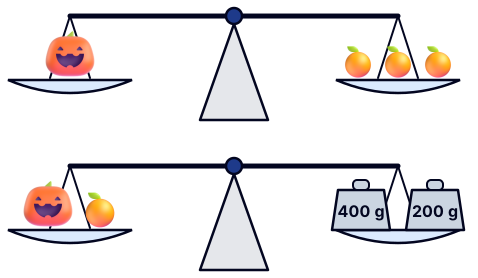
All the oranges weigh the same. Both balances are level. How much does the pumpkin weigh?
Problem 7
23 children and 4 grown-ups go on a class trip to the zoo. Each car can take 5 people. Everyone must ride in a car. How many cars do they need?

Problem 8
Hal is 8th from the front of a line. Isla is 3 places behind Hal. Then the first 4 children in the line leave. Now Isla is 3rd from the back. How many children are in the line now?

Problem 9
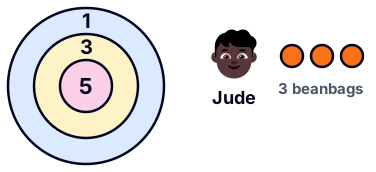
★ Challenge. Jude throws 3 beanbags at the target, and every one lands on it. Each beanbag scores the number on the ring it lands in. How many different totals can Jude get?
Trick: Make a list in order. Then cross out any total you already have.
Problem 10
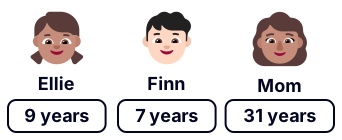
★ Challenge. Mom is 31 years old. Her children, Ellie and Finn, are 9 and 7 years old. In how many years will Ellie’s age plus Finn’s age be the same as Mom’s age?
Solutions
Problem 1
Problem 1: Answer 15 laps
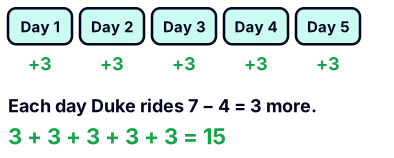
Each day Duke rides 7 − 4 = 3 more laps. 5 days: 3 + 3 + 3 + 3 + 3 = 15!
For the grown-up: find the difference for one day first, then add it up day by day. Check the long way: Duke rides 35 laps and Cora rides 20, and 35 − 20 = 15. Common wrong answer: 3 (one day only), or 55 (adding everything both children rode). More like this: Chapter 4 of the Grade 2 guide.
Problem 2
Problem 2: Answer 7 nickels
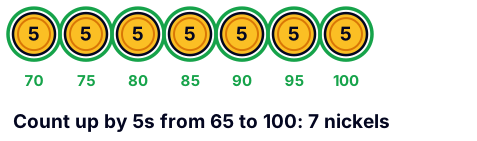
$1 is 100¢. Count up by 5s from 65: 70, 75, 80, 85, 90, 95, 100. That is 7 nickels!
For the grown-up: three steps: turn the dollar into cents, find the change (100 − 65 = 35¢), then count how many nickels make 35¢. Counting up from the price by 5s does the last two steps at once. Check: 7 nickels are 35¢, and 65 + 35 = 100. Common wrong answer: 35 (the change in cents, not the number of nickels), or 13 (counting nickels for 65¢ instead of the change). More like this: Chapter 1 of the Grade 2 guide.
Problem 3
Problem 3: Answer Tower 8
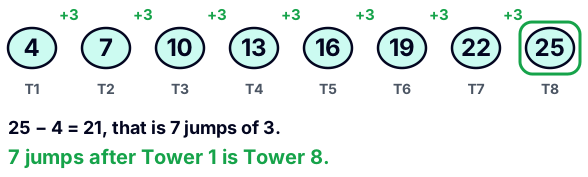
Each tower has 3 more blocks. 4, 7, 10, 13, 16, 19, 22, 25. That is Tower 8!
For the grown-up: the rule is “+3 each tower”, read from the picture (4, 7, 10). Listing the towers works well; the shortcut is 25 − 4 = 21 more blocks, which is 7 jumps of 3, and 7 jumps after Tower 1 lands on Tower 8. Common wrong answer: 7 (the number of jumps, not the tower they land on), or 9 (counting one tower too many while listing). More like this: Chapter 12 of the Grade 2 guide.
Problem 4
Problem 4: Answer June 20
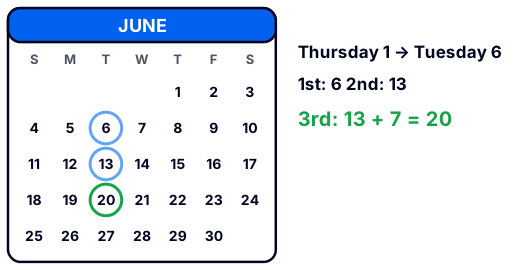
Thursday 1, Friday 2, Saturday 3, Sunday 4, Monday 5, Tuesday 6. That is the first Tuesday. 6 + 7 = 13, 13 + 7 = 20!
For the grown-up: two steps: find the first Tuesday by counting on from Thursday the 1st (it is the 6th), then jump a week at a time, because every 7 days is the same weekday again. The first Tuesday is the 6th, so the third is two jumps later. Check: draw the June calendar and read down the Tuesday column: 6, 13, 20, 27. Common wrong answer: 22 (adding 3 weeks to June 1 without finding the first Tuesday), or 27 (counting three jumps from the first Tuesday, which gives the fourth). More like this: Chapter 3 of the Grade 2 guide.
Problem 5
Problem 5: Answer Cora
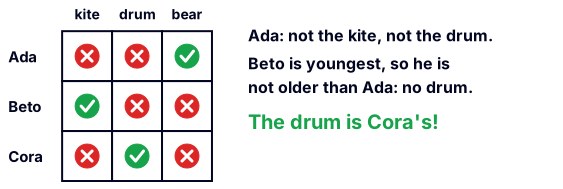
Ada is not the kite’s owner and not the drum’s owner, so Ada has the teddy bear. Beto is the youngest, so he can’t be older than Ada: Beto has the kite. Cora has the drum!
For the grown-up: “Ada is older than the kite’s owner” means the kite’s owner is someone else, so each of the first two clues crosses out one thing for Ada. The drum’s owner must be older than Ada, and the youngest child can’t be, so it is Cora. Check: Cora is older than Ada, and Ada is older than Beto, who has the kite. Common wrong answer: Ada (a child who reads “Ada” in the drum clue and picks her), or Beto (guessing from the order of the names). More like this: Chapter 6 of the Grade 2 guide.
Problem 6
Problem 6: Answer 450 g
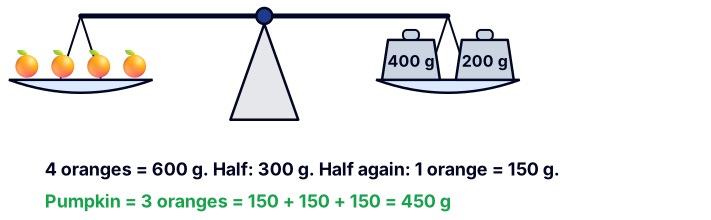
The pumpkin weighs the same as 3 oranges. So 4 oranges weigh 400 + 200 = 600 g. Half is 300, half again is 150: one orange. The pumpkin is 150 + 150 + 150 = 450 g!
For the grown-up: the top balance lets you swap the pumpkin on the bottom balance for 3 oranges, so the bottom pan holds 4 equal oranges and 600 g. Sharing 600 g among 4 oranges: half of 600 is 300 for 2 oranges, half again is 150 for one. Check: pumpkin 450 + orange 150 = 600. Common wrong answer: 150 (the orange, not the pumpkin), or 600 (the whole bottom pan). More like this: Chapter 5 of the Grade 2 guide.
Problem 7
Problem 7: Answer 6 cars
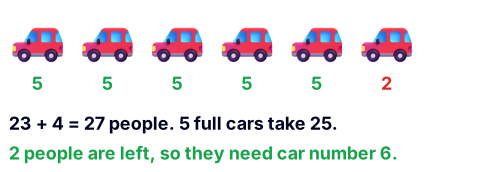
23 + 4 = 27 people. 5 cars take 5 + 5 + 5 + 5 + 5 = 25. The last 2 people need one more car: 6!
For the grown-up: three steps: count everyone (the grown-ups ride too), fill cars of 5, then add one car for the people left over, because everyone must ride. Check: 5 cars hold only 25, which is less than 27, and 6 cars hold 30, which is enough. Common wrong answer: 5 (leaving the last 2 people behind, or forgetting the grown-ups), or 27 (the number of people, not cars). More like this: Chapter 13 of the Grade 2 guide.
Problem 8
Problem 8: Answer 9 children
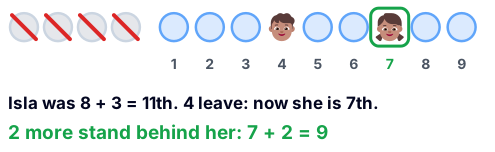
Isla was 8 + 3 = 11th. 4 leave from the front, so now she is 7th. 2 children are behind her. 7 + 2 = 9!
For the grown-up: first find Isla’s place (3 places behind 8th is 11th). When 4 children leave the front, everyone moves up 4 places, so she becomes 7th. Being 3rd from the back means 2 children stand behind her, so the line has her 7 places plus 2. Check: in a line of 9, the 7th child is 3rd from the back. Common wrong answer: 10 (7 + 3, counting Isla twice), or 14 (11 + 3, forgetting the 4 who left). More like this: Chapter 7 of the Grade 2 guide.
Problem 9
Problem 9: Answer 7 totals
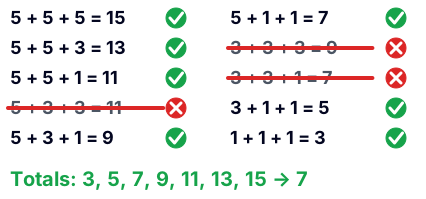
List them: 15, 13, 11, 11, 9, 9, 7, 7, 5, 3. Cross out the repeats: 3, 5, 7, 9, 11, 13, 15. That is 7!
For the grown-up: list the throws in order, starting with three 5s, then two 5s, then one 5, then none, so nothing is missed: 10 throws in all. Some throws give the same total (5 + 5 + 1 and 5 + 3 + 3 are both 11; 5 + 3 + 1 and 3 + 3 + 3 are both 9; 5 + 1 + 1 and 3 + 3 + 1 are both 7), and the question asks for different totals. Check: every total is odd and lies between 3 and 15, and all 7 odd numbers from 3 to 15 appear. Common wrong answer: 10 (counting throws, not totals), or 3 (the three ring numbers). More like this: Chapter 10 of the Grade 2 guide.
Problem 10
Problem 10: Answer 15 years
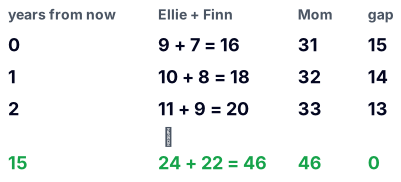
Now: 9 + 7 = 16, and Mom is 31, so the gap is 15. Each year the children’s total grows by 2 but Mom grows by 1, so the gap shrinks by 1. 15 years!
For the grown-up: the key idea is that two children add two years to their total every year, while Mom adds one. So the gap of 31 − 16 = 15 closes by 1 each year and is gone after 15 years. A table (year 1: 18 and 32, year 2: 20 and 33, …) shows the same thing. Check: in 15 years Ellie is 24 and Finn is 22, and 24 + 22 = 46, Mom’s age then. Common wrong answer: 7 or 8 (closing the gap by 2 a year, forgetting that Mom gets older too), or 46 (Mom’s age then, not the number of years). More like this: Chapter 2 of the Grade 2 guide.
More Noetic practice for grade 2
For more at this level, our Noetic Grade 2 prep guide has 15 chapters, 190 original problems and two full practice tests, with a free sample to try first. Practice for the other grades: Grade 3 · Grade 4 · Grade 5 · Grade 6. For the format, the awards and a four-week plan, read our Noetic Learning Math Contest preparation guide.
This guide is not affiliated with or endorsed by Noetic Learning. “Noetic Learning Math Contest” is a trademark of its respective owners.