
Free practice
MOEMS Practice Problems: Division E (Grades 4-6)
Ten original MOEMS Division E olympiad problems, two olympiads' worth, with every answer explained and the strategy behind it.
MOEMS full prep and practice guides: Division E Division M
Free practice, other divisions: Div M
Other contests, grades 4–6: Math Kangaroo 3–4 Math Kangaroo 5–6 Noetic 4 Noetic 5 Noetic 6 CML AMC 8
Printable PDF: all 10 problems with room to work, then every answer explained.
On this page · 3 sections
Ten original practice problems for the MOEMS Division E olympiads, written by us at real olympiad difficulty. Every one has a worked solution that names the strategy behind it and the most common wrong answer.
A MOEMS Division E olympiad has 5 problems and about 30 minutes, one point each, and every answer is written in: there are no choices to pick from. This set is two olympiads’ worth, ramped: problems 1–3 warm up, 4–8 are olympiad level, and the two ★ problems are as hard as the toughest problem 5s. Use paper and pencil, no calculator, and try each one on your own before you look at the answers.
The 10 problems
Problem 1
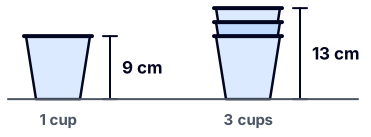
Paper cups fit inside each other when you stack them. One cup is 9 cm tall, and a stack of 3 cups is 13 cm tall. How many cups are in a stack that is 33 cm tall?
Problem 2
The pages of a book are numbered 1, 2, 3, and so on, in order. Printing all of the page numbers takes 222 digits. How many pages does the book have?

Tip: Count the 1-digit pages and the 2-digit pages first.
Problem 3
Zoe uses the four cards 1, 3, 5 and 7, each exactly once, to make two 2-digit numbers. Then she multiplies the two numbers. What is the largest product she can get?

Problem 4
This year, Mia’s birthday, March 3, is on a Tuesday. Her brother’s birthday is June 12 of the same year. On what day of the week is her brother’s birthday?
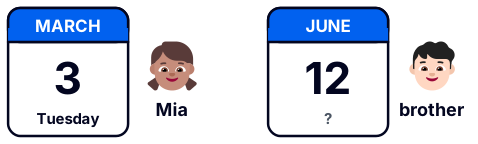
Fact: March and May have 31 days. April and June have 30 days.
Problem 5
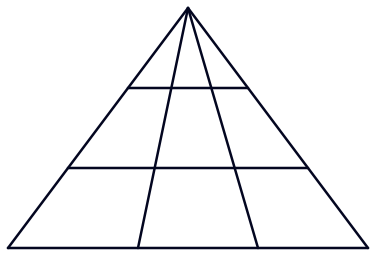
How many triangles of all sizes can you find in this figure?
Problem 6
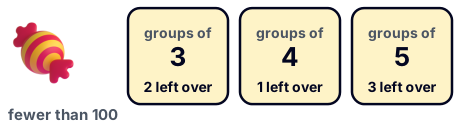
Kim has fewer than 100 candies. The cards show how many are left over when she shares them out into equal groups of 3, of 4 or of 5. How many candies does Kim have?
Problem 7
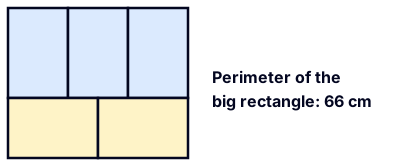
Five identical small rectangles fit together, with no gaps, to make the big rectangle shown. The perimeter of the big rectangle is 66 cm. What is the perimeter of one small rectangle?
Problem 8
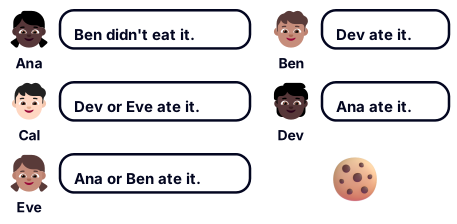
One of these five friends ate the last cookie. Each friend says one thing. Exactly two of the five are telling the truth. Who ate the cookie?
Problem 9
★ Challenge. Ava, Ben and Cy each have some cards. First Ava gives Ben and Cy as many cards as each of them already has, so their piles double. Then Ben does the same for Ava and Cy. Then Cy does the same for Ava and Ben. Now each has 24 cards. How many cards did Ava have at the start?

Tip: Start at the end, where you know everyone’s cards, and undo one step at a time.
Problem 10
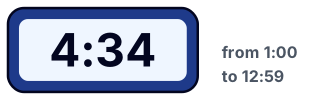
★ Challenge. A digital clock shows only hours and minutes, from 1:00 up to 12:59. The time 4:34 reads the same forwards and backwards. How many of the times from 1:00 to 12:59 read the same forwards and backwards?
Solutions
Problem 1
Problem 1: Answer 13 cups
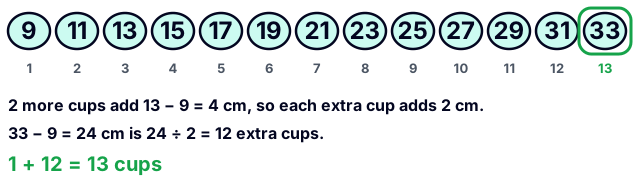
The 2 extra cups add 4 cm, so each extra cup adds 2 cm. 33 − 9 = 24 cm is 12 extra cups, plus the first cup: 13!
For the grown-up: strategy: find a pattern. The first cup gives the full 9 cm, and every cup after it adds only its rim, the same amount each time. Two extra cups add 13 − 9 = 4 cm, so one adds 2 cm. Check: 9 + 12 × 2 = 33. Common wrong answer: 12 (the extra cups, forgetting the first one), or 3 or 4 (33 ÷ 9, as if the cups sat on top of each other instead of inside).
Problem 2
Problem 2: Answer 110 pages
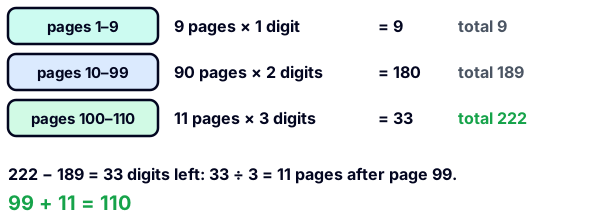
Pages 1–9 use 9 digits and pages 10–99 use 180: 189 so far. The other 33 digits make 11 three-digit pages, so the last page is 99 + 11 = 110!
For the grown-up: strategy: break the count into cases by how many digits each page number has. There are 9 one-digit pages and 90 two-digit pages (10 to 99, not 89: count 99 − 10 + 1). The 33 digits left are 11 pages of 3 digits, which are pages 100 to 110. Check: 9 + 180 + 33 = 222. Common wrong answer: 74 (222 ÷ 3, as if every page number had 3 digits), or 11 (the three-digit pages only).
Problem 3
Problem 3: Answer 3763

Put the big digits 7 and 5 in the tens places. Then try both ways: 73 × 51 = 3723, but 71 × 53 = 3763 is bigger!
For the grown-up: strategy: guess and check, with a twist. The tens digits matter most, so 7 and 5 go there (75 × 31 = 2325 wastes the 5 in the second number’s ones place). That leaves two choices, and the better one gives the bigger ones digit to the smaller number, which keeps the two factors close together (71 and 53 are closer than 73 and 51). Check: with 7 and 5 as the tens digits there are only two ways to place the 3 and the 1, and 71 × 53 = 3763 beats 73 × 51 = 3723; putting 7 and 3 in the tens (75 × 31 = 2325) is much smaller. Common wrong answer: 3723 (73 × 51, putting the 3 with the 7 because “biggest with biggest”), or 2325 (75 × 31).
Problem 4
Problem 4: Answer Friday
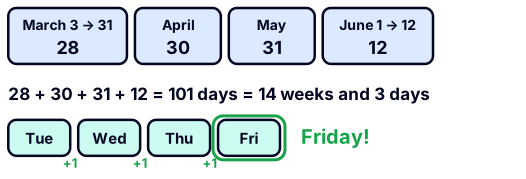
From March 3: 28 more days in March, then 30 + 31, then 12 in June: 101 days. That is 14 weeks and 3 days, and Tuesday + 3 days is Friday!
For the grown-up: strategy: count the days, then throw away whole weeks, because every 7 days is the same weekday again. From March 3 to March 31 is 31 − 3 = 28 days later. Then April (30) and May (31) take us to May 31, and 12 more days reach June 12: 101 days. 101 = 98 + 3, so 3 days after Tuesday: Wednesday, Thursday, Friday. Check: March 31 is 28 days later, so it is also a Tuesday; so are April 28, May 26 and June 9, and June 12 is 3 days after June 9. Common wrong answer: Saturday (counting March 3 itself, 102 days), or Wednesday (giving March and May 30 days each).
Problem 5
Problem 5: Answer 18 triangles
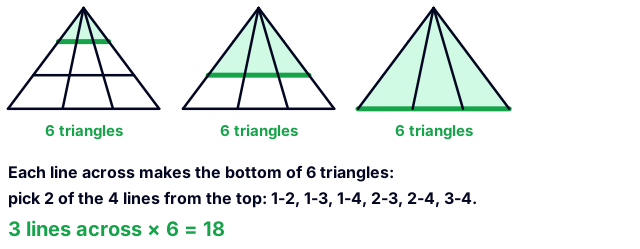
Every triangle has its top at the top corner and its bottom on one line across. Each line across is the bottom of 6 triangles, so 3 × 6 = 18!
For the grown-up: strategy: organise the count so nothing is missed or counted twice. A triangle here needs two of the 4 lines from the top corner and one of the 3 lines across (two lines across never meet, and three lines from the corner all meet at one point). Two of 4 lines can be picked in 6 ways (1-2, 1-3, 1-4, 2-3, 2-4, 3-4), and each pair works with any of the 3 lines across. Check: the top band alone shows 3 small + 2 middle + 1 big = 6. Common wrong answer: 6 (only the triangles in the top band, or only those on the bottom line), 12 (missing one line across), or 9 (counting the small pieces, but only 3 of them are triangles).
Problem 6
Problem 6: Answer 53 candies
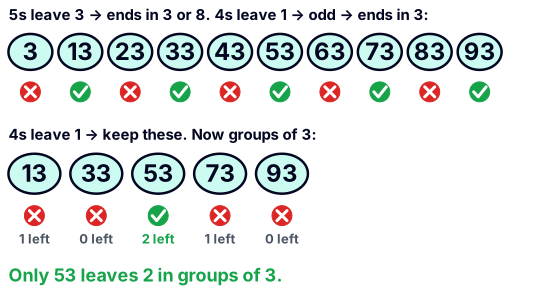
3 left in 5s: the number ends in 3 or 8. 1 left in 4s: it is odd, so it ends in 3. Of 3, 13, …, 93, the ones with 1 left in 4s are 13, 33, 53, 73, 93. Only 53 leaves 2 in 3s!
For the grown-up: strategy: use the easiest clue first to make a short list, then test it with the others. Groups of 5 are the easiest to read from the last digit (3 or 8 left means it ends in 3 or 8), and 1 left in 4s means the number is odd, so it ends in 3. That leaves only ten numbers under 100; the 4s keep five of them, and the 3s keep one. Check: 53 = 17 × 3 + 2 = 13 × 4 + 1 = 10 × 5 + 3. Common wrong answer: 13 or 33 (they pass the 5s and the 4s, but in groups of 3 they leave 1 and 0), or 38 (it passes the 5s and the 3s, but it is even, so 4s leave 2).
Problem 7
Problem 7: Answer 30 cm
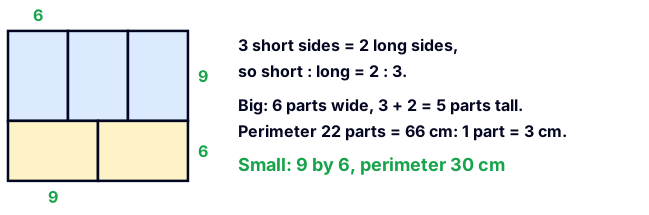
3 short sides on top match 2 long sides below, so short : long = 2 : 3. The big rectangle is 6 parts by 5 parts, perimeter 22 parts = 66 cm, so a part is 3 cm. Small: 9 by 6, perimeter 30 cm!
For the grown-up: strategy: find what fits. The top edge is three short sides and the bottom edge is two long sides, and they are the same length, so a long side is one and a half short sides. Calling a short side 2 parts and a long side 3 parts, the big rectangle is 6 parts wide and 3 + 2 = 5 parts tall, so its perimeter is 6 + 5 + 6 + 5 = 22 parts. Check: the big rectangle is 18 cm by 15 cm, and 18 + 15 + 18 + 15 = 66. Common wrong answer: 15 (only a long side plus a short side, half the perimeter), or 33 (half of 66).
Problem 8
Problem 8: Answer Eve
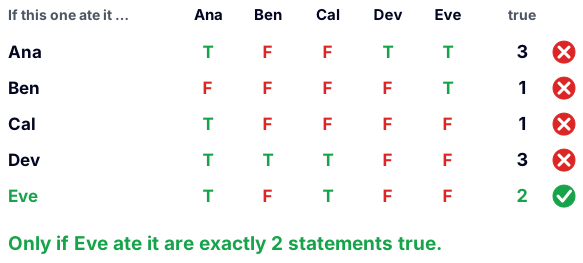
Try each friend as the cookie-eater and count the true statements. Ana: 3. Ben: 1. Cal: 1. Dev: 3. Eve: 2. Only Eve gives exactly two!
For the grown-up: strategy: make a table and test every case. No two statements cancel each other out here, so there is no shortcut: suppose each friend in turn ate it, mark every statement true or false, and count. If Eve ate it, Ana (“Ben didn’t”) and Cal (“Dev or Eve”) are telling the truth, and Ben, Dev and Eve are not: exactly two. Check: every other suspect gives 1 or 3 true statements, so Eve is the only answer. Common wrong answer: Ben or Cal (each makes exactly one statement true: the answer to the more familiar “only one tells the truth” puzzle), or Ana or Dev (3 true statements each: reading “exactly two” as “at least two”).
Problem 9
Problem 9: Answer 39 cards
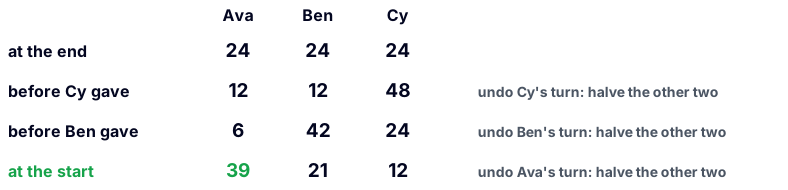
Work backwards from 24, 24, 24. Before Cy gave, Ava and Ben had half: 12 and 12, and Cy had 24 + 12 + 12 = 48. Undo Ben, then Ava, the same way: Ava started with 39!
For the grown-up: strategy: work backwards. Each step doubles two piles, so undoing it halves those two piles and gives the giver back what they lost. Undo Cy: 12, 12, 48. Undo Ben: Ava 6, Cy 24, Ben 12 + 6 + 24 = 42. Undo Ava: Ben 21, Cy 12, Ava 6 + 21 + 12 = 39. The total, 72 cards, never changes, which is a good running check. Check forward: 39, 21, 12 → 6, 42, 24 → 12, 12, 48 → 24, 24, 24. Common wrong answer: 12 (undoing the steps in the wrong order, Ava’s first), or 24 (assuming nothing changed).
Problem 10
Problem 10: Answer 57 times
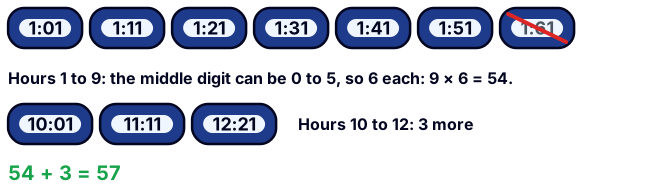
For hours 1 to 9 the time looks like 4:34: the middle digit can only be 0 to 5, so 6 times each, 9 × 6 = 54. Then 10:01, 11:11 and 12:21: 57!
For the grown-up: strategy: split into cases and watch the twist. A one-digit hour h gives h : ? h, and the minutes ?h must be a real minute, so the middle digit is 0 to 5 (1:61 does not exist): 6 times for each of the 9 hours. A two-digit hour fixes all four digits: 10 needs :01, 11 needs :11 and 12 needs :21, all real times. Check: list hour 1 (1:01, 1:11, 1:21, 1:31, 1:41, 1:51) and the pattern is the same for every hour from 1 to 9. Common wrong answer: 54 (forgetting the two-digit hours), or 90 (letting the middle digit run from 0 to 9).
More MOEMS Division E practice
Our MOEMS Division E prep guide teaches the strategies behind these problems, with many more original problems and a free sample to try first. Practice for the other division: Division M. For how the olympiads work, see our MOEMS practice problems overview.
This guide is not affiliated with or endorsed by Math Olympiads for Elementary and Middle Schools (MOEMS®). “MOEMS” is a trademark of its respective owners.