
Free practice
Noetic Math Contest Practice Problems: Grade 3
Ten original Noetic-style problems for grade 3, at real contest difficulty, with every answer explained for parents.
Noetic full prep and practice guides: 2 3 4 5–6
Free practice, other grades: 2 4 5 6
Other contests, grade 3: Math Kangaroo 3–4 CML
Printable PDF: all 10 problems with room to work, then every answer explained.
On this page · 3 sections
Ten original practice problems for the Grade 3 Noetic Learning Math Contest, written by us at real contest difficulty. None comes from a real Noetic test. Every one has a worked solution, with a note for you on the most common wrong answer.
The Noetic Grade 3 test has 20 problems like these, and you get 45 minutes. These ten come from ten different chapters of the full guide, from warm-ups to the hardest Challenges. Try each one on your own before you look at the answers.
The 10 problems
Problem 1
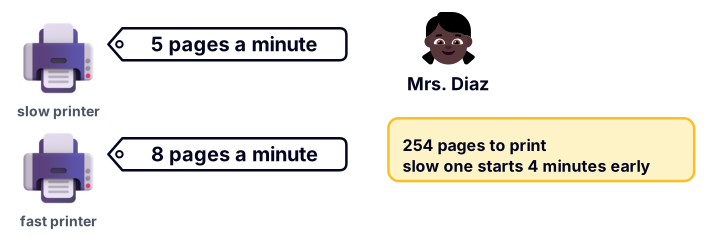
A slow printer prints 5 pages a minute. A fast printer prints 8 pages a minute. Mrs. Diaz needs 254 pages. She starts the slow printer 4 minutes before the fast one. Then both print until all 254 pages are done. How many minutes does the fast printer print?
Problem 2
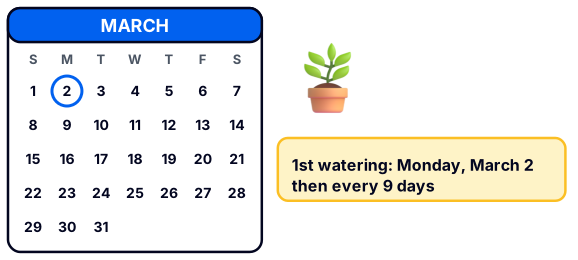
Kai waters his plant for the first time on Monday, March 2. After that he waters it every 9 days. On what date does he water it for the 5th time?
Watch out: Five things in a row have only four gaps between them.
Problem 3
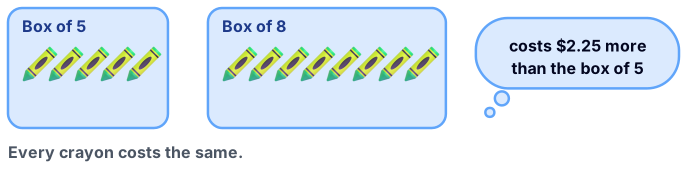
A box of 8 crayons costs $2.25 more than a box of 5 crayons. Every crayon costs the same. How much does a box of 12 of these crayons cost?
Problem 4
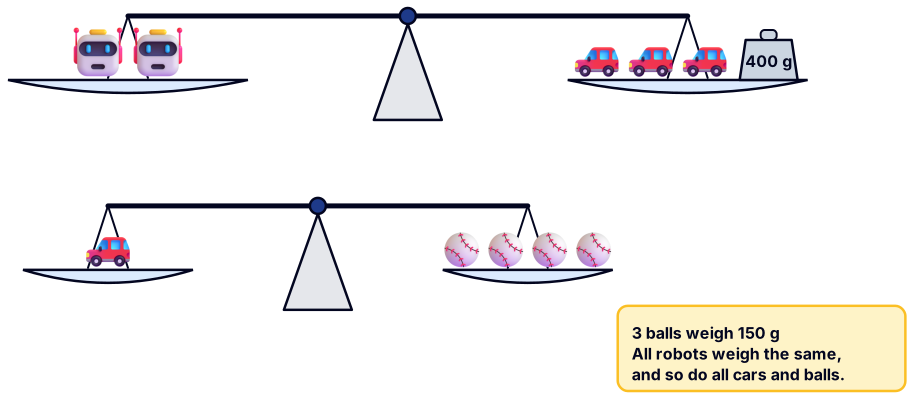
Both balances are level. Two toy robots balance 3 toy cars and a 400 g weight. One toy car balances 4 baseballs. Three baseballs weigh 150 g. All the robots weigh the same, and so do all the cars and all the balls. How much does one robot weigh?
Problem 5
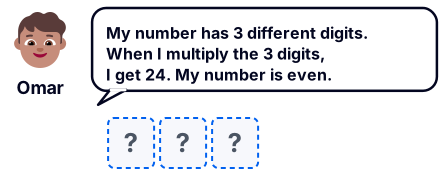
Omar thinks of a 3-digit number. Its three digits are all different. When he multiplies the three digits, he gets 24. His number is even. How many different numbers could Omar be thinking of?
Problem 6
Three equal squares are put together to make an L shape, as in the picture. A ladybug walks all the way around the L, a distance of 40 cm. What is the area of the whole L?
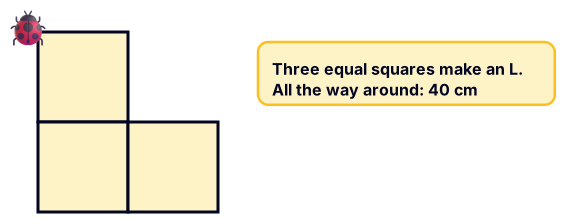
Tip: Draw the shape. Mark every side that must be the same length.
Problem 7
Lia lays tiles in rows. Row 1 has 3 tiles. Each row has 2 more tiles than the row above it. She makes 8 rows. How many tiles does she use in all?

Trick: When numbers grow by the same step, the first and the last add up to the same as the second and the second-to-last.
Problem 8
A ticket costs 60¢. Ben pays exactly 60¢ using quarters, dimes and nickels. He can use any number of each coin, and he does not need all three kinds. How many different ways can he pay?

Problem 9
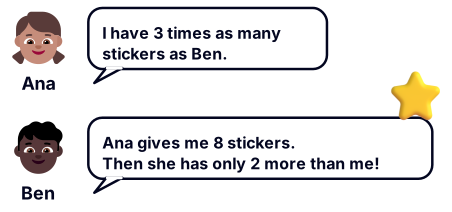
★ Challenge. Ana has 3 times as many stickers as Ben. Ana gives Ben 8 of her stickers. Now Ana has only 2 more stickers than Ben. How many stickers did Ana have at the start?
Problem 10
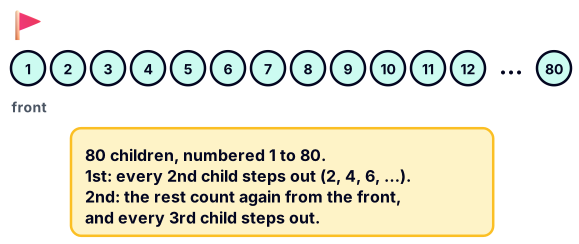
★ Challenge. Eighty children stand in a line, numbered 1 to 80 from the front. First, every 2nd child steps out: 2, 4, 6, and so on. Then the children still in line count again from the front, and every 3rd one steps out. Which child is now 15th in line?
Solutions
Problem 1
Problem 1: Answer 18 minutes
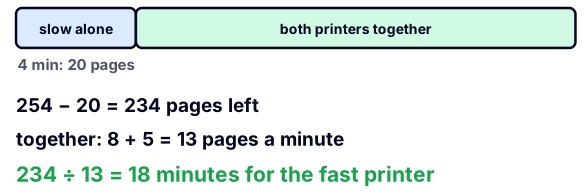
The slow printer works alone for 4 minutes: 20 pages. 254 − 20 = 234 left. Together they print 5 + 8 = 13 a minute. 234 ÷ 13 = 18 minutes!
For the grown-up: split the job into the part one printer does alone and the part both do together. Check: the slow printer runs 22 minutes (110 pages) and the fast one 18 minutes (144 pages); 110 + 144 = 254. Common wrong answer: 22 (the slow printer’s time), or 20 (the pages printed in the head start, not minutes). More like this: Chapter 5 of the Grade 3 guide.
Problem 2
Problem 2: Answer April 7
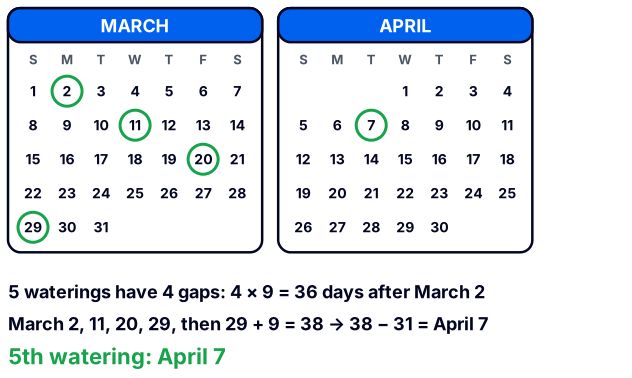
5 waterings have 4 gaps: 4 × 9 = 36 days. March 2, 11, 20, 29, then 9 more days: April 7!
For the grown-up: the 5th watering is 4 gaps after the 1st, not 5. Crossing the end of March means using March’s 31 days: March 29 + 9 = “March 38”, and 38 − 31 = April 7. Common wrong answer: April 16 (5 gaps of 9), or April 8 (counting March as 30 days). More like this: Chapter 4 of the Grade 3 guide.
Problem 3
Problem 3: Answer $9

The big box has 3 more crayons, and it costs $2.25 more. So 3 crayons cost $2.25 and 1 crayon costs 75¢. 12 crayons: 12 × 75¢ = $9!
For the grown-up: the two boxes differ only by the extra crayons, so the price difference pays for exactly those 3. Check: a box of 5 is $3.75 and a box of 8 is $6.00, $2.25 apart. Common wrong answer: $5.40 (12 × 45¢, sharing $2.25 among 5), $2.25 (the difference), or 75 (the price of one crayon in cents). More like this: Chapter 1 of the Grade 3 guide.
Problem 4
Problem 4: Answer 500 g
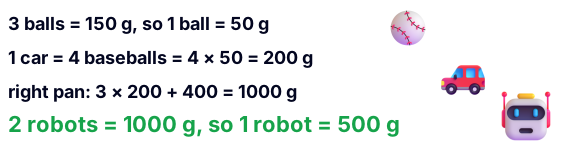
3 balls = 150 g, so 1 ball = 50 g. A car = 4 baseballs = 200 g. Right pan: 3 × 200 + 400 = 1000 g. Two robots = 1000 g, so one robot = 500 g!
For the grown-up: start from the one thing whose weight you can find (a ball) and swap your way up the chain. Check: 2 × 500 = 1000 = 3 × 200 + 400. Common wrong answer: 1000 (both robots), 300 (forgetting the 400 g weight), or 200 (a car, not a robot). More like this: Chapter 6 of the Grade 3 guide.
Problem 5
Problem 5: Answer 10 numbers
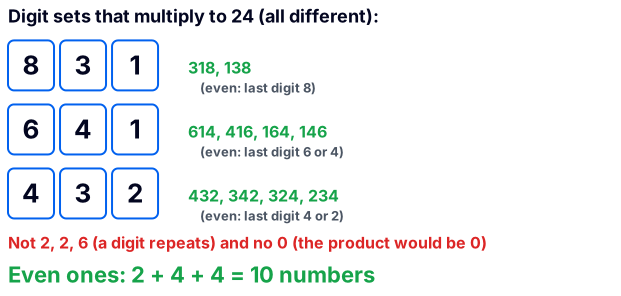
Digits that multiply to 24, all different: 8, 3, 1 or 6, 4, 1 or 4, 3, 2. Even means the last digit is even. 8,3,1: ends in 8, 2 ways. 6,4,1: ends in 6 or 4, 4 ways. 4,3,2: ends in 4 or 2, 4 ways. 2 + 4 + 4 = 10!
For the grown-up: first find the digit sets in an organized way (start from the biggest digit), then fix an even last digit and count the orders of the other two. 2, 2, 6 is out because a digit repeats, and 0 can’t be used. Common wrong answer: 18 (all the numbers, odd ones too), 3 (the sets). More like this: Chapter 10 of the Grade 3 guide.
Problem 6
Problem 6: Answer 75 square centimeters
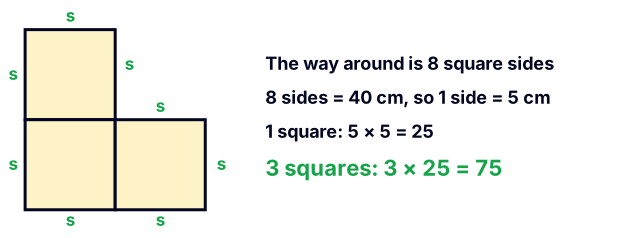
Walk around the L and count the square sides: 8. 8 sides = 40 cm, so one side is 5 cm. One square: 5 × 5 = 25. Three squares: 75!
For the grown-up: the lines where squares touch are inside the L, so they are not part of the way around. Counting the outside edges one by one is the safest way. Check: 8 × 5 = 40. Common wrong answer: 25 (one square only), or 48 (side 4, counting the 2 inside lines as well: 10 sides). More like this: Chapter 13 of the Grade 3 guide.
Problem 7
Problem 7: Answer 80 tiles
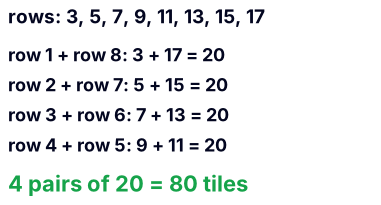
Rows: 3, 5, 7, 9, 11, 13, 15, 17. Pair them: 3 + 17 = 20, 5 + 15 = 20, 7 + 13 = 20, 9 + 11 = 20. 4 × 20 = 80!
For the grown-up: each pair adds to the same total because one number grows by 2 as the other shrinks by 2. Row 8 has 3 + 7 × 2 = 17 tiles (7 steps, not 8). Common wrong answer: 17 (only the last row), or 160 (counting every row twice when pairing). More like this: Chapter 11 of the Grade 3 guide.
Problem 8
Problem 8: Answer 13 ways
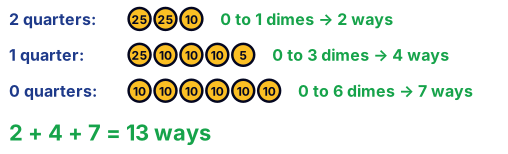
2 quarters: 10¢ left, a dime or 2 nickels, 2 ways. 1 quarter: 35¢ left, 0 to 3 dimes, 4 ways. No quarter: 60¢, 0 to 6 dimes, 7 ways. 2 + 4 + 7 = 13!
For the grown-up: an organized list starts with the biggest coin and goes down, so no way is missed or counted twice. Once the quarters and dimes are chosen, the nickels are fixed, so each line is just “how many dimes can fit”. Common wrong answer: 12 (missing the all-nickel way), or 3 (counting only the number of quarters). More like this: Chapter 12 of the Grade 3 guide.
Problem 9
Problem 9: Answer 27 stickers
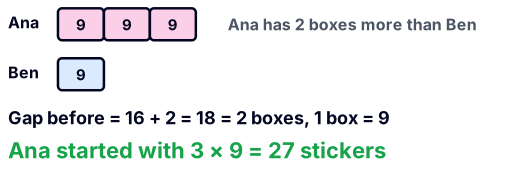
Draw Ben as 1 box and Ana as 3 boxes: Ana has 2 boxes more. Giving 8 makes Ana 8 smaller and Ben 8 bigger, so the gap shrinks by 16 and is now 2. The gap was 18 = 2 boxes, so a box is 9. Ana had 3 × 9 = 27!
For the grown-up: a gift changes the gap twice: the giver loses and the receiver gains. Check: 27 − 8 = 19 and 9 + 8 = 17. Common wrong answer: 9 (Ben’s stickers), 15 (shrinking the gap by only 8: 2 boxes = 10), or 21 (taking the 2 away instead of adding it: gap 14). More like this: Chapter 2 of the Grade 3 guide.
Problem 10
Problem 10: Answer child 43

Round 1 leaves the odd numbers. Round 2 takes out every 3rd of them: 5, 11, 17, … So each block of 6 numbers keeps 2 children: 1, 3, then 7, 9, then 13, 15. The 15th child is the 1st of the 8th block, which starts at 43!
For the grown-up: the line is too long to write out, so work a short piece and find the pattern: two children stay out of every six (1, 3, 7, 9, 13, 15, …). Common wrong answer: 29 (the 15th after round 1 only), 45 (the second of the 8th pair), or 15 (the old 15th place). More like this: Chapter 8 of the Grade 3 guide.
More Noetic practice for grade 3
For more at this level, our Noetic Grade 3 prep guide has 15 chapters, 190 original problems and two full practice tests, with a free sample to try first. Practice for the other grades: Grade 2 · Grade 4 · Grade 5 · Grade 6. For the format, the awards and a four-week plan, read our Noetic Learning Math Contest preparation guide.
This guide is not affiliated with or endorsed by Noetic Learning. “Noetic Learning Math Contest” is a trademark of its respective owners.