Free practice
Noetic Math Contest Practice Problems: Grade 6
Ten original Noetic-style problems for grade 6, at real contest difficulty, with every answer explained for parents.
Noetic full prep and practice guides: 2 3 4 5–6
Free practice, other grades: 2 3 4 5
Other contests, grade 6: Math Kangaroo 5–6 MOEMS Div E MOEMS Div M CML AMC 8
Printable PDF: all 10 problems with room to work, then every answer explained.
On this page · 3 sections
Ten original practice problems for the Grade 6 Noetic Learning Math Contest, written by us at real contest difficulty. None comes from a real Noetic test. Every one has a worked solution, with a note for you on the most common wrong answer.
The Noetic Grade 6 test has 20 problems like these, and you get 45 minutes with no calculator. You write in every answer, and a wrong answer costs nothing, so never leave a line blank. The first problems take two or three steps; the last ones need a real idea. Try each problem on your own before you look at the answers.
The 10 problems
Problem 1
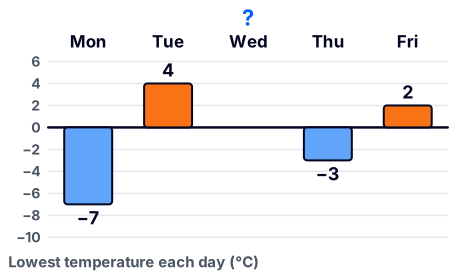
The chart shows the lowest temperature in a mountain town each day from Monday to Friday, but Wednesday’s bar is missing. The mean (average) of the five temperatures is −2 °C. What was the lowest temperature on Wednesday?
Fact: The mean is the total of the numbers divided by how many numbers there are.
Problem 2
Lena’s bag holds only quarters and dimes. For every 3 quarters there are 8 dimes. The coins are worth $9.30 in all. How many coins are in the bag?

Problem 3
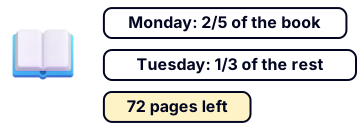
Mia read 2/5 of her book on Monday. On Tuesday she read 1/3 of the pages that were left. Now she still has 72 pages to read. How many pages does the book have?
Problem 4
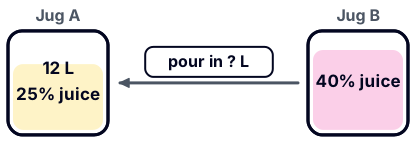
Jug A holds 12 liters of a drink that is 25% juice. Jug B holds plenty of a drink that is 40% juice. How many liters from Jug B must be poured into Jug A so that the drink in Jug A becomes 30% juice?
Problem 5
ABCD is a square with sides 12 cm. E is the midpoint of side AB, and F is on side BC with BF = 3 cm. What is the area of the shaded triangle DEF?
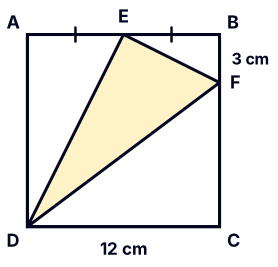
Fact: A right triangle’s area is half of one short side times the other.
Problem 6
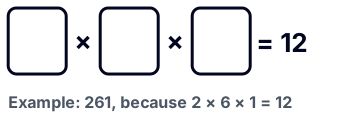
The digits of 261 multiply to 12, because 2 × 6 × 1 = 12. How many 3-digit numbers have digits that multiply to 12? (261 is one of them.)
Problem 7
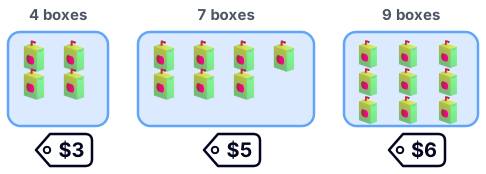
Juice boxes come only in packs of 4 for $3, packs of 7 for $5 and packs of 9 for $6. Sam needs exactly 38 juice boxes, with none left over. What is the least amount he can pay?
Problem 8
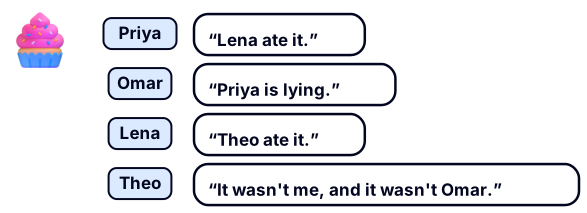
One of four friends ate the last cupcake. Each friend says one thing, as shown. Exactly one of the four statements is true. Who ate the cupcake?
Problem 9
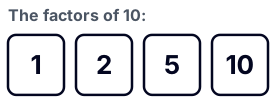
★ Challenge. The number 10 has exactly 4 factors: 1, 2, 5 and 10. How many whole numbers from 1 to 200 have exactly 3 factors?
Problem 10
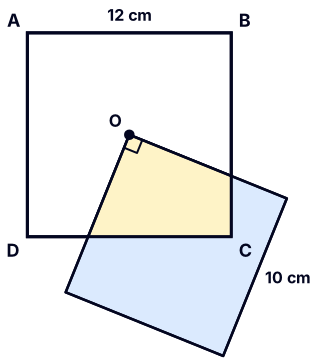
★ Challenge. Square ABCD has sides 12 cm, and O is its center. A second square, with sides 10 cm, has one corner at O and is turned as shown. What is the area of the part where the two squares overlap?
Solutions
Problem 1
Problem 1: Answer −6 °C
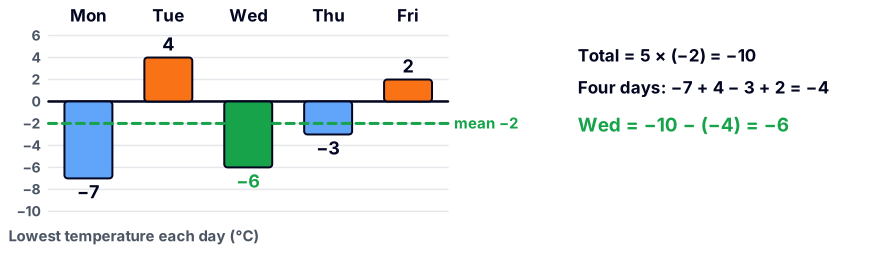
Mean −2 for 5 days means the total is −10. The other four days add to −4, so Wednesday is −10 − (−4) = −6.
For the grown-up: a mean tells you the total: 5 days × (−2) = −10. Adding the four known days, −7 + 4 − 3 + 2 = −4, so Wednesday must bring the total down by 6 more: −6. Check: −7 + 4 − 6 − 3 + 2 = −10, and −10 ÷ 5 = −2. Common wrong answer: −2 (taking the mean as the missing day), 6 or −14 (sign slips when subtracting −4 from −10), or −1 (averaging the four days instead of using the total).
Problem 2
Problem 2: Answer 66 coins
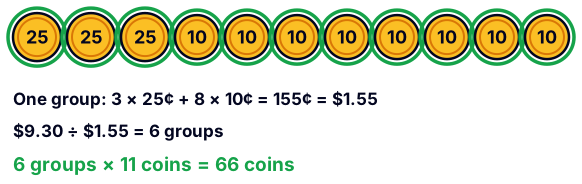
One group of 3 quarters and 8 dimes is 75¢ + 80¢ = $1.55. $9.30 is 6 such groups, and each group has 11 coins: 66.
For the grown-up: a ratio means the coins come in equal groups of 3 quarters and 8 dimes. Find the value of one group, see how many groups make the total (930 ÷ 155 = 6), then count coins. Check: 18 quarters are $4.50, 48 dimes are $4.80, and $4.50 + $4.80 = $9.30; 18 : 48 is 3 : 8. Common wrong answer: 6 (the number of groups, not coins), 11 (one group), or 48 (the dimes only).
Problem 3
Problem 3: Answer 180 pages
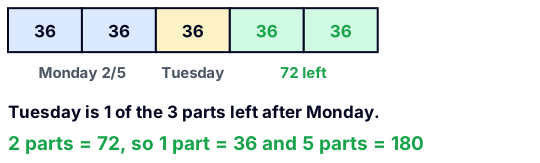
After Monday, 3/5 of the book is left. Tuesday takes 1/3 of that, which is 1/5. So 2/5 is left, and 2/5 is 72 pages: 1/5 is 36, the book is 180.
For the grown-up: the key words are “of the pages that were left”: Tuesday’s 1/3 is a fraction of the 3/5 that remained, not of the whole book. Cutting the book into fifths makes it a picture: Monday 2 parts, Tuesday 1 of the 3 remaining parts, 2 parts left. Check: Monday 72 pages, Tuesday 36 of the 108 left, and 108 − 36 = 72. Common wrong answer: 270 (taking 1/3 of the whole book, so 2/5 + 1/3 = 11/15 read and 4/15 = 72), or 120 (thinking 72 is 3/5 of the book).
Problem 4
Problem 4: Answer 6 L
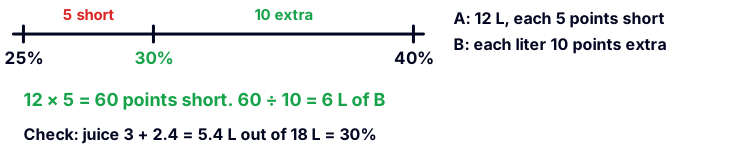
Jug A is 5 points below 30% on each of its 12 liters; each liter of B is 10 points above. 60 ÷ 10 = 6 L.
For the grown-up: the mix lands at 30%, so what Jug A lacks must be made up by what Jug B adds: 12 liters × 5 points short = 60, and each liter of B brings 10 points extra, so 6 liters. Algebra gives the same: 3 + 0.4x = 0.3(12 + x), so 0.1x = 0.6 and x = 6. Check: juice 3 L + 2.4 L = 5.4 L in 18 L, and 5.4 ÷ 18 = 30%. Common wrong answer: 24 (the ratio turned around: more of the drink that is further away), 12 (equal amounts, which gives 32.5%), or 18 (the total in Jug A afterwards).
Problem 5
Problem 5: Answer 45 cm²
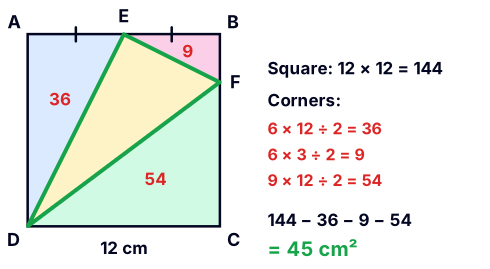
The shaded triangle is the square minus three right triangles: 144 − 36 − 9 − 54 = 45.
For the grown-up: triangle DEF has no side along a grid line to measure, but the three white corner triangles are right triangles whose legs are easy to read: AE = 6 and AD = 12 give 36; EB = 6 and BF = 3 give 9; FC = 12 − 3 = 9 and CD = 12 give 54. The square is 12 × 12 = 144, so DEF is 144 − 99 = 45. Check: the three corners plus the shaded triangle fill the square, 36 + 9 + 54 + 45 = 144. Common wrong answer: 72 (half the square, a guess from the picture), 99 (the white corners, not the shaded triangle), or 54 (using FC = 12 or forgetting to subtract BF).
Problem 6
Problem 6: Answer 15 numbers
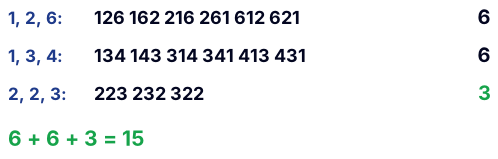
Three digits with product 12 are 1, 2, 6 or 1, 3, 4 or 2, 2, 3. Orders: 6 + 6 + 3 = 15.
For the grown-up: split the job in two. First find every set of three digits that multiply to 12 (no digit can be 0, and 12 or 1 × 1 × 12 is not allowed, since 12 is not a digit): {1, 2, 6}, {1, 3, 4}, {2, 2, 3}. Then count orders: three different digits can be arranged in 3 × 2 × 1 = 6 ways, but 2, 2, 3 has a repeated digit, so only 3 orders (223, 232, 322). Check: the see-it picture lists all 15. Common wrong answer: 18 (6 orders for 2, 2, 3 as well), 3 (the digit sets, not the numbers), or 12 (missing one set, usually 2, 2, 3 or 1, 3, 4).
Problem 7
Problem 7: Answer $26
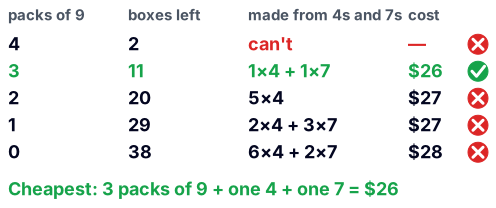
Sort by packs of 9. Three 9s leave 11 = 4 + 7: $18 + $3 + $5 = $26. Every other way costs more.
For the grown-up: list the ways in order of the biggest pack so none is missed. Four 9s leave 2 (impossible); three leave 11 = 4 + 7 ($26); two leave 20 = 5 fours ($27); one leaves 29 = 2 fours + 3 sevens ($27); none needs 6 fours + 2 sevens ($28). Check: 27 + 4 + 7 = 38 boxes. Common wrong answer: $27 (stopping at the first way found, often 5 fours + 2 nines), or $24 (four 9-packs, which is only 36 boxes).
Problem 8
Problem 8: Answer Omar
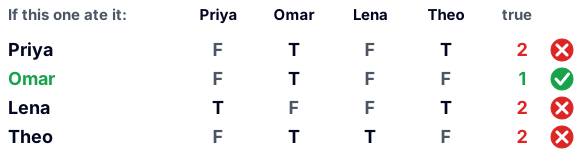
Priya and Omar can’t both be right or both wrong, so the one true statement is one of theirs. Lena and Theo lie: not Theo, and Theo or Omar ate it. Omar!
For the grown-up: “Priya is lying” is true exactly when Priya’s statement is false, so between them Priya and Omar make exactly one true statement. That uses up the one truth, so Lena and Theo are both lying. Lena’s lie means Theo didn’t eat it; Theo’s lie means Theo or Omar did. So Omar ate it. Check: if Omar ate it, Priya is wrong, Omar is right, Lena is wrong and Theo is wrong: one true. The table tests the other three, and each gives two true. Common wrong answer: Lena (believing Priya), or Theo (believing Lena).
Problem 9
Problem 9: Answer 6 numbers
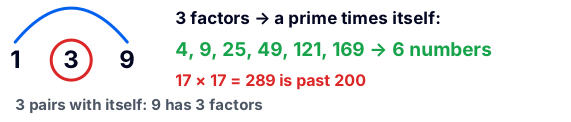
Factors pair up, so an odd count means a square; exactly 3 means a prime squared.
For the grown-up: each factor d of n pairs with n ÷ d, so the count is even unless a factor pairs with itself, which happens only when n is a square, k × k. Then 1, k and n are factors, and any other factor of k adds more, so exactly 3 factors means k is prime: 2, 3, 5, 7, 11, 13 give 4, 9, 25, 49, 121, 169 (17 × 17 = 289 is too big). Check: 49 has factors 1, 7, 49; 36 is a square with 9 factors. Common wrong answer: 14 (all the squares up to 196), 7 (counting 1, which has 1 factor), or 5 (missing 169).
Problem 10
Problem 10: Answer 36 cm²
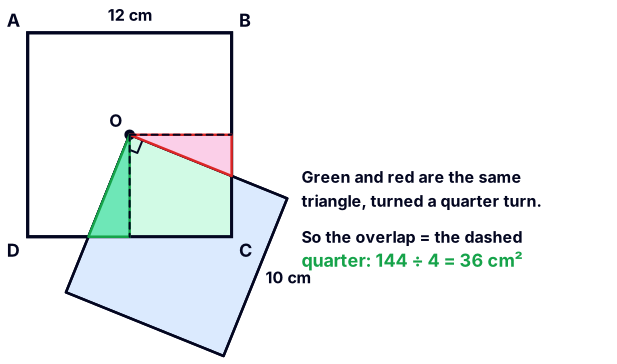
Turn the overlap back to the dashed quarter square: it gains the green triangle and loses the red one, and they are the same size. So the overlap is 144 ÷ 4 = 36.
For the grown-up: if the small square were not turned, the overlap would be exactly the quarter of the big square next to O: 6 × 6 = 36. Turning it about O swaps the red triangle for the green one. They are the same triangle turned a quarter turn about O (each has a 6 cm side from O to the middle of a side, a right angle, and the same angle at O), so the area never changes. The 10 cm only matters because it is long enough (more than the 8.5 cm from O to a corner) for the small square to reach past the big square’s edges. Check: at any turn the area is the same, and the unturned case is clearly 36. Common wrong answer: 100 or 144 (one square’s area), 25 (a quarter of the small square), or “can’t be found” (thinking the angle is needed).
More Noetic practice for grade 6
For more at this level, our Noetic Grades 5–6 prep guide has strategies for each topic area, original practice problems and a full practice contest, with a free sample to try first. Practice for the other grades: Grade 2 · Grade 3 · Grade 4 · Grade 5. For the format, the awards and a four-week plan, read our Noetic Learning Math Contest preparation guide.
This guide is not affiliated with or endorsed by Noetic Learning. “Noetic Learning Math Contest” is a trademark of its respective owners.