Free practice
Noetic Math Contest Practice Problems: Grade 5
Ten original Noetic-style problems for grade 5, at real contest difficulty, with every answer explained for parents.
Noetic full prep and practice guides: 2 3 4 5–6
Free practice, other grades: 2 3 4 6
Other contests, grade 5: Math Kangaroo 5–6 MOEMS Div E CML
Printable PDF: all 10 problems with room to work, then every answer explained.
On this page · 3 sections
Ten original practice problems for the Grade 5 Noetic Learning Math Contest, written by us at real contest difficulty. None comes from a real Noetic test. Every one has a worked solution, with a note for you on the most common wrong answer.
The Noetic test for Grade 5 has 20 problems like these, and you get 45 minutes with no calculator. You write each answer in, and a wrong answer costs nothing, so try every problem. The first three are warm-ups and the two ★ problems are as hard as the hardest on the real paper. Work each one on your own before you look at the answers.
The 10 problems
Problem 1
Pencils cost $0.35 each and paintbrushes cost $0.45 each. Nia buys 4 pencils and some paintbrushes. She pays with a $5 bill and gets $0.90 back. How many paintbrushes does she buy?

Problem 2
Leo scored 14, 9, 17 and 12 points in his first four basketball games. How many points must he score in his fifth game so that his average for the five games is 15 points?
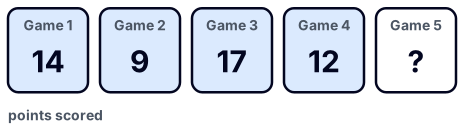
Fact: Average × number of games = total points.
Problem 3
Beads on a long string follow the pattern shown: orange, blue, blue, yellow, green, then the same five colors again and again. How many of the first 48 beads are blue?

Problem 4
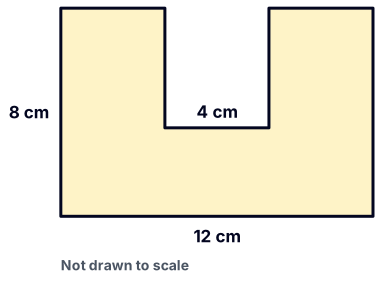
A rectangle 12 cm long and 8 cm wide has a smaller rectangle, 4 cm wide, cut out of the middle of its top edge, as shown. The shape that is left has an area of 84 cm². What is the perimeter of the shape that is left?
Problem 5
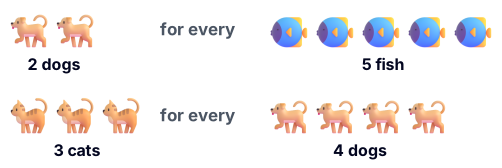
In a pet shop there are 2 dogs for every 5 fish, and 3 cats for every 4 dogs. The shop has 30 fish. How many cats and dogs does the shop have altogether?
Problem 6
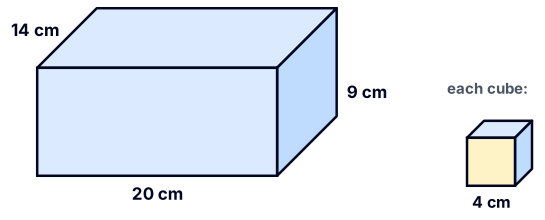
A box is 20 cm long, 14 cm wide and 9 cm tall inside. Lena packs as many 4 cm cubes into it as she can, in straight rows and layers, and the lid must close. How much of the space inside the box is left empty?
Problem 7
Ana, Ben, Cam, Dev and Eva ran a race, with no ties. Ben finished right after Ana. Cam finished ahead of Ben, but Cam did not win. Dev did not win either. Exactly one runner finished between Dev and Eva. Who finished third?
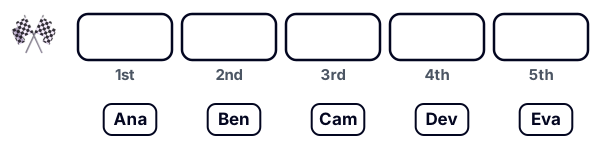
Tip: Ana and Ben always finish side by side. Treat them as one block.
Problem 8
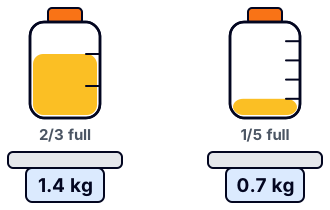
A jar that is 2/3 full of honey weighs 1.4 kg. The same jar, when it is 1/5 full of honey, weighs 0.7 kg. How much does the jar weigh when it is completely full of honey?
Problem 9
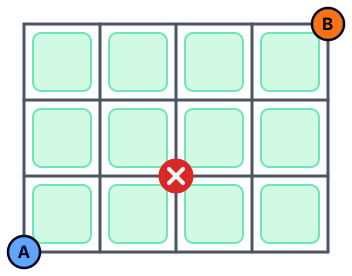
★ Challenge. Max walks along the streets from A to B. He always walks right or up, never left or down. The corner marked X is closed, so he cannot walk through it. How many different routes can Max take?
Problem 10
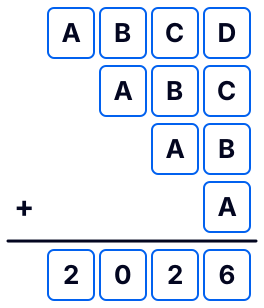
★ Challenge. In the addition below, each letter stands for a different digit, and the same letter always stands for the same digit. What four-digit number is ABCD?
Solutions
Problem 1
Problem 1: Answer 6 paintbrushes

Find what she spent, take off the pencils, then share what is left: $2.70 ÷ $0.45 = 6.
For the grown-up: three steps. She spent $5.00 − $0.90 = $4.10. The 4 pencils cost 4 × $0.35 = $1.40, so the paintbrushes cost $4.10 − $1.40 = $2.70. In cents, 270 ÷ 45 = 6. Check: $1.40 + 6 × $0.45 = $1.40 + $2.70 = $4.10, and $4.10 + $0.90 = $5.00. Common wrong answer: 8 (forgetting the change: $5.00 − $1.40 = $3.60, and $3.60 ÷ $0.45 = 8), or 2 (dividing the change, $0.90, by $0.45).
Problem 2
Problem 2: Answer 23 points

An average of 15 over 5 games means 75 points in all. He has 52, so he needs 23.
For the grown-up: averages are easiest as totals: average × count = total. Five games at 15 is 75 points; the first four add to 14 + 9 + 17 + 12 = 52; the fifth game must make up 75 − 52 = 23. Check: (52 + 23) ÷ 5 = 75 ÷ 5 = 15. Another way: compare each game with 15 (−1, −6, +2, −3, a shortfall of 8 in all), so game 5 must be 15 + 8 = 23. Common wrong answer: 15 (thinking one game at the target average is enough), or 17 (adding only the 2-point gap between the first four games’ average, 13, and 15).
Problem 3
Problem 3: Answer 20 blue beads
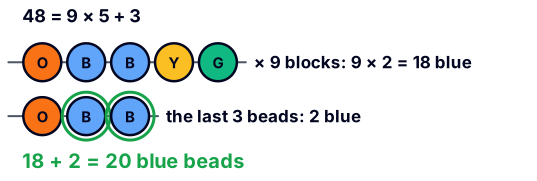
48 beads are 9 full blocks of 5 and 3 more. 9 blocks have 18 blue, and the next 3 beads (orange, blue, blue) add 2: 20.
For the grown-up: in a repeating pattern, count whole blocks first, then look at the part block. 48 ÷ 5 = 9 remainder 3. Each block of five has 2 blue beads, so 9 blocks give 18. The remainder is the start of the next block, orange, blue, blue, which holds 2 more blue. Check: beads 46, 47, 48 are orange, blue, blue. Common wrong answer: 18 (ignoring the 3 extra beads), or 19 (taking 2/5 of 48 = 19.2 and rounding, or counting only one blue in the part block).
Problem 4
Problem 4: Answer 46 cm
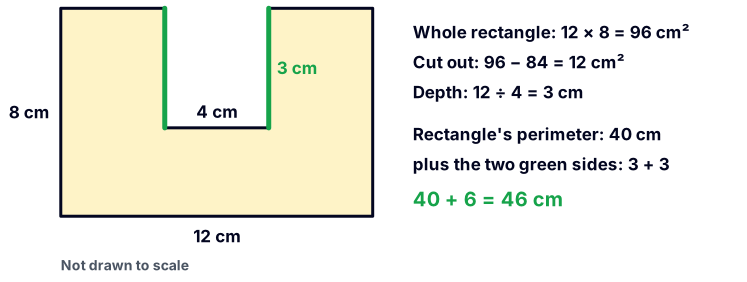
The cut-out has area 96 − 84 = 12 cm², so it is 12 ÷ 4 = 3 cm deep (the picture is not to scale). The cut adds its two 3 cm sides to the rectangle’s 40 cm: 46 cm.
For the grown-up: the depth isn’t marked, so the area has to find it: the whole rectangle is 12 × 8 = 96 cm², 12 cm² was removed, and a 4 cm wide piece of area 12 is 3 cm deep. For the perimeter, the notch’s bottom (4 cm) replaces the 4 cm of top edge cut away, so only its two sides are new. Check by walking round: 12 + 8 + 12 + 8 − 4 + 4 + 3 + 3 = 46. Common wrong answer: 40 (the rectangle’s perimeter, missing the two inner sides), 43 (adding only one 3 cm side), or 36 (subtracting the 4 cm gap and forgetting the notch’s three sides).
Problem 5
Problem 5: Answer 21 animals
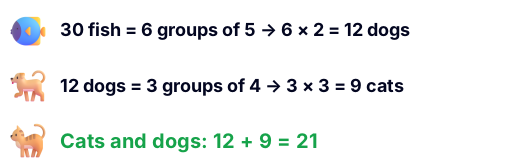
30 fish make 6 groups of 5, so there are 6 × 2 = 12 dogs. 12 dogs make 3 groups of 4, so 3 × 3 = 9 cats. 12 + 9 = 21.
For the grown-up: a ratio in words (“2 dogs for every 5 fish”) means the animals come in matching groups. Count the groups you know (30 ÷ 5 = 6), then use the dogs as the bridge to the second ratio: 12 ÷ 4 = 3 groups, so 9 cats. Check: 12 : 30 is 2 : 5 (divide both by 6), and 9 : 12 is 3 : 4 (divide both by 3). Common wrong answer: 12 or 9 (stopping at one animal), 51 (adding the fish too), or 28 (reading the second ratio backwards: 4 cats for every 3 dogs would give 16 cats).
Problem 6
Problem 6: Answer 600 cm³
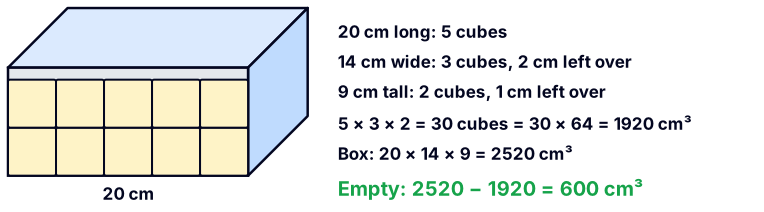
Cubes can’t be cut: 5 along, 3 across, 2 up makes 30 cubes, filling 30 × 64 = 1,920 cm³ of the box’s 2,520 cm³. Empty: 600 cm³.
For the grown-up: first count whole cubes along each edge: 20 ÷ 4 = 5 exactly, but 14 ÷ 4 = 3 with 2 cm left over and 9 ÷ 4 = 2 with 1 cm left over, and a gap thinner than 4 cm holds no cube. So 5 × 3 × 2 = 30 cubes, each 4 × 4 × 4 = 64 cm³. The box holds 20 × 14 × 9 = 2,520 cm³, so 2,520 − 1,920 = 600 cm³ stays empty. Check: the empty space is the box minus a 20 × 12 × 8 block of cubes, and 20 × 12 × 8 = 1,920. Common wrong answer: 0 or 24 (dividing 2,520 by 64 to get about 39 cubes, so almost nothing empty: 2,520 − 39 × 64 = 24), or 30 (the number of cubes, not the space).
Problem 7
Problem 7: Answer Dev
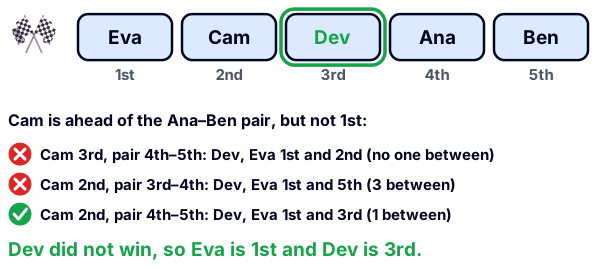
Ana and Ben are a pair, with Cam somewhere ahead of them but not 1st. Only Cam 2nd, pair 4th–5th leaves Dev and Eva one place apart (1st and 3rd). Dev didn’t win, so Dev is 3rd.
For the grown-up: “right after” glues Ana and Ben together, and Cam ahead of Ben means Cam is ahead of the whole pair. Cam can’t be 1st, so there are three cases: Cam 3rd with the pair 4th–5th, or Cam 2nd with the pair 3rd–4th or 4th–5th. Dev and Eva take the two places left, and they must have exactly one runner between them; only the last case works (1st and 3rd). The last clue decides who is where. Check every clue against Eva, Cam, Dev, Ana, Ben. Common wrong answer: Eva (the winner, answering the wrong question), or Ana (putting Cam 2nd and the pair 3rd–4th without checking the Dev–Eva clue).
Problem 8
Problem 8: Answer 1.9 kg
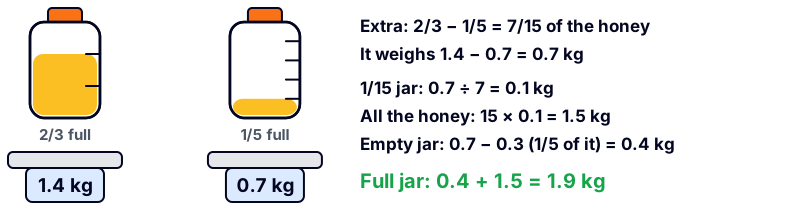
The jar is the same both times, so the extra 0.7 kg is 2/3 − 1/5 = 7/15 of the honey. So 1/15 is 0.1 kg and all the honey is 1.5 kg. The jar is 0.7 − 0.3 = 0.4 kg, and full it weighs 1.9 kg.
For the grown-up: compare the two pictures: the jar cancels out, and the difference, 1.4 − 0.7 = 0.7 kg, is the difference in honey. Over fifteenths, 2/3 − 1/5 = 10/15 − 3/15 = 7/15 of a full jar of honey, so 1/15 weighs 0.1 kg and a full jar of honey is 1.5 kg. One fifth of that, 0.3 kg, is in the lighter jar, so the jar alone is 0.7 − 0.3 = 0.4 kg, and the full jar is 0.4 + 1.5 = 1.9 kg. Check: 0.4 + 2/3 × 1.5 = 0.4 + 1.0 = 1.4 kg. Common wrong answer: 1.5 (the honey without the jar), 0.4 (the empty jar), or 2.1 (adding the two readings).
Problem 9
Problem 9: Answer 17 routes
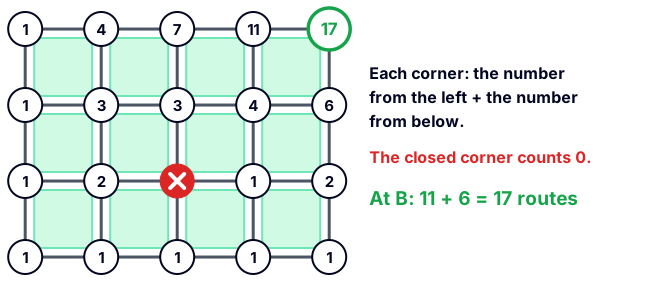
Write at each corner how many routes reach it: the number from the left plus the number from below, with 0 at the closed corner. B gets 11 + 6 = 17.
For the grown-up: every route reaches a corner either from the left or from below, so its count is the sum of those two corners’ counts. The bottom edge and left side get 1 each; the closed corner gets 0. Check another way: without the closure there are 35 routes; the routes through the closed corner are 3 (ways to reach it) × 6 (ways on from it to B) = 18; 35 − 18 = 17. Common wrong answer: 35 (ignoring the closed corner), 32 (taking away only the 3 routes that reach the closed corner, not every route that passes through it), or 7 (the number of blocks walked, not routes).
Problem 10
Problem 10: Answer 1825
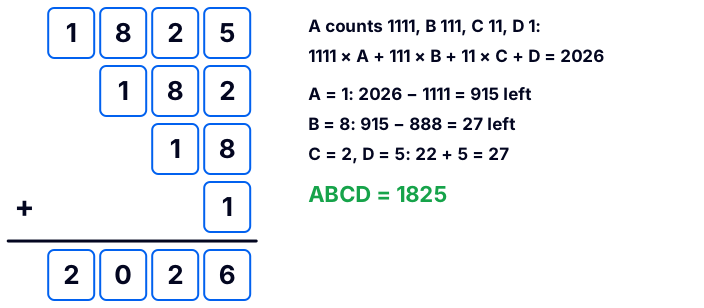
A appears in four places, so it is worth 1111; B is worth 111, C 11 and D 1. A = 1 leaves 915, B = 8 leaves 27, so C = 2 and D = 5.
For the grown-up: the key idea is to collect the letters by place value: ABCD + ABC + AB + A = 1111 × A + 111 × B + 11 × C + D. A must be 1 (2 × 1111 is too big), leaving 2026 − 1111 = 915. B is at most 8 (9 × 111 = 999 is too big), and B = 7 would leave 915 − 777 = 138 for 11 × C + D, more than the largest possible, 11 × 9 + 9 = 108. So B = 8, leaving 27 = 11 × 2 + 5. Check: 1825 + 182 + 18 + 1 = 2026, with four different digits. Common wrong answer: 2026 (copying the total), or answers from guessing column by column, such as 1835 (a sum of 2037), from losing track of carries.
More Noetic practice for grade 5
For more at this level, our Noetic Grades 5–6 prep guide has strategies for each topic area, original practice problems and a full practice contest, with a free sample to try first. Practice for the other grades: Grade 2 · Grade 3 · Grade 4 · Grade 6. For the format, the awards and a four-week plan, read our Noetic Learning Math Contest preparation guide.
This guide is not affiliated with or endorsed by Noetic Learning. “Noetic Learning Math Contest” is a trademark of its respective owners.