
Free practice
CML Practice Problems: Grade 2 (Continental Math League)
Ten original Continental Math League problems for grade 2, from warm-ups to Challenges, with every answer explained for parents.
CML full prep and practice guides: 2 2–6
Free practice, other grades: 3 4 5 6 7 8
Other contests, grade 2: Math Kangaroo 1–2 Noetic 2
Printable PDF: all 10 problems with room to work, then every answer explained.
On this page · 3 sections
Ten original practice problems for the Continental Math League (CML) Grade 2 meet, written by us at real meet difficulty. None comes from a real CML paper. Every one has a worked solution, with a line for your child and a note for you on the most common wrong answer.
CML writes a separate paper for each grade, and second graders get their own: 3 meets a season, each with 6 problems in 30 minutes. There are no answer choices. Your child writes every answer in the answer column, so the only check is their own. Some questions ask for two answers, and CML’s answer keys give credit only when both are right. In this set, problems 4, 7 and 9 work that way.
The set is ramped: problems 1–3 warm up, 4–8 are at meet level, and the two ★ Challenges are as hard as the hardest problem on a real Grade 2 paper. You’ll meet the puzzle types second graders rarely see in school: a made-up symbol with a rule, letters that stand for digits, points on a line, a calendar count and a coin purse.
One way to use it: set a timer for 30 minutes and let your child try problems 1–6, the length of a real meet. Try 7–10 another day with no clock. Read each problem aloud together first if reading still slows your child down, then let them do the math alone.
The 10 problems
Problem 1
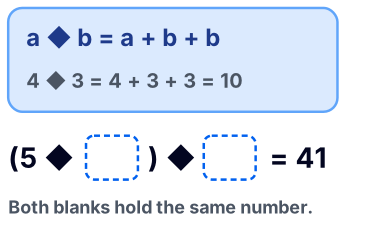
a ◆ b means a + b + b. For example, 4 ◆ 3 = 4 + 3 + 3 = 10. Both blanks hold the same number, and (5 ◆ ___) ◆ ___ = 41. What number goes in each blank?
Problem 2
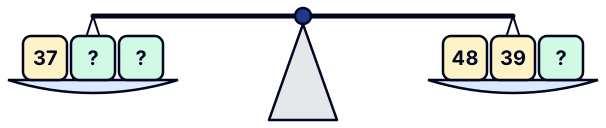
The balance is level. Every box marked ? holds the same number. What number is in each ? box?
Problem 3
Mia has 45¢. Leo has 15¢ more than Mia. Zoe has 8¢ less than Leo. Then Leo gives Zoe 10¢. Now Zoe has ___¢ more than Mia. What number goes in the blank?
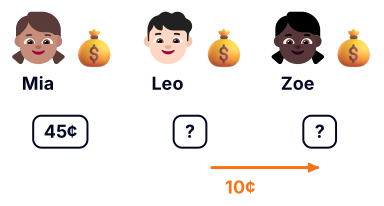
Tip: Write each person’s amount after every step.
Problem 4
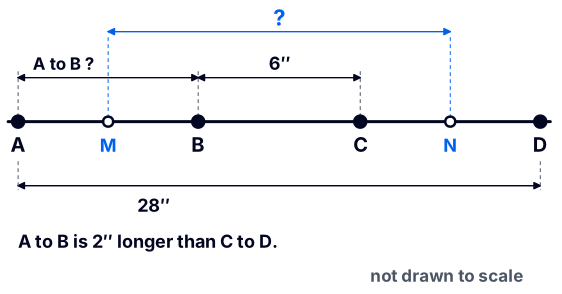
Points A, B, C and D lie on a straight line, in that order. From A to D is 28 inches, and from B to C is 6 inches. A to B is 2 inches longer than C to D. M is halfway between A and B, and N is halfway between C and D. How long is A to B, and how far is it from M to N? Both parts must be right.
Problem 5
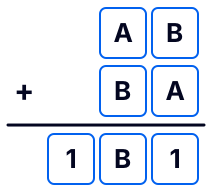
In this addition, each letter stands for a digit. Different letters are different digits, and the same letter is always the same digit. What two-digit number is AB?
Problem 6
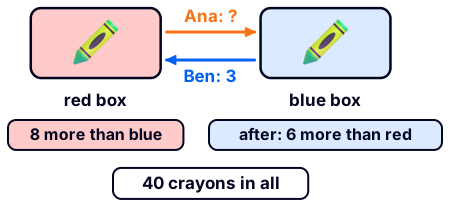
A red box and a blue box hold 40 crayons in all. The red box has 8 more crayons than the blue box. Ana moves some crayons from the red box to the blue box. Then Ben moves 3 crayons from the blue box back to the red box. Now the blue box has 6 more crayons than the red box. How many crayons did Ana move?
Problem 7
Sam’s birthday is on Saturday, April 6. His sister’s birthday is 100 days later. On what day of the week is her birthday, and what is the date? Both parts must be right.
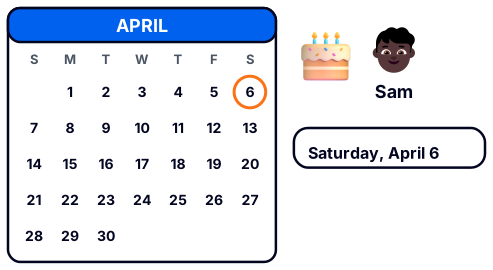
Fact: April, June, September and November have 30 days; the rest have 31, except February.
Problem 8
The red bus has 11 children and the blue bus has 19. At a stop, some children move from the blue bus to the red bus, and 3 other children get off the blue bus and go home. Now the red bus has twice as many children as the blue bus. How many children moved to the red bus?
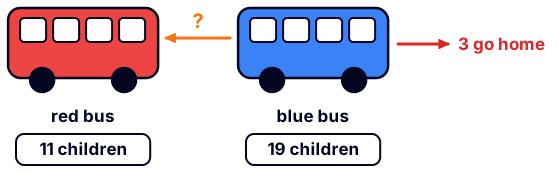
Trick: When things move, keep track of the total.
Problem 9
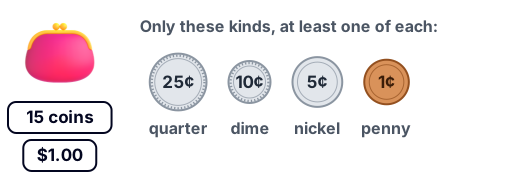
★ Challenge. Tess has 15 coins worth $1.00 in all. Each coin is a quarter, a dime, a nickel or a penny, and she has at least one of each kind. What are the fewest and the most nickels she could have? Both parts must be right.
Problem 10
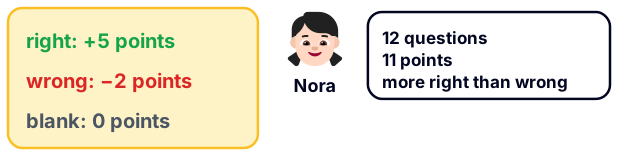
★ Challenge. In a quiz, each right answer earns 5 points, each wrong answer takes away 2 points, and a question left blank scores 0. Nora’s quiz has 12 questions. She ends with 11 points, and she got more questions right than wrong. How many questions did she leave blank?
Solutions
Problem 1
Problem 1: Answer 9

5 ◆ ? is 5 + ? + ?. Then ◆ ? adds ? + ? again. So 5 and four ?s make 41: four ?s make 36, and 9 + 9 + 9 + 9 = 36. Each blank is 9!
For the grown-up: a “defined operation” is on nearly every CML paper: read the rule, then follow it exactly. Here the blank is used twice, inside the bracket and outside it, and the rule adds the second number twice each time, so the blank is added four times in all. Trying numbers also works: 5 ◆ 9 = 23 and 23 ◆ 9 = 23 + 9 + 9 = 41. Common wrong answer: 18 (making only the bracket 41: 5 + 18 + 18), or 12 (adding the blank only three times).
Problem 2
Problem 2: Answer 50
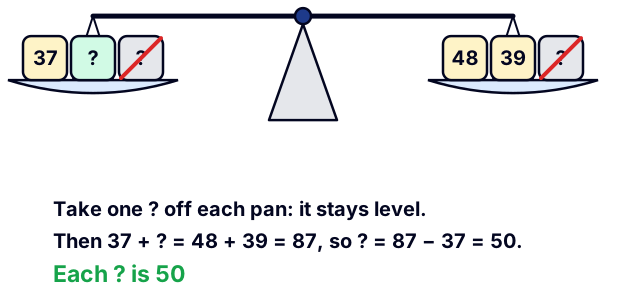
Take one ? box off each pan: the balance stays level. Now 37 + ? = 48 + 39 = 87, so ? = 87 − 37 = 50!
For the grown-up: a level balance stays level when the same thing comes off both pans, and every ? is the same number, so one ? on each side can go. What is left is a plain missing-number sentence. Check: 37 + 50 + 50 = 137 and 48 + 39 + 50 = 137. Common wrong answer: 25 (sharing 87 − 37 = 50 between the two ? boxes on the left, forgetting the ? on the right), or 87.
Problem 3
Problem 3: Answer 17¢
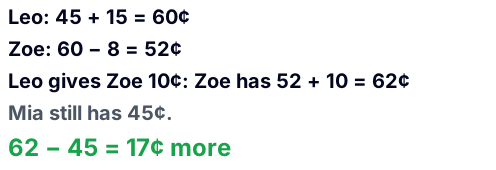
Leo has 45 + 15 = 60¢. Zoe has 60 − 8 = 52¢. Leo gives her 10¢, so she has 62¢. 62 − 45 = 17¢!
For the grown-up: work through the story in order, writing each child’s amount: “more than” adds, “less than” takes away, and a gift moves money from one child to another. Mia is not part of the gift, so she still has 45¢. Check: Zoe started 7¢ ahead of Mia (52 − 45) and the gift adds 10¢ more, so 17¢. Common wrong answer: 7 (forgetting the gift), or 27 (also counting the 10¢ as taken from Mia).
Problem 4
Problem 4: Answer A to B 12 inches, M to N 17 inches
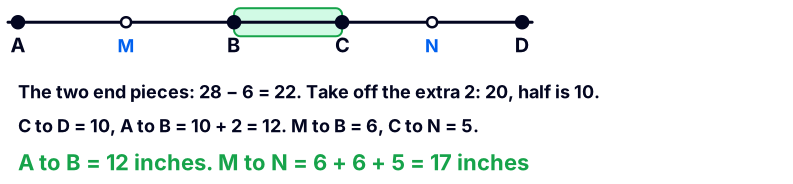
The two end pieces, A to B and C to D, make 28 − 6 = 22 inches. A to B is 2 longer, so take the extra 2 away: 20, and half is 10. C to D is 10 and A to B is 12. M is halfway along A to B, so M to B is 6. N is halfway along C to D, so C to N is 5. M to N is 6 + 6 + 5 = 17 inches!
For the grown-up: this is a “sum and difference” inside a picture: the whole minus the middle gives the sum of the end pieces, and “2 longer” gives their difference. Then the middle piece and the two half-pieces add up. Check: 12 + 6 + 10 = 28 and 12 − 10 = 2. Common wrong answer: 11 (sharing 22 equally), or 22 for M to N (adding whole end pieces: 6 + 6 + 10).
Problem 5
Problem 5: Answer 92
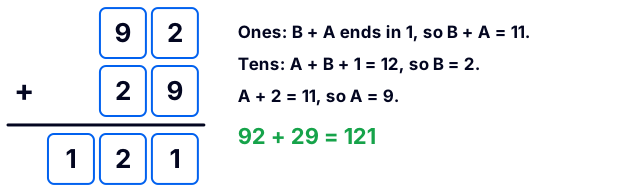
Ones: B + A must end in 1, so B + A = 11, carry 1. Tens: A + B + 1 = 12. The middle digit B is 2, so A is 9. AB is 92!
For the grown-up: both columns add the same two digits, A and B. The ones column must end in 1, and two different digits can’t add to 1, so they add to 11 and carry 1. Then the tens column is 11 + 1 = 12: write 2, carry 1, which gives 121, so B = 2 and A = 11 − 2 = 9. Check: 92 + 29 = 121, and the middle digit is B = 2. Common wrong answer: 29 (the number BA), or 11 (A + B instead of the number AB).
Problem 6
Problem 6: Answer 10 crayons
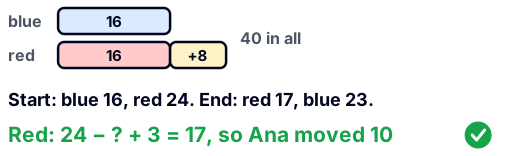
Take away the red box’s 8 extra: 40 − 8 = 32, half is 16. So blue has 16 and red has 24. At the end blue is 6 ahead, still with 40 in all: 40 − 6 = 34, half is 17, so red ends with 17. Red: 24, minus Ana’s crayons, plus Ben’s 3, is 17. 24 + 3 = 27, and 27 − 10 = 17: Ana moved 10!
For the grown-up: moving crayons keeps the total at 40, so the sum-and-difference split works before (red 24, blue 16) and after (red 17, blue 23). Then follow the red box through both moves. Or: each crayon moved changes the gap by 2, so 14 needs 7 net from red, and Ana moved 7 + 3. Common wrong answer: 7 (forgetting Ben’s 3), or 14 (8 + 6).
Problem 7
Problem 7: Answer Monday, July 15

100 days is 14 weeks (98 days) and 2 more. Saturday + 2 days is Monday. April 6 to April 30 is 24 days, May adds 31 (55), June adds 30 (85). 100 − 85 = 15 more days: July 15!
For the grown-up: two separate jobs. For the weekday, whole weeks don’t change it, so only the 2 days left over count: Sunday, Monday. For the date, count to the end of each month: 24 to April 30, then whole months while they fit, then the days left. Common wrong answer: Saturday (thinking 100 days is whole weeks), or July 14 or 16 (counting April 6 itself, or giving May only 30 days).
Problem 8
Problem 8: Answer 7 children
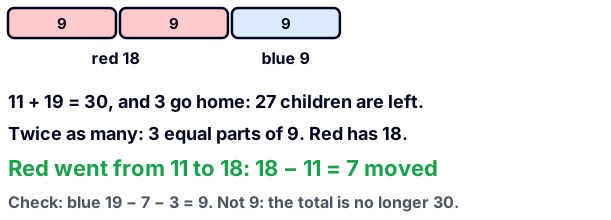
There are 11 + 19 = 30 children, and 3 go home, so 27 are left on the buses. Twice as many: red has 2 parts, blue has 1 part. 3 parts make 27, so a part is 9. Red has 18 now: 18 − 11 = 7!
For the grown-up: moving children from bus to bus keeps the total, but the 3 who go home take it from 30 to 27. “Red has twice as many as blue” splits 27 into 3 equal parts (red 2, blue 1), each 9. Red grew from 11 to 18, so 7 children moved. Check: blue 19 − 7 − 3 = 9 and red 11 + 7 = 18, which is twice 9. Common wrong answer: 9 (splitting the old total of 30), or 6 (taking the 3 off the red bus).
Problem 9
Problem 9: Answer 1 and 7 nickels
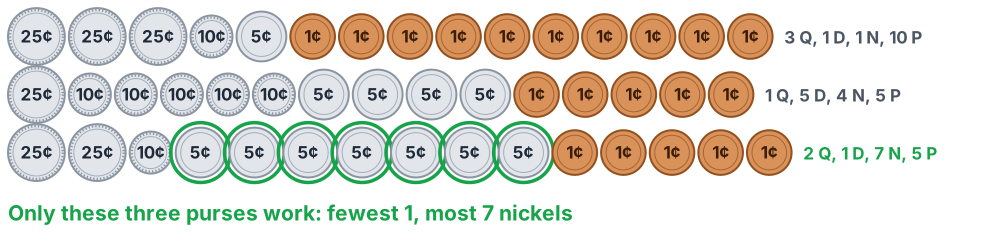
Quarters, dimes and nickels always make a number ending in 0 or 5, and $1.00 = 100¢ ends in 0, so there are 5 or 10 pennies (15 leaves no room). 10 pennies: 5 coins make 90¢, which only works as 3 quarters, 1 dime, 1 nickel. 5 pennies: 10 coins make 95¢: 1 quarter, 5 dimes, 4 nickels, or 2 quarters, 1 dime, 7 nickels (3 quarters is too much). The fewest nickels is 1 and the most is 7!
For the grown-up: settle the pennies first, then try 1, 2, 3 quarters, swapping nickels for dimes. Check: 50 + 10 + 35 + 5 = 100¢ in 15 coins. Common wrong answer: 4 (stopping at the first purse found).
Problem 10
Problem 10: Answer 7 questions
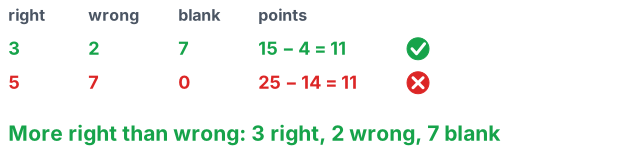
Right answers make a number of 5s. 11 + 2 for each wrong answer must be a number of 5s: 2 wrong gives 15 (3 right), 7 wrong gives 25 (5 right). 5 right and 7 wrong has more wrong than right, so Nora has 3 right and 2 wrong. 12 − 5 = 7 blank!
For the grown-up: right answers give 5, 10, 15, … points: the score plus 2 per wrong answer. Only 2 or 7 wrong fit in 12 questions, and “more right than wrong” picks 2. Check: 15 − 4 = 11. Common wrong answer: 0 (the other fit), or 2 (the number wrong).
More CML practice for grade 2
For more at this level, our CML Grade 2 prep guide has 14 chapters, 140 original write-in problems and six full practice meets, with a free sample to try first. CML lets a child enter at or above their own grade, so a confident second grader can also try the Grade 3 set. Practice for the other grades: Grade 3 · Grade 4 · Grade 5 · Grade 6 · Grade 7 · Grade 8. All seven grades, and two full practice meets, are on our Continental Math League practice problems page. For how the season works, read our CML parent’s guide and how to prepare for CML.
This guide is not affiliated with or endorsed by Continental Mathematics League. “Continental Mathematics League” is a trademark of its respective owners.