
Free practice
CML Practice Problems: Grade 4 (Continental Math League)
Ten original Continental Math League problems for grade 4, pitched at the Pythagorean division, with every answer explained.
CML full prep and practice guides: 2 2–6
Free practice, other grades: 2 3 5 6 7 8
Other contests, grade 4: Math Kangaroo 3–4 Noetic 4 MOEMS Div E
Printable PDF: all 10 problems with room to work, then every answer explained.
On this page · 3 sections
Ten original practice problems for the Continental Math League (CML) Grade 4 meets, written by us. None comes from a real CML paper. Every one has a worked solution, with a note for you on the most common wrong answer.
Grade 4 is the first year CML runs 5 meets a season, each with 6 problems in 30 minutes. From grade 4 up, CML writes two papers for each grade: the Euclidean division, with questions that call for average reading comprehension and reasoning, and the Pythagorean division, which calls for above-average reading and reasoning. A student sits one of them, never both. Our Euclidean vs Pythagorean guide helps you choose. This set is pitched at the Pythagorean paper, so if your child sits Euclidean, expect it to feel harder than a real meet.
Every answer is written in. Problems 2, 5, 9 and 10 ask for two answers, and CML’s answer keys give credit only when both are right. The set is ramped: problems 1–3 warm up, 4–8 are at meet level, and the two ★ Challenges are as hard as the hardest Grade 5 problems. Expect a made-up symbol, a ferry timetable, hidden digits, a square cut into rectangles and two runners on a track.
One way to use it: a 30-minute timed run of problems 1–6, like a real meet, then 7–10 untimed on another day. Five minutes a problem goes quickly, so watch where your child gets stuck, not only what they get wrong.
The 10 problems
Problem 1
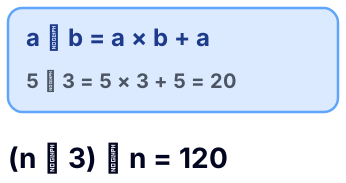
a ◎ b means a × b + a. For example, 5 ◎ 3 = 5 × 3 + 5 = 20. If (n ◎ 3) ◎ n = 120, what number is n?
Problem 2
The first ferry of the day leaves the dock at 6:40 a.m., and then a ferry leaves every 25 minutes. Mia gets to the dock at 9:12 a.m. How many ferries have already left, and how many minutes must she wait for the next one? Both parts must be right.
Tip: When a time keeps adding minutes, watch for crossing the hour.
Problem 3
In the four-digit number 2A5B, the letters A and B stand for digits (they may be the same). The number is a multiple of 36. What is the largest number it could be?

Fact: 36 = 4 × 9. A number is a multiple of 9 when its digits add up to a multiple of 9.
Problem 4
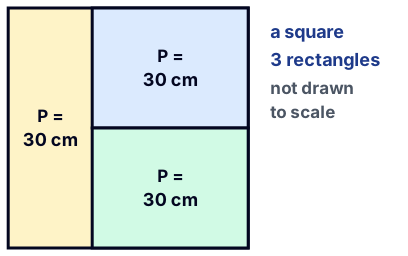
A square is cut into three rectangles, as shown: one cut from top to bottom, then one cut across the right-hand part. All three rectangles have a perimeter of 30 cm. What is the area of the square?
Problem 5
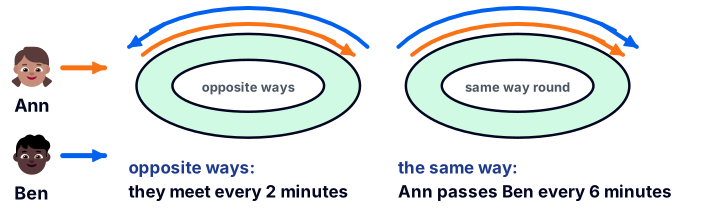
Ann and Ben run laps of a track at steady speeds, Ann faster. Running opposite ways, they meet every 2 minutes. Running the same way, Ann passes Ben every 6 minutes. How many minutes does each take for one lap? Both parts must be right.
Problem 6
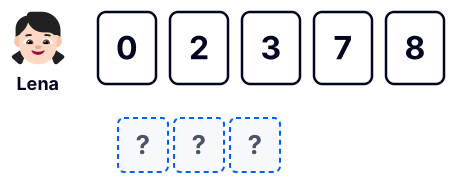
Lena has five digit cards: 0, 2, 3, 7 and 8. She puts three different cards in a row to make a three-digit number (it can’t start with 0). How many different three-digit numbers can she make that are multiples of 6?
Fact: A multiple of 6 is even, and its digits add up to a multiple of 3.
Problem 7
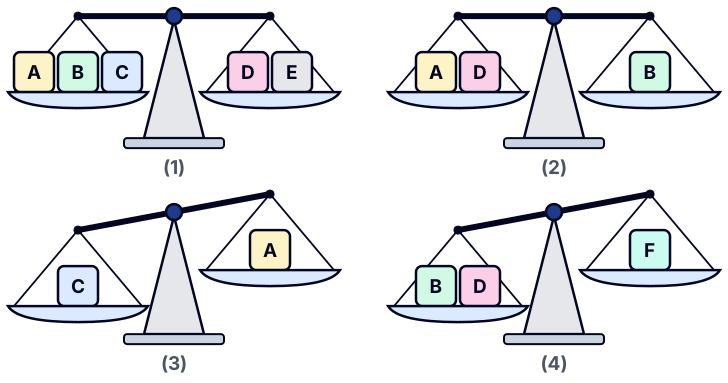
Boxes A, B, C, D, E and F weigh 1, 2, 3, 4, 5 and 6 kg, a different weight each. The four balances show how some of the boxes compare; a pan that hangs lower holds more weight. How much does box F weigh?
Problem 8
On a book, Nadia spends one-quarter of her money and $2 more. On lunch, she spends one-half of what she has left and $5 more. Her lunch cost $6 more than her book. How much money did she start with?
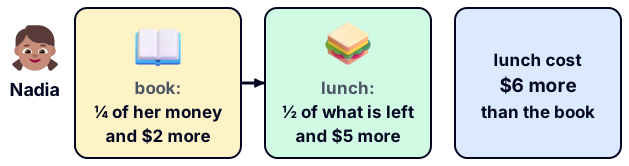
Tip: Draw the money as a bar cut into equal parts.
Problem 9
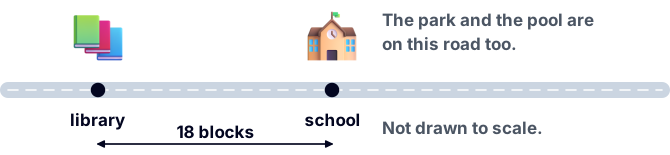
★ Challenge. On a straight road, the school is 18 blocks from the library. The park is on the same road, and it is twice as far from the library as it is from the school. The pool is halfway between the school and the park. How far is the pool from the library? There are two answers. Both must be right.
Problem 10
★ Challenge. Ana’s house is 4 miles from Ben’s house, Ben’s house is 10 miles from Cal’s house, and Cal’s house is 3 miles from Dee’s house. These are straight-line distances, and the four houses do not have to lie on one straight line. What are the greatest and the least possible distances from Ana’s house to Dee’s house? Both must be right.
Solutions
Problem 1
Problem 1: Answer 5
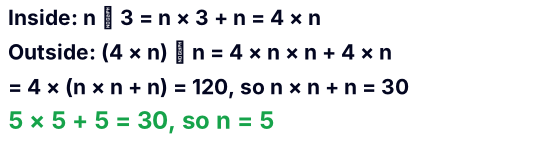
Inside first: n ◎ 3 = n × 3 + n = 4 × n. Then (4 × n) ◎ n = 4 × n × n + 4 × n = 4 × (n × n + n) = 120. So n × n + n = 30, and 5 × 5 + 5 = 30: n = 5!
For the grown-up: a defined operation turns up on nearly every CML paper. The rule is not the same both ways round (a ◎ b adds a, not b), so the bracket must be worked first and the result used as the new a. Writing the bracket as 4 × n turns the whole left side into 4 × (n × n + n); then a short guess-and-check finds n, because n × n + n grows quickly (2 → 6, 3 → 12, 4 → 20, 5 → 30). Check: 5 ◎ 3 = 15 + 5 = 20, and 20 ◎ 5 = 100 + 20 = 120. Common wrong answer: 30 (stopping at n × n + n = 30), or 6 (guessing from n × n ≈ 30 and forgetting the + n).
Problem 2
Problem 2: Answer 7 ferries and 23 minutes
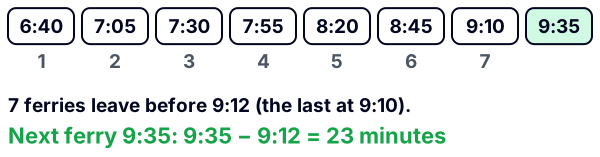
Ferries leave at 6:40, 7:05, 7:30, 7:55, 8:20, 8:45 and 9:10: 7 ferries before Mia arrives. The next one is at 9:35, and 9:12 to 9:35 is 23 minutes!
For the grown-up: adding 25 minutes at a time crosses the hour every few steps, so write each time carefully (7:55 + 25 = 8:20). Faster: 6:40 to 9:12 is 152 minutes = 6 gaps of 25 and 2 minutes, so 9:10 is the 7th bus. Both parts must be right, as on the real paper. Common wrong answer: 6 ferries (counting the gaps, not the ferries), or 22 or 25 minutes (slips crossing the hour).
Problem 3
Problem 3: Answer 2952
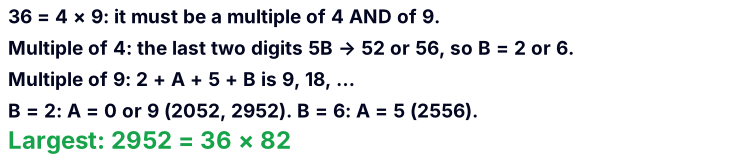
36 = 4 × 9. For 4, the last two digits 5B must be a multiple of 4: 52 or 56. For 9, the digits must add to a multiple of 9. With B = 2: 2 + A + 5 + 2 = 9 + A, so A = 0 or 9. With B = 6: A = 5. The largest is 2952!
For the grown-up: 4 and 9 share no factor, so being a multiple of both is the same as being a multiple of 36. Each test fixes one letter: the last two digits decide divisibility by 4, and the digit sum decides divisibility by 9. That gives 2052, 2952 and 2556; compare them. Check: 2952 = 36 × 82. Common wrong answer: 2556 (trying only B = 6, which looks bigger), or 2052 (taking the first A that works).
Problem 4
Problem 4: Answer 144 square cm
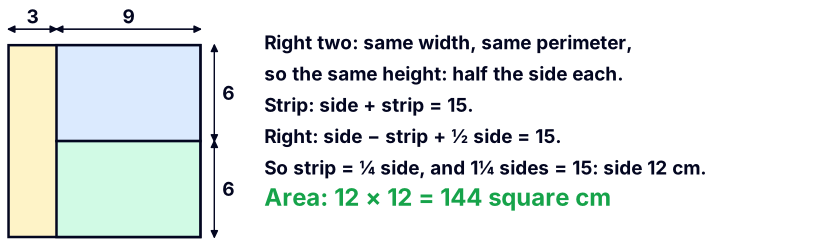
The two right-hand rectangles are equally wide and have equal perimeters, so they are equally tall: each is half the side. Half a perimeter is 15 cm. Left strip: side + strip = 15. Top right: (side − strip) + half the side = 15. So the strip is a quarter of the side, and side + a quarter side = 15: the side is 12 cm. Area 12 × 12 = 144 square cm!
For the grown-up: half of each perimeter is one length plus one width, 15 cm. Comparing the two rectangles on the right shows their heights are equal, so each is half the side. Comparing the left strip (side + strip) with a right rectangle (side − strip + half the side) shows that two strips make half a side, so a strip is a quarter of the side, and five quarters of the side are 15 cm. The picture is not to scale on purpose: the lengths come from the perimeters, not from a ruler. Check: 12 by 3 gives 2 × 15 = 30, and 9 by 6 gives 2 × 15 = 30. Common wrong answer: 225 (taking 15 cm as the side), or 100 (guessing the side 10 from 30 ÷ 3).
Problem 5
Problem 5: Answer Ann 3 minutes, Ben 6 minutes
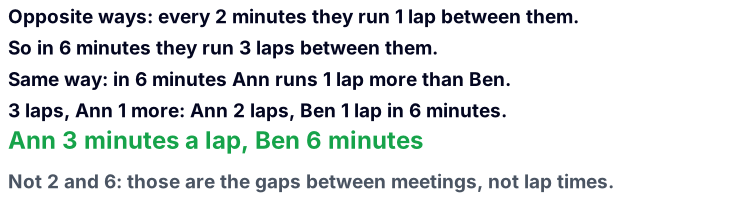
Running opposite ways, every 2 minutes they run 1 lap between them, so in 6 minutes they run 3 laps. Running the same way, in 6 minutes Ann runs 1 lap more than Ben. 3 laps with Ann 1 ahead: Ann 2, Ben 1. Ann: 3 minutes a lap, Ben: 6 minutes!
For the grown-up: when two runners go opposite ways, they meet each time their distances add up to one more lap; when they go the same way, the faster passes each time she gains one lap. Put both facts on the same 6 minutes: total 3 laps, difference 1 lap, so 2 laps and 1 lap (sum and difference). Check: in 2 minutes Ann runs ⅔ lap and Ben ⅓, together 1 lap; in 6 minutes Ann runs 2 laps and Ben 1, a gain of 1 lap. Common wrong answer: 2 and 6 (taking the gaps between meetings as the lap times), or Ann 6 and Ben 3 (swapping the two lap times: the faster runner has the shorter lap).
Problem 6
Problem 6: Answer 10 numbers
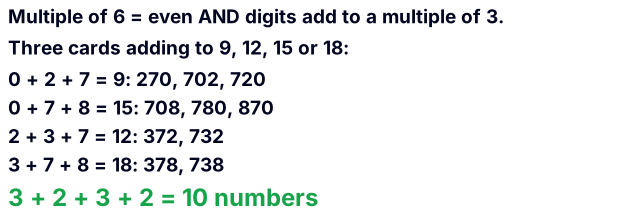
A multiple of 6 is even and its digits add to a multiple of 3. The three-card sets that add to 9, 12, 15 or 18 are 0 2 7, 2 3 7, 0 7 8 and 3 7 8. Now make even numbers with no 0 in front: 270, 702, 720; 372, 732; 708, 780, 870; 378, 738. That is 10!
For the grown-up: split the two tests. The digit-sum test picks which three cards can be used together; the even test decides which card goes last; then the “no 0 in front” rule removes a few. Doing it set by set keeps the list short and checkable. Check one: 708 = 6 × 118. Common wrong answer: 12 (also counting 072 and 078, which start with 0), or numbers that are even but whose digits do not add to a multiple of 3, such as 238.
Problem 7
Problem 7: Answer 3 kg
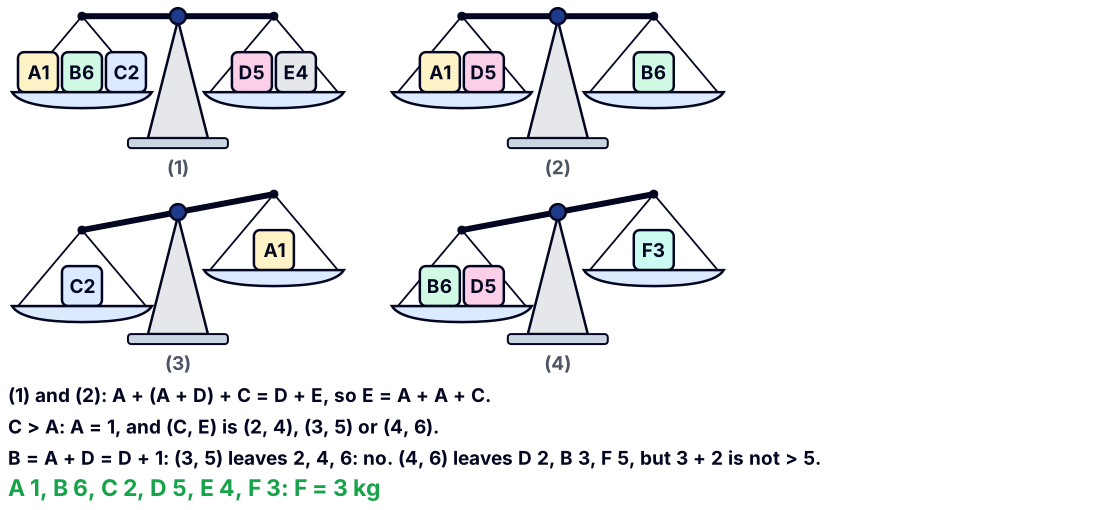
Balance 2 says B = A + D. Put that into balance 1: A + A + D + C = D + E, and taking D off both sides leaves E = A + A + C. C is heavier than A, and E is at most 6, so A = 1 and (C, E) is (2, 4), (3, 5) or (4, 6). B = D + 1, so B and D are two weights in a row. (3, 5) leaves 2, 4, 6: no two in a row. (4, 6) leaves 2, 3, 5: D 2, B 3, F 5, but then B + D = 5 is not heavier than F. (2, 4) leaves 3, 5, 6: D 5, B 6, F 3, and 6 + 5 is heavier than 3. F is 3 kg!
For the grown-up: put one level balance into the other to get a short rule (E = 2 × A + C), then list the few cases and let the other balances knock them out. Every balance is needed: without the last one, F could also be 5. Check: 1 + 6 + 2 = 5 + 4; 1 + 5 = 6; 2 > 1; 6 + 5 > 3. Common wrong answer: 5 (the (4, 6) case, missing balance 4), or 6 (box B).
Problem 8
Problem 8: Answer $32
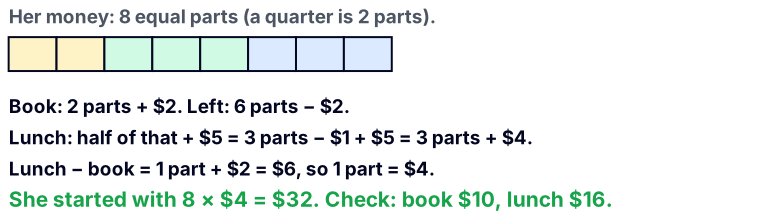
Cut her money into 8 equal parts, so a quarter is 2 parts. The book cost 2 parts + $2, which leaves 6 parts − $2. Lunch was half of that, 3 parts − $1, and $5 more: 3 parts + $4. Lunch cost 1 part + $2 more than the book, and that is $6, so 1 part is $4. She started with 8 × $4 = $32!
For the grown-up: the story doesn’t say how it ends, so working backwards won’t start; equal parts (or trying amounts that are multiples of 8) will. Check: $32 → book $8 + $2 = $10, leaving $22 → lunch $11 + $5 = $16, and $16 − $10 = $6. Common wrong answer: $48 (taking 1 part as $6), or $16 (the lunch).
Problem 9
Problem 9: Answer 15 blocks and 27 blocks
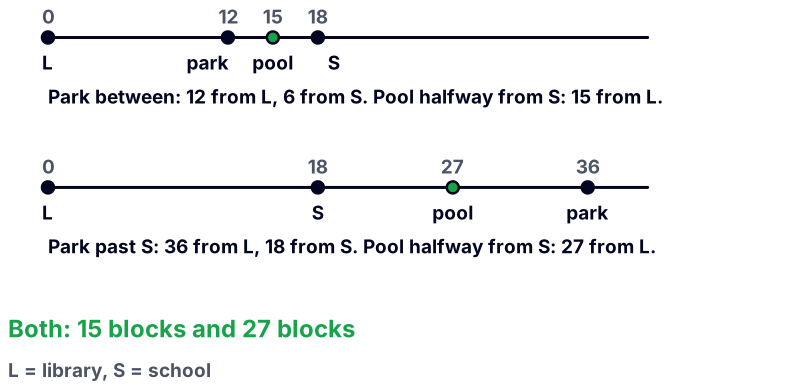
The park is nearer the school than the library, so it is between them or past the school. Between: split 18 into 2 parts and 1 part, so the park is 12 from the library, and the pool is halfway from 18 to 12, at 15. Past the school: the park is as far past the school as the school is from the library, so it is 36 away, and the pool is halfway from 18 to 36, at 27. 15 and 27 blocks!
For the grown-up: “twice as far from the library as from the school” has two places on a line: one between them (splitting 18 into 12 and 6) and one beyond the school (36 and 18). It cannot be on the far side of the library, where it would be closer to the library. Then each case gives its own halfway point. Check: 12 = 2 × 6 and 36 = 2 × 18; (18 + 12) ÷ 2 = 15 and (18 + 36) ÷ 2 = 27. Common wrong answer: only 15 (missing the place past the school), or 24 and 6 (halfway between the library and the park instead of the school and the park).
Problem 10
Problem 10: Answer 17 miles and 3 miles
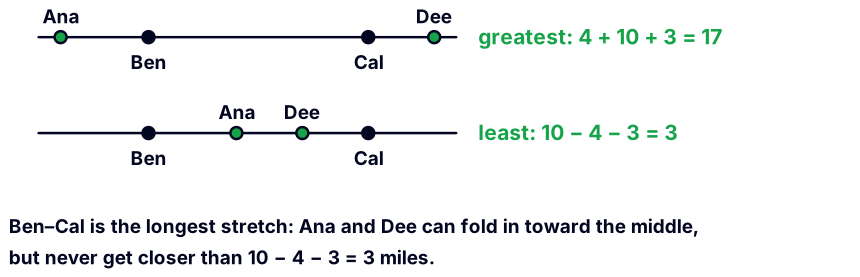
Greatest: put the houses in a line, Ana and Dee on the outsides: 4 + 10 + 3 = 17 miles. Least: Ben to Cal is the long stretch, 10 miles. Ana can be at most 4 miles in from Ben’s end and Dee at most 3 miles in from Cal’s end, so they are still at least 10 − 4 − 3 = 3 miles apart!
For the grown-up: a path never gets shorter by bending, so the farthest Ana and Dee can be is the whole path laid out straight. For the least, the key is which distance is longest: the 10-mile Ben–Cal stretch cannot be covered by the 4 and 3 miles hanging off its ends, so Ana and Dee cannot meet; folding both short pieces inward along the line leaves 3 miles. (If the longest were one of the end pieces, the answer would change, which is why the order matters.) Common wrong answer: 0 or 1 (thinking the houses could meet, or computing 4 − 10 − 3 and “fixing” the sign), 9 (folding only one side: 10 − 4 + 3), or only 17.
More CML practice for grade 4
For more at this level, our CML prep guide for Grades 2–6 covers the strategies behind each kind of problem, with original practice problems and full practice meets, and a free sample to try first. Practice for the other grades: Grade 2 · Grade 3 · Grade 5 · Grade 6 · Grade 7 · Grade 8. All seven grades, and two full practice meets, are on our Continental Math League practice problems page. For how the season works, read our CML parent’s guide and how to prepare for CML.
This guide is not affiliated with or endorsed by Continental Mathematics League. “Continental Mathematics League” is a trademark of its respective owners.