Free practice
CML Practice Problems: Grade 6 (Continental Math League)
Ten original Continental Math League problems for grade 6, pitched a notch above the Pythagorean division, with every answer explained.
CML full prep and practice guides: 2 2–6
Free practice, other grades: 2 3 4 5 7 8
Other contests, grade 6: Math Kangaroo 5–6 Noetic 6 MOEMS Div E MOEMS Div M AMC 8
Printable PDF: all 10 problems with room to work, then every answer explained.
On this page · 3 sections
Ten original practice problems for the Continental Math League (CML) Grade 6 meets, written by us. None comes from a real CML paper. Every one has a worked solution, with a note for you on the most common wrong answer.
A sixth grader’s CML season is 5 meets, each with 6 problems in 30 minutes. From grade 4 up, CML writes two papers for each grade: the Euclidean division, with questions that call for average reading comprehension and reasoning, and the Pythagorean division, which calls for above-average reading and reasoning. A student sits one of them, never both. Our Euclidean vs Pythagorean guide helps you choose. This set is pitched a notch above the Pythagorean paper, so most children will find it harder than a real meet. That is on purpose.
Every answer is written in. Problem 1 asks for two answers, and CML’s answer keys give credit only when both are right; problem 3 wants a mixed number. The set is ramped: problems 1–3 warm up, 4–8 are at meet level, and the two ★ Challenges are as hard as the hardest Grade 7 problems. Expect factor counting, clock hands, areas of triangles, remainders and a careful count of triangles.
One way to use it: a 30-minute timed run of problems 1–6, like a real meet, then 7–10 untimed on another day. A 6th grader can usually check their own work; ask them to check one answer a different way before turning to the solutions.
The 10 problems
Problem 1
In this problem, a ▲ b means a × a − 2 × b. For example, 5 ▲ 3 = 25 − 6 = 19. There are two whole numbers n that make (3 ▲ n) ▲ 1 = 47 true. They are ___ and ___. Both must be right.
Problem 2
A whole number N is made by multiplying only 2s and 3s together, using at least one of each. N has exactly 12 factors, and 2 × N has exactly 15 factors. What is N?
Fact: The factors of a number are the whole numbers that divide it exactly. 12 has 6 factors: 1, 2, 3, 4, 6 and 12.
Problem 3
At 2:00 the hour hand of a clock points at 2 and the minute hand at 12. Both hands move steadily. How many minutes after 2:00 is the first time that the two hands make a right angle (90°)? Give your answer as a mixed number.
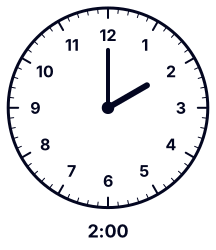
Fact: The minute hand turns 6° every minute.
Problem 4
How many whole numbers less than 100 have exactly 6 factors?
Problem 5
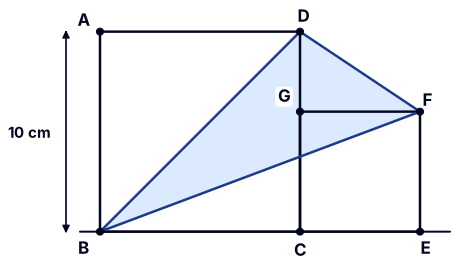
Square ABCD has sides of 10 cm. Square CEFG sits beside it on the same line, as shown, but its size is not given. What is the area of the shaded triangle BDF?
Problem 6
Mrs. Lee hands out 12 identical stickers to her 4 students, Ana, Ben, Cal and Dee. She gives out every sticker, each student gets at least 1, and no student gets more than 4. In how many different ways can she do it? (Two ways are different if some student gets a different number of stickers.)
Problem 7
Grandma shares a bag of plums among her grandchildren. The first child takes 1 plum and then one-seventh of the plums left in the bag. The second child takes 2 plums and then one-seventh of the plums left. The third takes 3 plums and then one-seventh of those left, and so on, until the last child takes the plums that are left and the bag is empty. Every child gets the same number of plums. How many plums were in the bag?
Problem 8
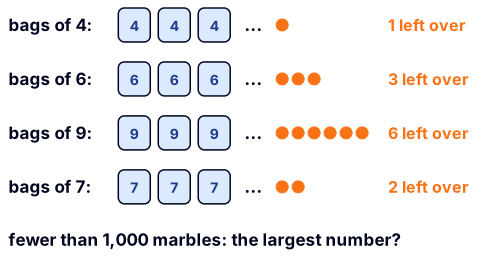
Mrs. Diaz has fewer than 1,000 marbles. When she packs them in bags of 4, 1 marble is left over. In bags of 6, 3 are left over. In bags of 9, 6 are left over. In bags of 7, 2 are left over. What is the largest number of marbles she could have?
Problem 9
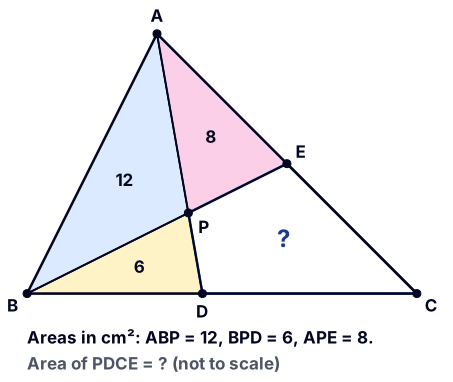
★ Challenge. In triangle ABC, point D is on side BC and point E is on side AC. Segments AD and BE cross at P, and they cut the triangle into three triangles and a four-sided shape. Triangle ABP has an area of 12 cm², triangle BPD has an area of 6 cm², and triangle APE has an area of 8 cm². What is the area of the four-sided shape PDCE?
Problem 10
★ Challenge. A triangle has sides that are whole numbers of centimeters and a perimeter of 30 cm. Two triangles with the same three side lengths count as one. How many of these triangles are acute, with all three angles smaller than 90°?
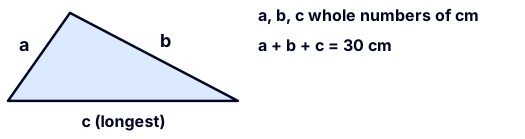
Fact: With c the longest side, the triangle is acute when c² < a² + b².
Solutions
Problem 1
Problem 1: Answer 1 and 8
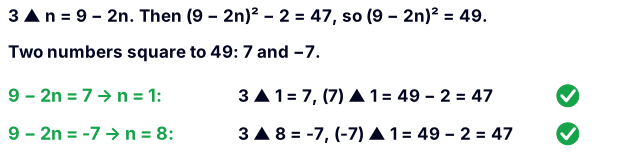
3 ▲ n = 9 − 2n. Then (9 − 2n) ▲ 1 = (9 − 2n)² − 2 = 47, so (9 − 2n)² = 49. Both 7 and −7 square to 49: n = 1 or n = 8.
Why it works: work from the inside out. The inner part, 3 ▲ n, is 3 × 3 − 2n = 9 − 2n. Using that as the first number of the outer ▲ squares it and takes away 2 × 1 = 2. A number whose square is 49 is 7 or −7, and a negative first number is allowed: when n = 8 the inner part is 9 − 16 = −7, and (−7) × (−7) = 49. Check: 3 ▲ 8 = −7 and (−7) ▲ 1 = 49 − 2 = 47; 3 ▲ 1 = 7 and 7 ▲ 1 = 47. Common wrong answer: 1 alone (missing the negative square root), or 7 (stopping at 9 − 2n = 7, the inner value, not n).
Problem 2
Problem 2: Answer 72
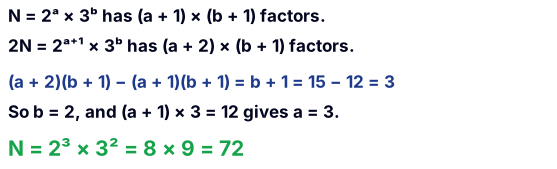
Write N = 2ᵃ × 3ᵇ. It has (a + 1)(b + 1) = 12 factors, and 2N = 2ᵃ⁺¹ × 3ᵇ has (a + 2)(b + 1) = 15. The difference is b + 1 = 3, so b = 2, then a + 1 = 4 and a = 3. N = 2³ × 3² = 72.
Why it works: a factor of 2ᵃ × 3ᵇ picks how many 2s (0 to a, so a + 1 choices) and how many 3s (b + 1 choices). Doubling N gives one more choice for the 2s, which adds one whole row of b + 1 factors. Check: 72 has 1, 2, 3, 4, 6, 8, 9, 12, 18, 24, 36, 72 (12 factors), and 144 = 12 × 12 has 15. Common wrong answer: 144 (that is 2N), or 96 = 2⁵ × 3 (it has 12 factors, but 192 has 14, not 15).
Problem 3
Problem 3: Answer 27 3/11 minutes after 2:00
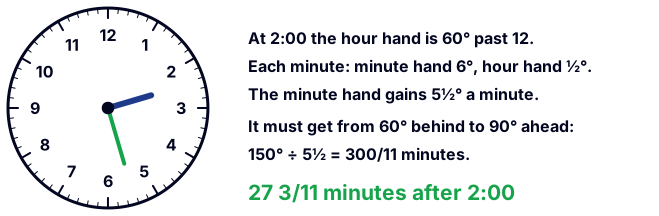
At 2:00 the minute hand is 60° behind the hour hand. Each minute it gains 6° − ½° = 5½°. To be 90° ahead it must gain 60° + 90° = 150°: 150 ÷ 5½ = 300/11 = 27 3/11 minutes.
Why it works: think of the minute hand chasing the hour hand. While it is still behind, the angle between them shrinks (at 2:10 they almost meet), so the first right angle comes after the minute hand has passed the hour hand. Check: after 300/11 minutes the minute hand is at 6 × 300/11 = 163 7/11° and the hour hand at 60 + 150/11 = 73 7/11°, which is 90° apart. Common wrong answer: 25 (putting the minute hand at the 5 and forgetting that the hour hand moves on), 30 (the hands at 2:30 are 105° apart), or 5 5/11 (thinking the 60° gap grows from the start: it shrinks first, to 0 near 2:11).
Problem 4
Problem 4: Answer 16 numbers
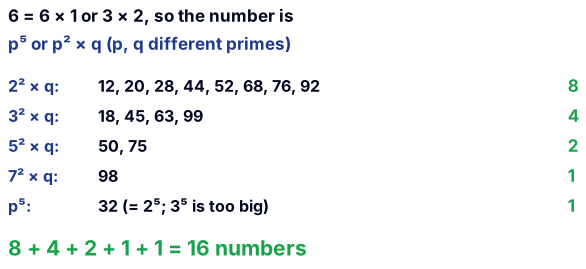
The number of factors comes from the prime powers: 6 = 6 or 3 × 2, so the number is p⁵ or p² × q with p and q different primes. Under 100: 4 × q for q = 3, 5, 7, 11, 13, 17, 19, 23 (8 numbers), 9 × q for q = 2, 5, 7, 11 (4), 25 × 2 and 25 × 3 (2), 49 × 2 (1), and 2⁵ = 32 (1). In all 16.
Why it works: a factor of p^a × q^b picks a power of p (a + 1 ways) and a power of q (b + 1 ways), so the count of factors is (a + 1)(b + 1)…; it is 6 only for exponents 5, or 2 and 1. Then list by the squared prime and keep the products under 100. Check one: 98 = 2 × 7 × 7 has factors 1, 2, 7, 14, 49, 98. Common wrong answer: 15 (missing 32 = 2⁵), or 14 (also missing 98), or 12 (using only q bigger than p).
Problem 5
Problem 5: Answer 50 cm²
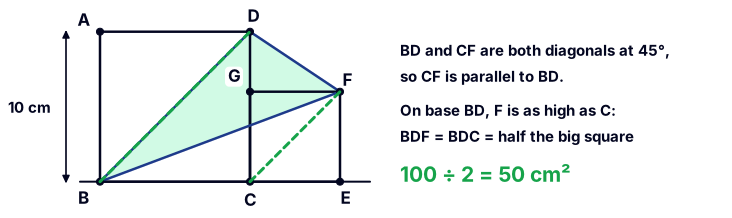
The diagonals BD and CF are parallel, so F is exactly as far from line BD as C is. Triangle BDF therefore has the same area as triangle BDC, half of 10 × 10: 50 cm².
Why it works: with BD as the base, the area depends only on the height, the distance from the third corner to line BD. BD and CF both make 45° with line BE, so they are parallel, and every point of CF, F included, is at the same distance from BD. The small square’s size never matters. Check with a small square of side 6, by coordinates B = (0, 0), D = (10, 10), F = (16, 6): area = ½ × |10 × 6 − 10 × 16| = 50. Common wrong answer: “it can’t be found” (the small side is not needed), or 100 (the whole big square).
Problem 6
Problem 6: Answer 31 ways
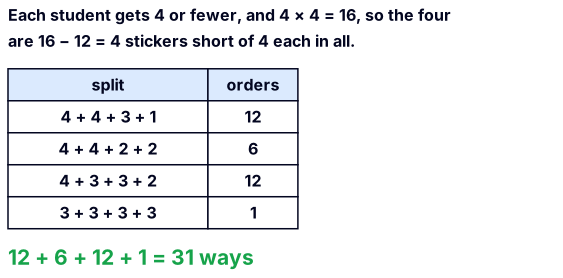
Sort by the numbers given, largest first: 4 + 4 + 3 + 1, 4 + 4 + 2 + 2, 4 + 3 + 3 + 2 and 3 + 3 + 3 + 3. Then count who gets which: 12, 6, 12 and 1 ways. 12 + 6 + 12 + 1 = 31.
Why it works: first find the different splits of 12 into four numbers from 1 to 4, then count the ways to hand each split to four named students. For 4, 4, 3, 1: choose who gets the 3 (4 ways) and who gets the 1 (3 ways), 12. For 4, 4, 2, 2: choose the two who get 4, 6 ways. For 4, 3, 3, 2: 4 × 3 = 12. For 3, 3, 3, 3: 1. Another way: 4 × 4 = 16, so the students are 4 stickers short of 4 each in all, and no one is short by more than 3 (everyone gets at least 1). Common wrong answer: 4 (the splits, forgetting that the students are different), or 35 (forgetting that no one can be short by 4, that is, get 0).
Problem 7
Problem 7: Answer 36 plums
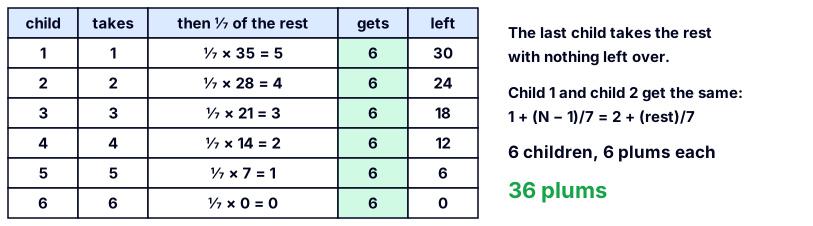
The first two children get the same. Call the plums N. Child 1 gets 1 + (N − 1)/7. Try N − 1 = 35 (a multiple of 7): child 1 gets 6, leaving 30; child 2 gets 2 + 28/7 = 6, leaving 24. It keeps working: 6 each for 6 children, 36 plums.
Why it works: every child gets the same, so each next child’s “extra one plum” must be paid for by a smaller seventh: the seventh shrinks by exactly 1 from one child to the next. From the first two children: 1 + (N − 1)/7 = 2 + (N − 1 − share)/7, which gives a share of 6 and N = 36. Check the last child: 6 plums left, child 6 takes 6 and one-seventh of 0. Common wrong answer: 6 (the number of children, or each child’s share), or 42 (6 × 7, thinking of sevenths of the whole bag).
Problem 8
Problem 8: Answer 933 marbles
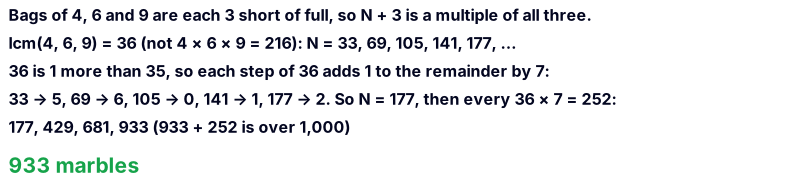
In bags of 4, 6 and 9 she is 3 marbles short of full bags each time, so N + 3 is a multiple of 4, 6 and 9, that is of 36: N = 33, 69, 105, 141, 177, … Now bags of 7: 36 is 1 more than 35, so each step adds 1 to the remainder. 33 leaves 5, so 177 (four steps on) leaves 2. After that, N repeats every 36 × 7 = 252: 177, 429, 681, 933. The largest under 1,000 is 933.
Why it works: “1 left in bags of 4, 3 in bags of 6, 6 in bags of 9” all mean “3 short”, which joins them into one condition. 4, 6 and 9 share factors, so the pattern repeats every lcm = 36 marbles, not every 216. Check: 933 = 4 × 233 + 1 = 6 × 155 + 3 = 9 × 10³ + 6 = 7 × 133 + 2. Common wrong answer: 177 (the smallest), 681 (stopping one step early), or an answer built on 216 instead of 36.
Problem 9
Problem 9: Answer 19 cm²
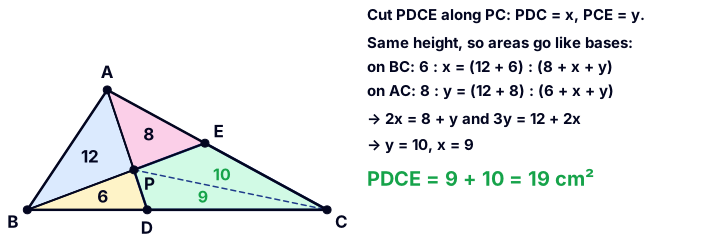
Draw PC, cutting the shape into PDC = x and PCE = y. Triangles with the same height have areas in the ratio of their bases. On BC, from P: BPD : PDC = BD : DC, and from A: ABD : ADC = BD : DC. So 6 : x = 18 : (8 + x + y), which gives 2x = 8 + y. On AC, from P: APE : PCE = AE : EC, and from B: ABE : CBE = AE : EC. So 8 : y = 20 : (6 + x + y), which gives 3y = 12 + 2x = 20 + y. So y = 10, x = 9, and PDCE = 19 cm².
Why it works: each side ratio can be seen from two corners (from P and from the far vertex), and the two views must agree; that gives two equations for the two hidden pieces. Check: AP : PD = 12 : 6 = 2 : 1 and BP : PE = 12 : 8 = 3 : 2; the whole triangle is 12 + 6 + 8 + 19 = 45 cm². Common wrong answer: 16 (12 × 8 ÷ 6, as if the shape were a fourth triangle in a grid of ratios), or 14 or 26 (one equation only).
Problem 10
Problem 10: Answer 9 triangles
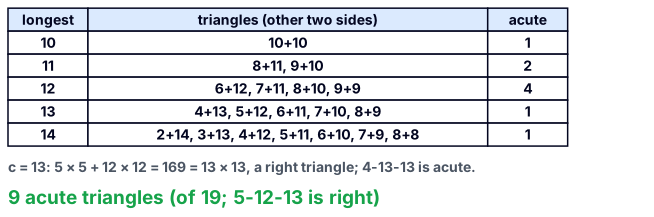
The two shorter sides must add to more than the longest side c, so c is 10 to 14: that gives 1 + 2 + 4 + 5 + 7 = 19 triangles. Test each with c × c against a × a + b × b: all with c = 10, 11 or 12 are acute (7), with c = 13 only 4-13-13 (5-12-13 is exactly right-angled), and with c = 14 only 2-14-14. In all 9.
Why it works: c is at least a third of 30 and less than half of it. For a fixed c, a + b is fixed too, and a × a + b × b grows as a and b spread apart, so for c = 13 and 14 only the most spread-out pairs (4 and 13, 2 and 14) beat c × c; the closer pairs are obtuse. Check: 2 × 2 + 14 × 14 = 200 > 196, but 3 × 3 + 13 × 13 = 178 < 196. Common wrong answer: 10 (counting the right triangle 5-12-13), 19 (all of them), or 12 (the ones with three different sides).
More CML practice for grade 6
For more at this level, our CML prep guide for Grades 2–6 covers the strategies behind each kind of problem, with original practice problems and full practice meets, and a free sample to try first. Practice for the other grades: Grade 2 · Grade 3 · Grade 4 · Grade 5 · Grade 7 · Grade 8. All seven grades, and two full practice meets, are on our Continental Math League practice problems page. For how the season works, read our CML parent’s guide and how to prepare for CML.
This guide is not affiliated with or endorsed by Continental Mathematics League. “Continental Mathematics League” is a trademark of its respective owners.