
Free practice
CML Practice Problems: Grade 8 (Continental Math League)
Ten original Continental Math League problems for grade 8, pitched a notch above the Pythagorean division, with every answer explained.
CML full prep and practice guides: 2 2–6
Free practice, other grades: 2 3 4 5 6 7
Other contests, grade 8: Math Kangaroo 7–8 MOEMS Div M AMC 8
Printable PDF: all 10 problems with room to work, then every answer explained.
On this page · 3 sections
Ten original practice problems for the Continental Math League (CML) Grade 8 meets, written by us. None comes from a real CML paper. Every one has a worked solution, with a note on the most common wrong answer.
An eighth grader’s CML season is 5 meets, each with 6 problems in 30 minutes. From grade 4 up, CML writes two papers for each grade: the Euclidean division, with questions that call for average reading comprehension and reasoning, and the Pythagorean division, which calls for above-average reading and reasoning. A student sits one of them, never both. Our Euclidean vs Pythagorean guide helps you choose. This set is pitched a notch above the Pythagorean paper.
CML’s sample Grade 8 papers include a couple of multiple-choice questions; here every answer is written in, so there are no choices to work back from. Problems 4 and 7 ask for two answers, and CML’s answer keys give credit only when both are right. The set is ramped: problems 1–3 warm up, 4–8 are at meet level, and the two ★ Challenges are as hard as the hardest Grade 9 problems. Expect modular arithmetic, digit reversals, a meeting-walkers rate problem, a paper fold, probability and a telescoping chain.
One way to use it: a 30-minute timed run of problems 1–6, like a real meet, then 7–10 untimed. Several answers here are exact values (a radical, a fraction), so ask for the exact form, not a decimal.
The 10 problems
Problem 1
For any numbers x and y, x ◇ y means xy − x − y + 2. For example, 4 ◇ 5 = 20 − 4 − 5 + 2 = 13. Working from left to right, for how many ordered triples of positive whole numbers (x, y, z) is x ◇ y ◇ z = 25? (Triples in a different order, like (2, 3, 4) and (4, 3, 2), count as different.)
Problem 2
How many whole numbers n from 1 to 100 make n² + 2n + 6 a multiple of 7?
Problem 3
A three-digit number has no zero digits. When it is added to the number formed by reversing its digits, the sum is a perfect square. How many such three-digit numbers are there?
Problem 4
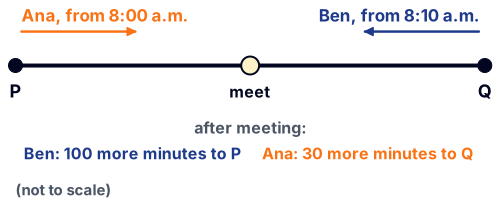
Ana walks from town P to town Q, and Ben walks from Q to P along the same road, each at a steady speed. Ana leaves P at 8:00 a.m., and Ben leaves Q at 8:10 a.m. After they meet, Ana needs 30 more minutes to reach Q, and Ben needs 100 more minutes to reach P. At what time do they meet? How many times as fast as Ben does Ana walk? Both must be right.
Problem 5
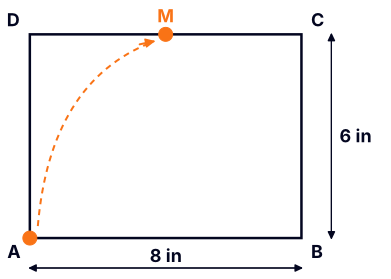
ABCD is a rectangular sheet of paper with AB = 8 in and AD = 6 in. M is the midpoint of side DC. The sheet is folded once so that corner A lands exactly on M, and then pressed flat. How long is the crease? Give an exact answer.
Problem 6
A bag holds only red and blue marbles, with 10 more red marbles than blue ones. Two marbles are drawn at random, without putting the first one back. The probability that the two marbles are the same color is exactly 1/2. How many marbles are in the bag?

Problem 7
When the first digit of a six-digit number is moved to the end (so 123456 would become 234561), the new number is exactly 3 times the original number. There are exactly two such six-digit numbers. What are they?
Problem 8
What is the sum of all real numbers x for which (x² − 7x + 11) raised to the power (x² − 13x + 42) equals 1?
Problem 9
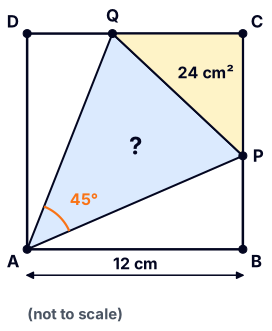
★ Challenge. Square ABCD has sides of 12 cm. Point P is on side BC and point Q is on side CD, so that angle PAQ is 45° and triangle PCQ has an area of 24 cm². What is the area of triangle APQ?
Problem 10
★ Challenge. For any numbers a and b with ab ≠ −1, a △ b means (a + b) ÷ (1 + ab). For example, 1 △ 1/2 = (3/2) ÷ (3/2) = 1. Working from left to right, find 1/2 △ 1/3 △ 1/4 △ 1/5 △ … △ 1/98 △ 1/99, which uses every fraction 1/k from 1/2 to 1/99 in order.

Solutions
Problem 1
Problem 1: Answer 30 triples
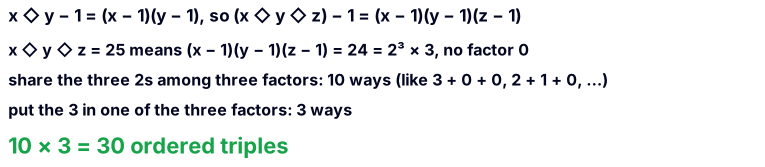
(x ◇ y) − 1 = (x − 1)(y − 1), so (x ◇ y ◇ z) − 1 = (x − 1)(y − 1)(z − 1) = 24 = 2³ × 3. The three 2s can be shared among the three factors in 10 ways, and the 3 goes to one of them in 3 ways: 30.
Why it works: a chain multiplies all the (number − 1)s, and counting prime by prime avoids a long list. Check: 3 ◇ 4 = 7 and 7 ◇ 5 = 35 − 12 + 2 = 25, from 2 × 3 × 4 = 24. Common wrong answer: 8 (the ordered pairs for two numbers), or 6 (unordered triples such as 1 × 1 × 24, 1 × 2 × 12, …).
Problem 2
Problem 2: Answer 29 numbers
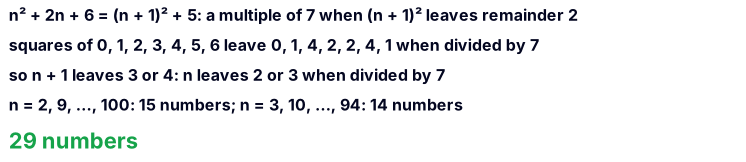
n² + 2n + 6 = (n + 1)² + 5, so it is a multiple of 7 when (n + 1)² leaves remainder 2 on division by 7. The squares of 0 to 6 leave 0, 1, 4, 2, 2, 4, 1, so n leaves 2 or 3: n = 2, 9, …, 100 (15) and n = 3, 10, …, 94 (14), 29 in all.
Why it works: only n’s remainder on division by 7 decides the remainder of n² + 2n + 6, so test seven remainders once, then count. Check: n = 2 gives 14 and n = 3 gives 21. Common wrong answer: 14 or 15 (finding only one of the two remainders), or 28 (counting 14 of each, missing that 100 leaves 2).
Problem 3
Problem 3: Answer 15 numbers
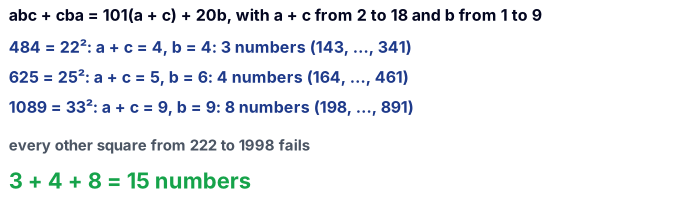
With digits a, b, c the sum is 101(a + c) + 20b. Of the squares from 222 to 1998, only 484 (a + c = 4, b = 4), 625 (a + c = 5, b = 6) and 1089 (a + c = 9, b = 9) fit. That gives 3 + 4 + 8 = 15 numbers.
Why it works: for each square, 101(a + c) must be the square minus 20b (20 to 180), which pins down a + c and b. Check: 164 + 461 = 625 = 25² and 297 + 792 = 1089 = 33². Common wrong answer: 8 (finding only 1089), 7 (counting each pair like 143 and 341 once), or 14 (missing 242, which reverses to itself).
Problem 4
Problem 4: Answer 9:00 a.m. and 5/3

Say Ana walks t minutes before they meet; Ben, who started 10 minutes later, walks t − 10. The stretch P–meeting takes Ana t minutes and Ben 100; the stretch meeting–Q takes Ben t − 10 and Ana 30. Over one distance, times are in the inverse ratio of speeds, so Ana’s speed ÷ Ben’s = 100/t = (t − 10)/30. So t(t − 10) = 3000, t = 60: they meet at 9:00 a.m., and Ana is 100/60 = 5/3 times as fast.
Why it works: the meeting point cuts the road into two stretches, and each person walks both of them, one before and one after the meeting. Both stretches give the same speed ratio; with a late start the two walking times before the meeting differ by 10, so t(t − 10) = 30 × 100. Check with speeds 5 and 3 km/h: in 60 minutes Ana walks 5 km to the meeting, Ben 2.5 km in 50; then Ana’s last 2.5 km take 30 minutes and Ben’s 5 km take 100. Common wrong answer: 8:50 a.m. (using Ben’s 50 minutes from 8:00), about 8:55 a.m. (t = √3000, as if they started together), or a ratio of 10/3 (comparing the two “after” times directly).
Problem 5
Problem 5: Answer 13√13/6 in
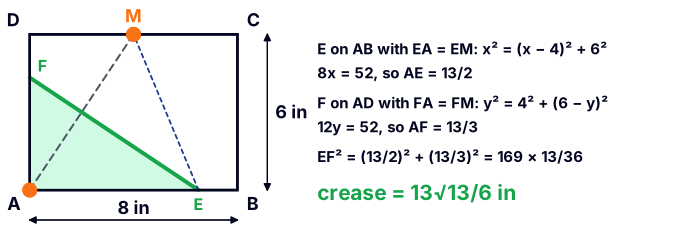
Every point on the crease is as far from A as from M. Let the crease meet AB at E, with AE = x. Then EM = x too, and E is 4 − x across and 6 up from M: x² = (x − 4)² + 6², so 8x = 52 and x = 13/2 (less than 8, so E is on AB). Let it meet AD at F with AF = y: y² = 4² + (6 − y)², so 12y = 52 and y = 13/3 (less than 6, so F is on AD). The crease EF is the hypotenuse of right triangle AEF: EF² = (13/2)² + (13/3)² = 169 × 13/36, so EF = 13√13/6 in.
Why it works: folding is reflecting, and the mirror line that sends A to M is the set of points equally far from both. Check: E is 13/2 from A, and from M it is √((13/2 − 4)² + 6²) = √(25/4 + 144/4) = 13/2 too. The crease is about 7.81 in, a little less than the 8 in side. Common wrong answer: 2√13 (the length AM, the line A travels along, not the crease), or 13/2 (only AE).
Problem 6
Problem 6: Answer 100 marbles
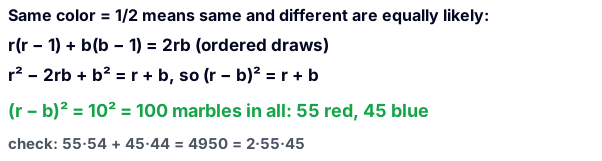
With r red and b blue, count ordered draws. Same color: r(r − 1) + b(b − 1). Different colors: 2rb. Same color has probability 1/2 exactly when these are equal: r² − r + b² − b = 2rb, which is (r − b)² = r + b. Since r − b = 10, r + b = 100: 55 red and 45 blue.
Why it works: “probability 1/2” says same and different are equally many, and moving 2rb across makes a perfect square. Check: 55 × 54 + 45 × 44 = 2970 + 1980 = 4950 = 2 × 55 × 45. Common wrong answer: 20 (twice the gap), 10 (the gap itself), or 55 (the number of red marbles).
Problem 7
Problem 7: Answer 142857 and 285714
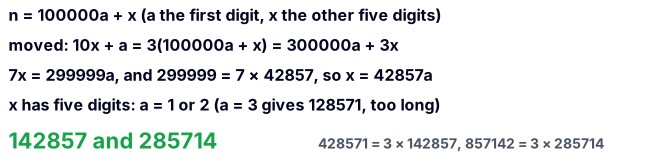
Write the number as 100000a + x, where a is the first digit and x is the five-digit tail (which may start with 0). Moving a to the end gives 10x + a. So 10x + a = 3(100000a + x), 7x = 299999a, and since 299999 = 7 × 42857, x = 42857a. The tail must be less than 100000, so a = 1 or 2: x = 42857 or 85714. The numbers are 142857 and 285714.
Why it works: naming the first digit and the rest turns “move a digit” into place value; the size of the tail picks out a = 1 and 2 (a = 3 gives 128571, six digits). Check: 3 × 142857 = 428571 and 3 × 285714 = 857142. Common wrong answer: only 142857 (stopping at a = 1), or 428571 (giving the moved number instead of the original).
Problem 8
Problem 8: Answer 27
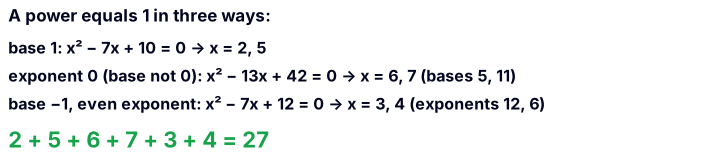
A power is 1 in three ways. Base 1: (x − 2)(x − 5) = 0, x = 2, 5. Exponent 0 with base not 0: (x − 6)(x − 7) = 0, bases 5 and 11, x = 6, 7. Base −1 with an even exponent: (x − 3)(x − 4) = 0, exponents 12 and 6, x = 3, 4. Sum: 27.
Why it works: for any other base the only power equal to 1 is the 0th (and 0⁰ is not allowed), so these cases are all. The −1 case needs the exponent to be even. Common wrong answer: 20 (missing the base −1 case: 2 + 5 + 6 + 7), 13 (only the exponent-0 case, using the sum of roots), or 7 (only base 1).
Problem 9
Problem 9: Answer 60 cm²
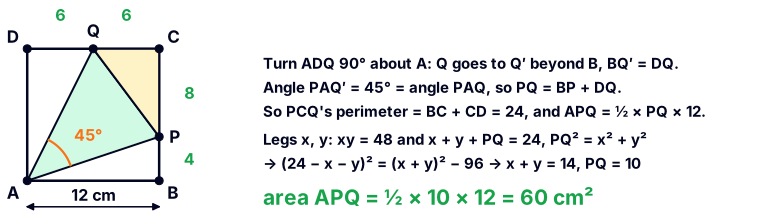
Turn ADQ a quarter turn about A onto ABQ′: triangles PAQ and PAQ′ are congruent (both angles at A are 45°). So PQ = BP + DQ, PCQ’s perimeter is 24, and APQ = ½ × PQ × 12. With legs x, y: xy = 48 and (24 − x − y)² = (x + y)² − 96, so x + y = 14 and PQ = 10. Area APQ = 60 cm².
Why it works: the quarter turn puts the two leftover angles at A side by side. Check: BP = 4, DQ = 6 gives 144 − 24 − 36 − 24 = 60 (BP = 6, DQ = 4 is the mirror case). Common wrong answer: 72 (half the square), or 48 (twice the corner).
Problem 10
Problem 10: Answer 4949/4951
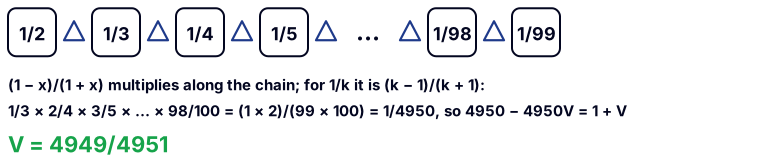
For x = a △ b, (1 − x)/(1 + x) = (1 − a)(1 − b) ÷ ((1 + a)(1 + b)), so this quantity multiplies along the chain. For 1/k it is (k − 1)/(k + 1), and 1/3 × 2/4 × 3/5 × … × 98/100 = (1 × 2)/(99 × 100) = 1/4950. So (1 − V)/(1 + V) = 1/4950, 4950 − 4950V = 1 + V and V = 4949/4951.
Why it works: (1 − x)/(1 + x) turns △ into multiplication, and the product telescopes: every factor from 3 to 98 appears once on top and once below. The first steps also show a pattern, 5/7, 9/11, 14/16, …, each (T − 1)/(T + 1) with T = 1 + 2 + … + k; for k = 99, T = 4950. Common wrong answer: 4949/4950 (stopping at 1 − 1/4950), or 1 (thinking the chain creeps up to 1).
More CML practice for grade 8
We don’t have a CML guide for grade 8 yet. For more practice at this level, try our free MOEMS Division M problems, also write-in, or our AMC 8 practice problems. Practice for the other grades: Grade 2 · Grade 3 · Grade 4 · Grade 5 · Grade 6 · Grade 7. All seven grades, and two full practice meets, are on our Continental Math League practice problems page. For how the season works, read our CML parent’s guide and how to prepare for CML.
This guide is not affiliated with or endorsed by Continental Mathematics League. “Continental Mathematics League” is a trademark of its respective owners.