
Free practice
CML Practice Problems: Grade 5 (Continental Math League)
Ten original Continental Math League problems for grade 5, pitched at the Pythagorean division, with every answer explained.
CML full prep and practice guides: 2 2–6
Free practice, other grades: 2 3 4 6 7 8
Other contests, grade 5: Math Kangaroo 5–6 Noetic 5 MOEMS Div E
Printable PDF: all 10 problems with room to work, then every answer explained.
On this page · 3 sections
Ten original practice problems for the Continental Math League (CML) Grade 5 meets, written by us. None comes from a real CML paper. Every one has a worked solution, with a note for you on the most common wrong answer.
A fifth grader’s CML season is 5 meets, each with 6 problems in 30 minutes. From grade 4 up, CML writes two papers for each grade: the Euclidean division, with questions that call for average reading comprehension and reasoning, and the Pythagorean division, which calls for above-average reading and reasoning. A student sits one of them, never both. Our Euclidean vs Pythagorean guide helps you choose. This set is pitched at the Pythagorean paper, so if your child sits Euclidean, expect it to run harder than a real meet.
Every answer is written in, with no choices to check against. Problems 2 and 7 ask for two answers, and CML’s answer keys give credit only when both are right. The set is ramped: problems 1–3 warm up, 4–8 are at meet level, and the two ★ Challenges are as hard as the hardest Grade 6 problems. Expect remainders, a shared-cost puzzle, a bus timetable, counting ways up a staircase and digit problems.
One way to use it: a 30-minute timed run of problems 1–6, like a real meet, then 7–10 untimed on another day. On the counting problems (5, 9 and 10), ask your child to show you their list: a careful list beats a quick guess.
The 10 problems
Problem 1
For whole numbers, a ◇ b means the remainder when a is divided by b. For example, 17 ◇ 5 = 2. For how many different whole numbers n is 2026 ◇ n = 26?
Problem 2
Five different positive whole numbers add up to 40, and no two of them are consecutive (next to each other, like 6 and 7). What is the largest that the biggest of them can be? What is the smallest that the biggest of them can be? Both must be right.
Problem 3
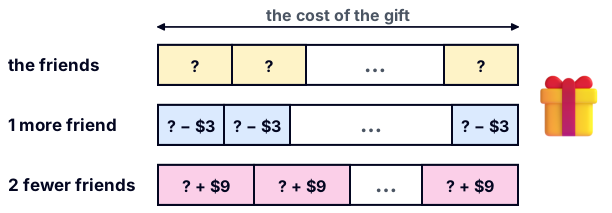
Some friends share the cost of a gift equally. If 1 more friend joined them, each would pay $3 less. If instead 2 of the friends dropped out, each of the others would pay $9 more. How much does the gift cost?
Problem 4
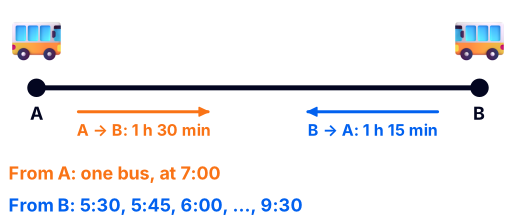
Towns A and B are joined by one road. A bus leaves A for B at 7:00 a.m., and its trip takes 1 hour 30 minutes. Buses leave B for A every 15 minutes from 5:30 a.m. to 9:30 a.m. (at 5:30, 5:45, 6:00, …, 9:30), and each of those trips takes 1 hour 15 minutes. How many buses coming from B does the 7:00 a.m. bus from A pass on the road between the towns? (Meeting a bus at a town does not count.)
Problem 5
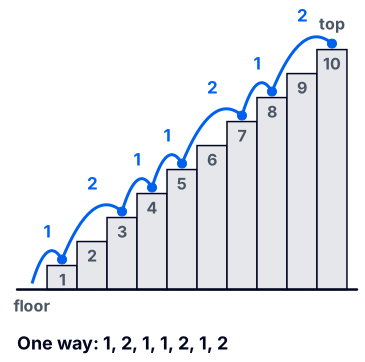
Kai climbs a staircase of 10 steps, from the floor to the top step. Each stride takes him up 1 step or 2 steps, but he never takes two 2-step strides one right after the other. In how many different ways can he climb to the top?
Problem 6
What is the smallest four-digit multiple of 44 whose digits add up to 30?
Problem 7
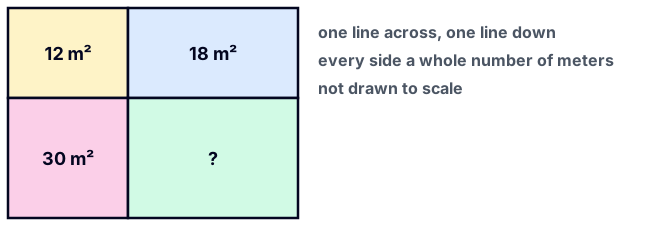
One straight line across and one straight line down cut a rectangular garden into four rectangular beds. Three of the beds have areas 12, 18 and 30 square meters, as shown. Every side of every bed is a whole number of meters. The garden’s perimeter can be either of two lengths. Find both.
Problem 8
What is the smallest positive whole number n such that 12 × n is a perfect square and 45 × n is a perfect cube?
Fact: A perfect square is n × n; a perfect cube is n × n × n.
Problem 9
★ Challenge. In some three-digit numbers, one of the digits is the average of the other two, like 258, 333 and 420. How many three-digit numbers are like this?

Problem 10
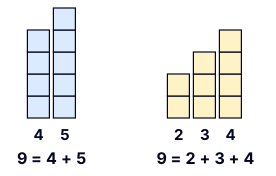
★ Challenge. Some numbers can be written as a sum of two or more consecutive positive whole numbers, like 9 = 4 + 5 or 9 = 2 + 3 + 4. How many of the whole numbers from 1 to 100 can NOT be written this way?
Solutions
Problem 1
Problem 1: Answer 11 numbers

n goes into 2026 − 26 = 2000 exactly, and n is more than 26 (a remainder is smaller than the divisor). 2000 has 20 divisors; the 9 from 1 to 25 are too small. 11 numbers!
For the grown-up: turn “remainder 26” into “2000 is a multiple of n”, count the divisors (2000 = 2⁴ × 5³, so 5 × 4 = 20), then drop the ones that are not bigger than 26. n = 2000 counts too: 2026 = 1 × 2000 + 26. Common wrong answer: 20 (every divisor of 2000, forgetting that the divisor must be bigger than the remainder), or 10 (leaving out 2000).
Problem 2
Problem 2: Answer 24 and 12
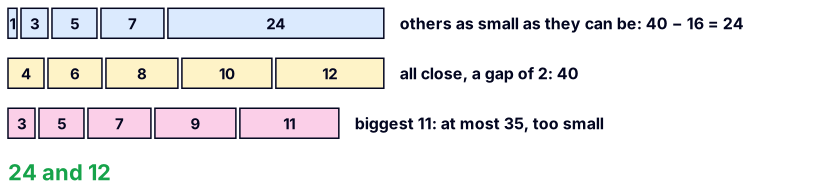
To make the biggest number large, make the other four as small as they can be with gaps: 1 + 3 + 5 + 7 = 16, so the biggest can be 40 − 16 = 24. To make the biggest number small, keep all five as close as the rule allows, 2 apart: 4 + 6 + 8 + 10 + 12 = 40, so 12 works. It can’t be 11: with no two next to each other, five numbers up to 11 add to at most 3 + 5 + 7 + 9 + 11 = 35.
For the grown-up: push to the extreme both ways; the second part needs a reason nothing smaller works. “No two consecutive” means each number is at least 2 more than the one before. Common wrong answer: 30 and 10 (ignoring the no-neighbours rule: 1 + 2 + 3 + 4 + 30 and 6 + 7 + 8 + 9 + 10), or 24 and 8 (the average 40 ÷ 5 = 8 is not the biggest).
Problem 3
Problem 3: Answer $216
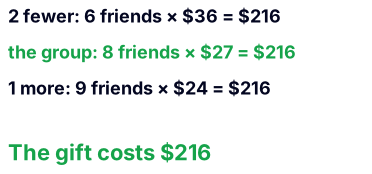
Try group sizes. The cost must split evenly among the group, one more, and two fewer. With 8 friends: if the gift costs 8 × 9 × 3 = $216, then 8 pay $27 each, 9 would pay $24 ($3 less) and 6 would pay $36 ($9 more). Both facts fit, so the gift costs $216.
For the grown-up: if n friends pay p each, one more friend saves everyone $3, and the n of them save 3n in all, which is exactly what the new friend pays: p − 3 = 3n, so p = 3n + 3 and the cost is 3n(n + 1). For two fewer: 2p = 9(n − 2). Then 6n + 6 = 9n − 18, n = 8, p = 27, cost $216. Check: 216 ÷ 8 = 27, 216 ÷ 9 = 24, 216 ÷ 6 = 36. Common wrong answer: 8 (the number of friends), $27 (each friend’s share), or $72 (= 8 × 9 from only the first fact).
Problem 4
Problem 4: Answer 10 buses
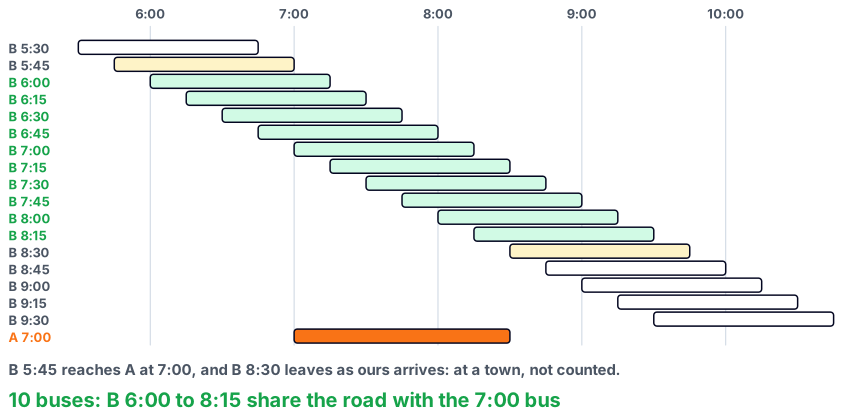
Our bus is on the road from 7:00 to 8:30. A bus from B passes it on the road if that bus is still on the road after 7:00 and set off before 8:30. A bus from B takes 1 hour 15 minutes, so it must leave B after 5:45: the 5:45 bus reaches A at 7:00, just as ours leaves, which is a meeting at a town. And the 8:30 bus leaves B just as ours arrives there. So the buses leaving at 6:00, 6:15, …, 8:15 count: 10 buses.
For the grown-up: two buses driving toward each other on one road pass exactly when their times on the road overlap, so compare time windows, not speeds. The two different trip times only change the window’s ends: after 7:00 − 1:15 = 5:45 and before 8:30. Common wrong answer: 12 (also counting the 5:45 and 8:30 buses, met at the towns), 6 (90 ÷ 15, forgetting buses already on the road), or 11.
Problem 5
Problem 5: Answer 41 ways
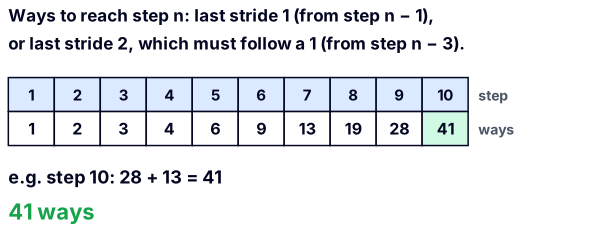
Count the ways to reach each step. The last stride is a 1 (from the step just below) or a 2, and a 2 must come right after a 1 or at the start (from three steps below). So ways(n) = ways(n − 1) + ways(n − 3): steps 1 to 10 give 1, 2, 3, 4, 6, 9, 13, 19, 28, 41.
For the grown-up: without the rule this is the Fibonacci count (89). With it, a 2-stride always follows a 1-stride or starts the climb, which gives the “three back” term. Check by counting the number of 2-strides: none: 1 way; one: 9; two: 21; three: 10; total 41. Common wrong answer: 89 (ignoring the rule), 40 (forgetting the climb with no 2-strides), or 28 (stopping at step 9).
Problem 6
Problem 6: Answer 6996

Digits a b c d. For 11, (a + c) − (b + d) is 0, 11 or 22; the pairs add to 30, so they differ by an even amount: 0. Both pairs make 15. Smallest a is 6, so c = 9. For 4, 9d must be 92 or 96; 92 needs b = 13. So 6996!
For the grown-up: 44 = 4 × 11, so use both tests. Two numbers with an even sum have an even difference, so the 11-test difference can’t be 11, and 22 would need a pair adding to 26. A number is a multiple of 4 when its last two digits are. Check: 6996 = 44 × 159, and 6 + 9 + 9 + 6 = 30. Common wrong answer: 6798 (a multiple of 22 but not of 44), or 6699 (only a multiple of 11).
Problem 7
Problem 7: Answer 44 m and 52 m
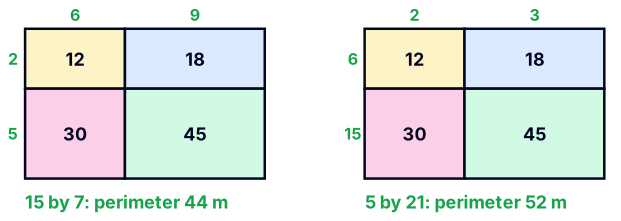
The top beds share a height that goes into 12 and 18: 1, 2, 3 or 6. Then the left width is 12 ÷ height, and 30 ÷ that width must be whole. Height 2: widths 6 and 9, bottom 5, garden 15 by 7. Height 6: widths 2 and 3, bottom 15, garden 5 by 21. Perimeters 44 m and 52 m!
For the grown-up: the fourth bed is always 18 × 30 ÷ 12 = 45 and the garden 105 square meters, but the area alone does not fix the shape: the whole-number sides do. Heights 1 and 3 fail because the bottom height would be 2½ or 7½. Check: 6 × 2 = 12, 9 × 2 = 18, 6 × 5 = 30; and 2 × 6, 3 × 6, 2 × 15. Common wrong answer: only one of them (stopping at the first case that works), or 105 (the area, not the perimeter).
Problem 8
Problem 8: Answer 75
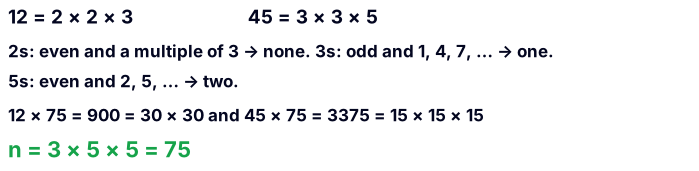
12 = 2 × 2 × 3 and 45 = 3 × 3 × 5. A square has each prime an even number of times, a cube a multiple of 3 times. 2s: n needs a number that is even and a multiple of 3: none. 3s: odd (for 12) and 1, 4, 7, … (for 45): one. 5s: even (for 12) and 2, 5, … (for 45): two. n = 3 × 5 × 5 = 75.
For the grown-up: treat each prime separately. Check: 12 × 75 = 900 = 30 × 30, and 45 × 75 = 3,375 = 15 × 15 × 15. Common wrong answer: 15 (makes 45 × 15 = 675, not a cube), 225 (enough for the cube with 5s, but 12 × 225 = 2,700 is not a square), or 3 (only fixing the square).
Problem 9
Problem 9: Answer 121 numbers
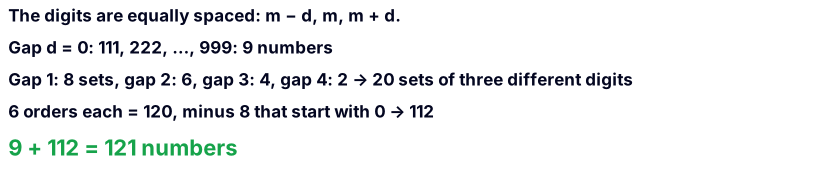
If one digit is the average of the other two, the three digits are equally spaced: m − d, m, m + d. With d = 0: 111, 222, …, 999, 9 numbers. With d = 1, 2, 3, 4 there are 8, 6, 4 and 2 sets of three different digits, 20 sets. Each set gives 6 orders, 120, but the sets with a 0 ({0, 1, 2}, {0, 2, 4}, {0, 3, 6}, {0, 4, 8}) have 2 orders each that start with 0: 120 − 8 = 112. In all, 9 + 112 = 121.
For the grown-up: count sets, then orders, then remove leading zeros. Two equal digits force the third to match, so no number has exactly two equal digits. Common wrong answer: 112 (forgetting 111, …, 999), 120 (not removing the orders that start with 0), or 129.
Problem 10
Problem 10: Answer 7 numbers

A sum of an odd count of numbers in a row is count × the middle one; of an even count, half the count × (first + last), where first + last is odd. Either way the sum has an odd factor bigger than 1. And every number with such a factor works (15 = 4 + 5 + 6, 40 = 6 + 7 + 8 + 9 + 10). So the numbers that can’t are the ones with no odd factor but 1: 1, 2, 4, 8, 16, 32, 64. That is 7 numbers.
For the grown-up: listing small numbers shows the pattern (1, 2, 4, 8 fail); the odd factor is the reason. Common wrong answer: 6 (forgetting 1), 1 (only 1, thinking every other number works), or 0.
More CML practice for grade 5
For more at this level, our CML prep guide for Grades 2–6 covers the strategies behind each kind of problem, with original practice problems and full practice meets, and a free sample to try first. Practice for the other grades: Grade 2 · Grade 3 · Grade 4 · Grade 6 · Grade 7 · Grade 8. All seven grades, and two full practice meets, are on our Continental Math League practice problems page. For how the season works, read our CML parent’s guide and how to prepare for CML.
This guide is not affiliated with or endorsed by Continental Mathematics League. “Continental Mathematics League” is a trademark of its respective owners.