
Free practice
CML Practice Problems: Grade 3 (Continental Math League)
Ten original Continental Math League problems for grade 3, from warm-ups to Challenges, with every answer explained for parents.
CML full prep and practice guides: 2 2–6
Free practice, other grades: 2 4 5 6 7 8
Other contests, grade 3: Math Kangaroo 3–4 Noetic 3
Printable PDF: all 10 problems with room to work, then every answer explained.
On this page · 3 sections
Ten original practice problems for the Continental Math League (CML) Grade 3 meet, written by us at real meet difficulty. None comes from a real CML paper. Every one has a worked solution, with a note for you on the most common wrong answer.
Third graders sit their own CML paper, with no divisions: 3 meets a season, each with 6 problems in 30 minutes. Every answer is written in, often in a blank inside the sentence, so there are no choices to work back from. Some answers have two or three parts, and CML’s answer keys give credit only when every part is right. Here, problems 3, 6 and 9 work that way.
The set is ramped: problems 1–3 warm up, 4–8 are at meet level, and the two ★ Challenges are as hard as the hardest Grade 4 problems. Along the way there is a number machine, a made-up symbol, a rope measured in feet and inches, a balance puzzle, a letter sum and an age problem.
One way to use it: give your child 30 minutes for problems 1–6, the length of a real meet, and save 7–10 for another day with no clock. Afterwards, go through the misses together. The parent notes name the wrong answer each problem tends to produce, which tells you what went wrong.
The 10 problems
Problem 1
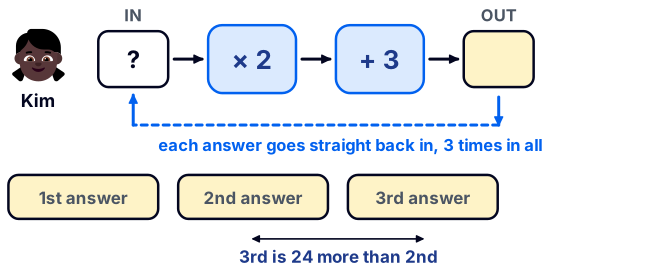
Kim’s number machine multiplies a number by 2 and then adds 3. Kim puts in a number, then puts the answer straight back into the machine, and then does it once more: three trips in all. The third answer is 24 more than the second answer. What number did Kim put in first?
Tip: To undo a machine, start at the end. Undo the last step first.
Problem 2
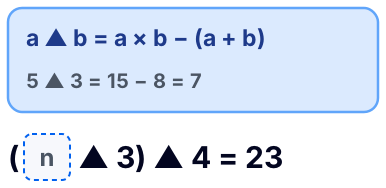
a ▲ b means a × b − (a + b). For example, 5 ▲ 3 = 15 − 8 = 7. What number n makes (n ▲ 3) ▲ 4 = 23 true?
Problem 3
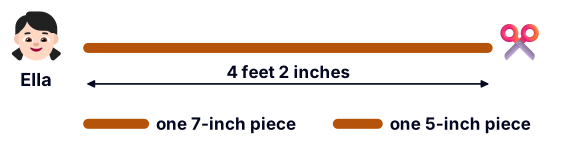
Ella has a rope 4 feet 2 inches long. She cuts all of it into 7-inch pieces and 5-inch pieces, with nothing left over, and she cuts as many 7-inch pieces as she can. How many pieces of each length does she cut? Both parts must be right.
Fact: 1 foot = 12 inches.
Problem 4
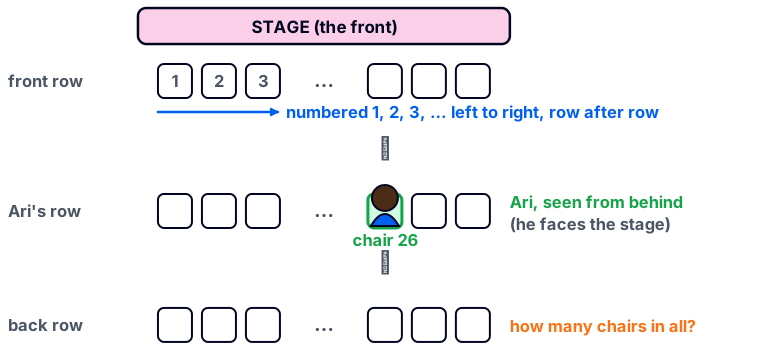
Chairs face a stage in rows of equal length. Ari’s row is 4th from the front and 9th from the back. Facing the stage, his chair is 3rd from the right. Chairs are numbered 1, 2, 3, … from the front row back, each row left to right. Ari’s is chair 26. How many chairs are there?
Problem 5
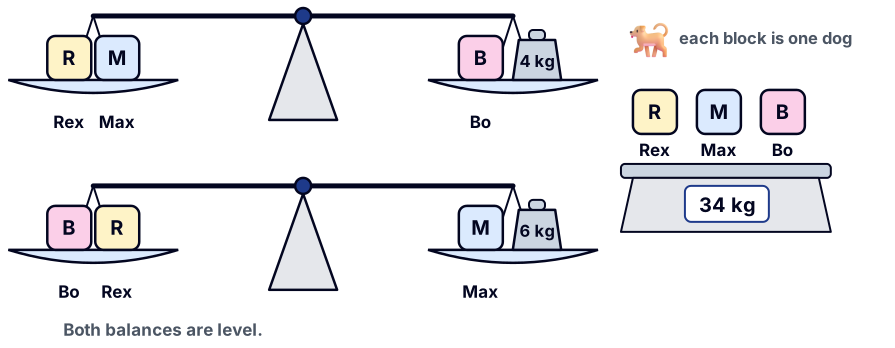
Three dogs, Rex, Max and Bo, are weighed. On one level balance, Rex and Max are on one side, and Bo and a 4 kg weight are on the other. On a second level balance, Bo and Rex are on one side, and Max and a 6 kg weight are on the other. All three dogs together weigh 34 kg. How much does Max weigh?
Problem 6
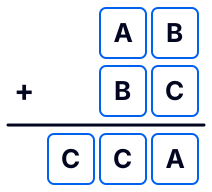
In this addition, each letter stands for a digit. Different letters are different digits, the same letter is always the same digit, and no number starts with 0. Find A, B and C. All three must be right.
Problem 7
Ana, Ben, Cal, Dee and Eli collected 10, 20, 30, 40 and 50 shells, a different amount each. Ana and Cal together have as many shells as Ben and Dee together. Ben and Cal together have fewer shells than Ana. Cal and Dee together have fewer shells than Eli. How many shells does Dee have?

Problem 8
Mom is 4 times as old as Iris. In 4 years, Mom will be 3 times as old as Iris. How many years from now will Mom be exactly twice as old as Iris?
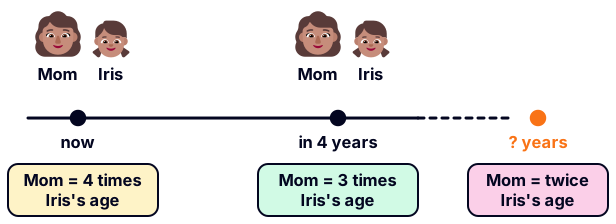
Trick: Two people’s ages always stay the same number of years apart.
Problem 9
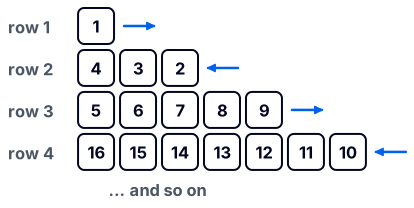
★ Challenge. The numbers 1, 2, 3, … are written in rows that all start at the left edge. Row 1 has one number, row 2 has three, row 3 has five, and each row has two more than the row before. The rows go left to right, then right to left, taking turns, as shown. Which number is directly above 200, and which number is directly below 200? Both parts must be right.
Problem 10
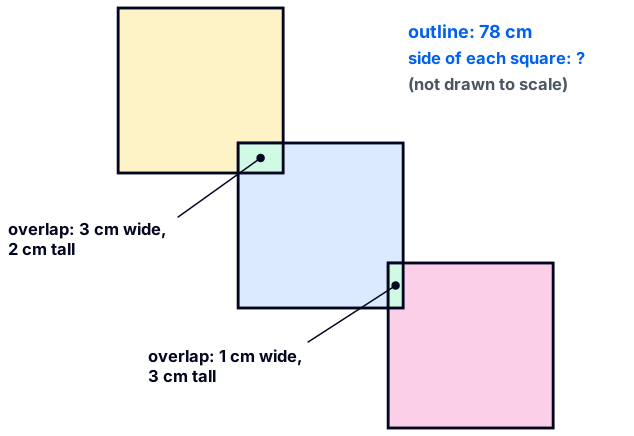
★ Challenge. Three equal squares overlap in a chain, as shown. The first two overlap in a rectangle 3 cm wide and 2 cm tall. The last two overlap in a rectangle 1 cm wide and 3 cm tall. The outline of the whole shape is 78 cm long. How long is a side of each square?
Solutions
Problem 1
Problem 1: Answer 3
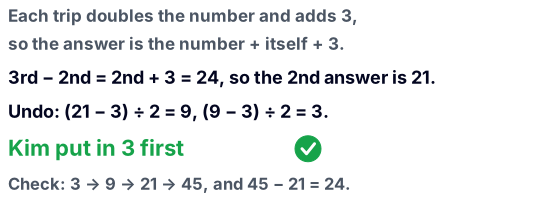
The machine doubles a number and adds 3, so each answer is the number put in, plus itself, plus 3. The third answer is the second answer + itself + 3, so it is 24 more when the second answer + 3 = 24: the second answer is 21. Undo: 21 − 3 = 18, half is 9. Undo again: 9 − 3 = 6, half is 3. Kim put in 3!
For the grown-up: the gap between two answers is “how much the machine adds”, which is the number going in plus 3. That turns the gap into the second answer. Then undo with the opposite steps in reverse order, once per trip. Check forwards: 3 → 9 → 21 → 45, and 45 − 21 = 24. Common wrong answer: 21 (the second answer), or 9 (undoing only once).
Problem 2
Problem 2: Answer 6
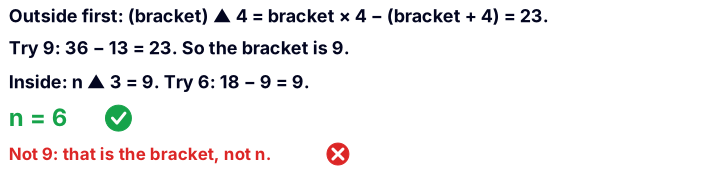
Undo the outside first. The bracket ▲ 4 = 23: try 9, 9 × 4 − 13 = 23, so the bracket is 9. Then n ▲ 3 = 9: try 6, 6 × 3 − 9 = 9. n = 6!
For the grown-up: the bracket is one number going into the outside rule: find it first, then what made it. Trying numbers is fine (x ▲ 4 = 3x − 4, so 3x = 27). Check: 6 ▲ 3 = 18 − 9 = 9 and 9 ▲ 4 = 36 − 13 = 23. Common wrong answer: 9 (the bracket, one step too early).
Problem 3
Problem 3: Answer 5 pieces of 7 inches and 3 pieces of 5 inches
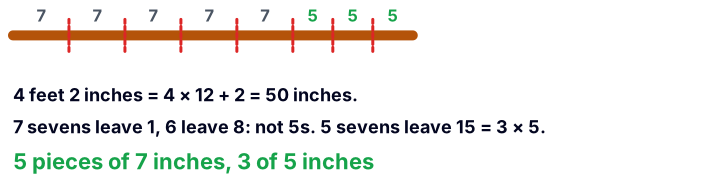
4 feet 2 inches is 4 × 12 + 2 = 50 inches. 7 pieces of 7 inches leave 1 inch, and 6 pieces leave 8 inches: neither shares into 5s. 5 pieces use 35 and leave 15 inches: three 5-inch pieces. So 5 of 7 inches and 3 of 5 inches!
For the grown-up: change to one unit first, then start with as many 7-inch pieces as fit and step down until what is left shares into 5s exactly. Check: 5 × 7 + 3 × 5 = 35 + 15 = 50. Common wrong answer: 7 and 0 (forgetting “nothing left over”), or 6 and 1 (a piece of 8 inches is not 5).
Problem 4
Problem 4: Answer 84 chairs
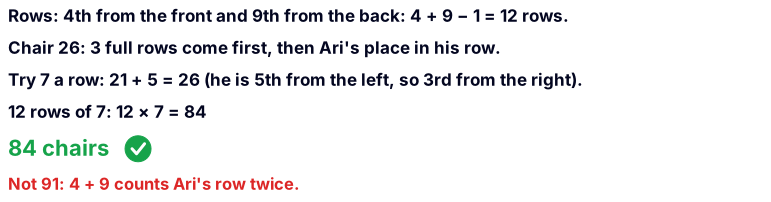
4th from the front and 9th from the back both count Ari’s row: 4 + 9 − 1 = 12 rows. Chair 26 comes after 3 full rows, and in his row Ari is 3rd from the right. Try 7 chairs a row: 3 rows make 21, and the 5th chair of a row of 7 is 3rd from the right: 21 + 5 = 26. So 12 rows of 7: 84 chairs!
For the grown-up: with c chairs a row, Ari’s number is 3 full rows (3 × c) plus his place from the left, c − 2: 4 × c − 2 = 26, so c = 7. The rows overlap in Ari’s row, so 4 + 9 − 1. Common wrong answer: 91 (13 rows, counting Ari’s row twice), or 78.
Problem 5
Problem 5: Answer 14 kg
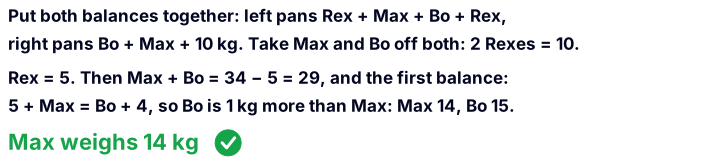
Put both balances together: the left pans hold Rex + Max + Bo + Rex, and the right pans hold Bo + Max + 4 + 6 kg. Take Max and Bo off both sides: 2 Rexes = 10 kg, so Rex is 5 kg. Then Max and Bo make 34 − 5 = 29 kg, and the first balance (5 + Max = Bo + 4) says Bo is 1 kg more than Max: Max 14, Bo 15!
For the grown-up: two level balances can be stacked into one big level balance; the dogs on both sides cancel. Check: 5 + 14 = 15 + 4 and 15 + 5 = 14 + 6, and 5 + 14 + 15 = 34. Common wrong answer: 15 (Bo), or 5 (Rex).
Problem 6
Problem 6: Answer A = 6, B = 5, C = 1
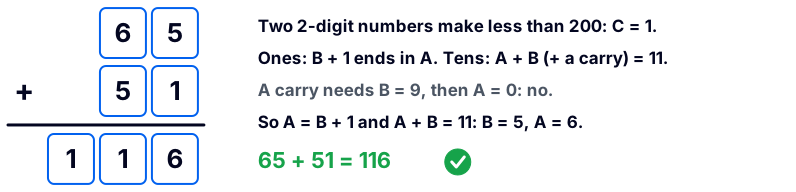
The sum of two two-digit numbers is less than 200, so C = 1. A carry from the ones would need B + 1 = 10, so B = 9 and A = 0: not allowed. So there is no carry: A = B + 1 and A + B = 11. B = 5 and A = 6!
For the grown-up: the size fixes C, and then the carry is the whole question. Check: 65 + 51 = 116. Common wrong answer: A = 5, B = 6 (56 + 61 = 117), or only C = 1.
Problem 7
Problem 7: Answer 30 shells

Ana has more than Ben and Cal together, and Eli more than Cal and Dee, so Ana and Eli are the two biggest, 40 and 50, and Ben, Cal and Dee share 10, 20 and 30. Ana + Cal = Ben + Dee: Ana 50 is too big (50 + Cal is more than any two of 10, 20, 30), so Ana is 40 and Eli 50. Then 40 + Cal = Ben + Dee needs Cal 10 and Ben + Dee = 50. Ben + 10 < 40 and 10 + Dee < 50: Ben 20, Dee 30!
For the grown-up: “fewer than” clues show who is biggest; then the equal sums pin down the rest. Check: 40 + 10 = 20 + 30, 20 + 10 < 40, 10 + 30 < 50. Common wrong answer: 20 (Ben and Dee swapped), or 50.
Problem 8
Problem 8: Answer in 16 years
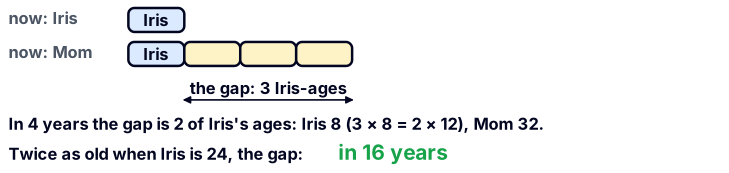
Mom is 4 Iris-ages, so she is 3 Iris-ages older. In 4 years she is 3 times Iris, so 2 of Iris’s new ages older. Try Iris 8: gap 24, and in 4 years Iris is 12 and 2 × 12 = 24. So Iris is 8, Mom 32, and Mom is always 24 years older. Mom is twice Iris when Iris is 24 (Mom 48): 16 years from now!
For the grown-up: the difference between two ages never changes, and it is used twice: once to find the ages (3 × Iris = 2 × (Iris + 4), Iris 8) and once for “twice as old”, which happens exactly when Iris’s age equals the gap. Check: 48 = 2 × 24. Common wrong answer: 32 or 24.
Problem 9
Problem 9: Answer 193 and 253
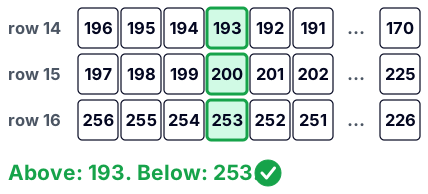
The rows hold 1, 3, 5, 7, … numbers, so they end at 1, 4, 9, 16, …: the square numbers. 14 × 14 = 196 and 15 × 15 = 225, so 200 is in row 15 (197 to 225). Odd rows go left to right, so 200 is 4th from the left. Rows 14 (170 to 196) and 16 (226 to 256) go right to left, so they start at the left with 196 and 256: their 4th numbers are 193 and 253!
For the grown-up: 1 + 3 + 5 + … gives the square numbers, which finds the row. Common wrong answer: 173 and 229 (counting row 14 and row 16 from the wrong end), or the two swapped.
Problem 10
Problem 10: Answer 8 cm

The overlaps’ edges, 10 cm and 8 cm, are inside the shape, not on the outline. So all 12 sides make 78 + 10 + 8 = 96 cm, and one side is 96 ÷ 12 = 8 cm!
For the grown-up: outline = 12 sides − 18. Common wrong answer: 5 (taking the 18 away from 78 instead of adding it), or 6 r 6 (sharing 78 by 12 and ignoring the overlaps).
More CML practice for grade 3
For more at this level, our CML prep guide for Grades 2–6 covers the strategies behind each kind of problem, with original practice problems and full practice meets, and a free sample to try first. Practice for the other grades: Grade 2 · Grade 4 · Grade 5 · Grade 6 · Grade 7 · Grade 8. All seven grades, and two full practice meets, are on our Continental Math League practice problems page. For how the season works, read our CML parent’s guide and how to prepare for CML.
This guide is not affiliated with or endorsed by Continental Mathematics League. “Continental Mathematics League” is a trademark of its respective owners.