
Free practice
CML Practice Problems: Grade 7 (Continental Math League)
Ten original Continental Math League problems for grade 7, pitched above the Pythagorean division, with every answer explained.
CML full prep and practice guides: 2 2–6
Free practice, other grades: 2 3 4 5 6 8
Other contests, grade 7: Math Kangaroo 7–8 MOEMS Div M AMC 8
Printable PDF: all 10 problems with room to work, then every answer explained.
On this page · 3 sections
Ten original practice problems for the Continental Math League (CML) Grade 7 meets, written by us. None comes from a real CML paper. Every one has a worked solution, with a note on the most common wrong answer.
A seventh grader’s CML season is 5 meets, each with 6 problems in 30 minutes. From grade 4 up, CML writes two papers for each grade: the Euclidean division, with questions that call for average reading comprehension and reasoning, and the Pythagorean division, which calls for above-average reading and reasoning. A student sits one of them, never both. Our Euclidean vs Pythagorean guide helps you choose. This set is pitched above the Pythagorean paper, so it should feel harder than a real meet.
Every answer is written in. Problems 1, 3 and 9 ask for two answers, and CML’s answer keys give credit only when both are right. The set is ramped: problems 1–3 warm up, 4–8 are at meet level, and the two ★ Challenges are as hard as the hardest Grade 8 problems. Expect powers, mean and median, polygon angles, probability with dice, circles inside triangles and an escalator.
One way to use it: a 30-minute timed run of problems 1–6, like a real meet, then 7–10 untimed. Have your child write down the exact form the question asks for (a fraction in lowest terms, both parts) before they start; that is where easy points slip.
The 10 problems
Problem 1
For positive whole numbers, a ⊕ b means aᵇ + bᵃ. For example, 3 ⊕ 2 = 3² + 2³ = 9 + 8 = 17. The whole numbers x and y are both greater than 1, x is less than y, and x ⊕ y = 593. What are x and y? Both must be right.
Problem 2
A list of seven positive whole numbers has a mean (average) of 10 and a median of 9. Its only mode is 12: 12 appears more often than any other number in the list. What is the largest possible value of the biggest number in the list?
Fact: The median is the middle number when the list is in order. A mode is a number that appears most often.
Problem 3
When one of the angles of a convex polygon is left out, the other angles add up to 2026°. How many sides does the polygon have, and how big is the angle that was left out? Both must be right.
Fact: The angles of a polygon with n sides add up to (n − 2) × 180°. In a convex polygon every angle is less than 180°.
Problem 4
Three fair six-sided dice are rolled. What is the probability that the three numbers rolled can be the side lengths of a triangle? (Three sides make a triangle only if it is a real one, not flat: 1, 2 and 3 do not.)

Problem 5
A right triangle has legs of 15 cm and 20 cm. The altitude to its hypotenuse splits it into two smaller right triangles. What is the sum of the radii of the inscribed circles of all three triangles: the big one and the two small ones?
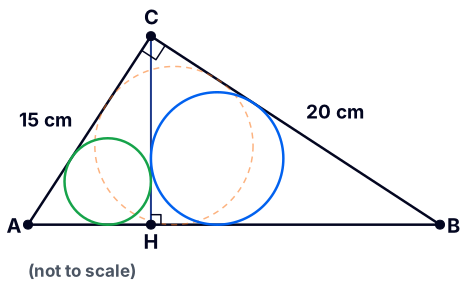
Fact: The inscribed circle of a triangle touches all three of its sides from the inside.
Problem 6
The positive whole numbers that are divisible by none of 2, 3, 5 and 7 are listed in order: 1, 11, 13, 17, 19, 23, 29, 31, 37, 41, 43, 47, 53, … What is the 2000th number in the list?
Problem 7
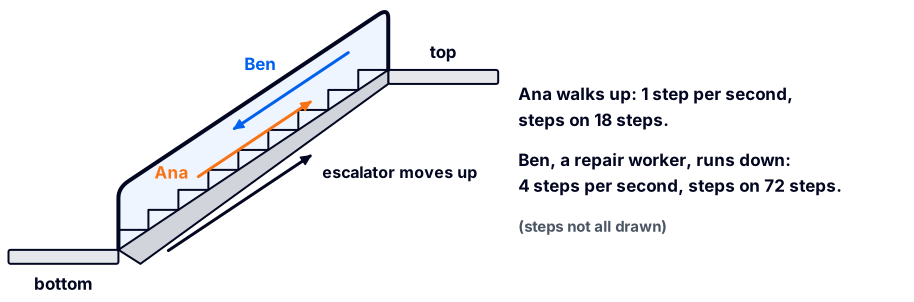
An escalator moves up at a steady speed. Ana walks up it at 1 step per second and steps on 18 steps on her way from the bottom to the top. Ben, a repair worker testing the escalator, runs down it, against its motion, at 4 steps per second and steps on 72 steps on his way from the top to the bottom. How many steps would you see on the escalator if it were stopped?
Problem 8
How many four-digit numbers have the sum of their first two digits equal to the sum of their last two digits? Two examples are 1203 (1 + 2 = 0 + 3) and 4572 (4 + 5 = 7 + 2).

Problem 9
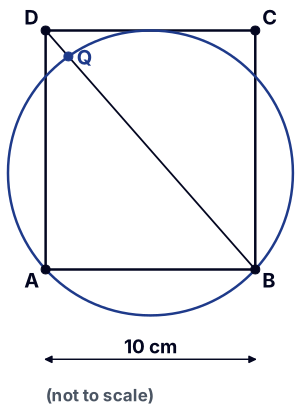
★ Challenge. Square ABCD has sides of 10 cm. A circle passes through the two corners A and B and just touches the opposite side CD. The diagonal BD crosses the circle again at a point Q. What is the radius of the circle, and how long is DQ? Both must be right.
Problem 10
★ Challenge. How many pairs of integers (x, y), positive or negative but not zero, make 1/x + 1/y = 1/12 true? Count (x, y) and (y, x) as two different pairs when x and y are different.
Solutions
Problem 1
Problem 1: Answer x = 2, y = 9
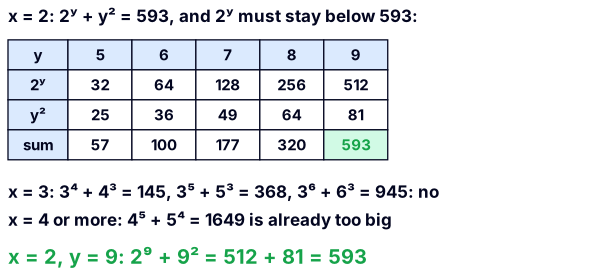
Try x = 2: 2ʸ + y² = 593. 2ʸ must stay below 593, so y ≤ 9, and y = 9 works: 512 + 81 = 593. For x = 3 the values jump from 368 (y = 5) to 945 (y = 6), and for x = 4 even 4⁵ + 5⁴ = 1649 is too big. So x = 2 and y = 9.
Why it works: a power like 2ʸ grows so fast that it limits the search: once one term passes 593 there is no going back. That leaves only x = 2 and x = 3 to check, and only a few y for each. The words “greater than 1” matter: 1 ⊕ 592 = 1 + 592 = 593 too. Common wrong answer: x = 1, y = 592 (ignoring “greater than 1”).
Problem 2
Problem 2: Answer 31
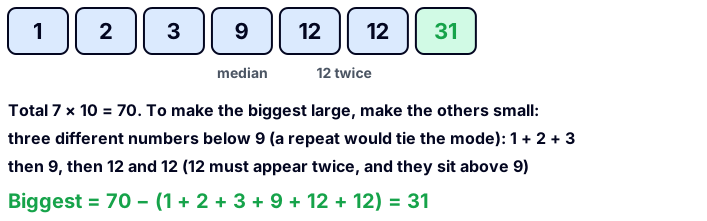
The seven numbers add to 7 × 10 = 70. In order, the 4th is 9. 12 must appear at least twice, and it is above 9, so it fills the 5th and 6th places. The three numbers below 9 must all be different (a repeat would tie 12 as a mode), so at least 1 + 2 + 3. Biggest: 70 − (1 + 2 + 3 + 9 + 12 + 12) = 31.
Why it works: to make one number as large as possible, make all the others as small as the rules allow. The mode rule does two jobs: it forces two 12s, and it forbids any other repeat, so the small numbers can’t be 1, 1, 1. Check: 1, 2, 3, 9, 12, 12, 31 has mean 70 ÷ 7 = 10, median 9 and only mode 12. Common wrong answer: 34 (using 1, 1, 1) or 33 (using 1, 1, 2): both make 1 a mode too.
Problem 3
Problem 3: Answer 14 sides, 134°
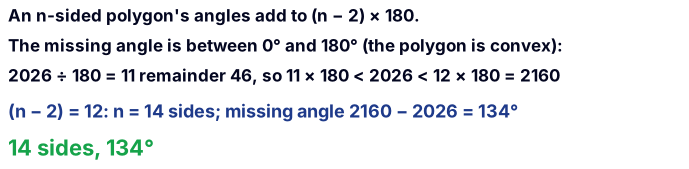
The full angle sum is a multiple of 180, a little more than 2026, and at most 180 more (the missing angle is less than 180°). 11 × 180 = 1980 is too small; 12 × 180 = 2160 works. So n − 2 = 12, n = 14 sides, and the missing angle is 2160 − 2026 = 134°.
Why it works: the angle sum (n − 2) × 180 only comes in steps of 180, and the left-out angle is between 0 and 180, so exactly one multiple of 180 fits just above 2026. Common wrong answer: 13 sides (using 2026 ÷ 180 ≈ 11 and adding 2 to the 11), or 46° (the remainder of 2026 ÷ 180, not the gap to 2160).
Problem 4
Problem 4: Answer 37/72
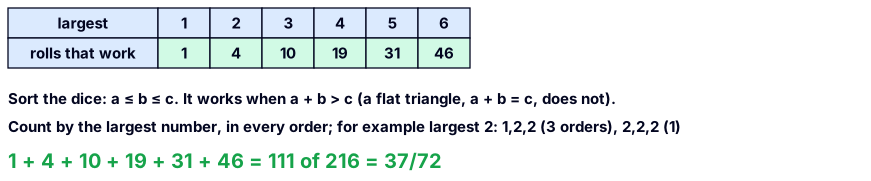
Sort the three numbers a ≤ b ≤ c; they make a triangle when a + b > c. Counting the rolls in every order, by the largest number: 1, 4, 10, 19, 31 and 46 for largest 1 to 6. That is 111 of the 216 rolls: 111/216 = 37/72.
Why it works: with the numbers in order, only one check matters: the two smaller sides must reach past the largest. Count each sorted triple with its number of orders (1, 3 or 6). For example, largest 3: 3,3,3 (1), 2,3,3 (3), 1,3,3 (3) and 2,2,3 (3) make 10. Common wrong answer: 13/18 (counting flat ones like 1, 2, 3 with a + b = c: 45 more rolls).
Problem 5
Problem 5: Answer 12 cm
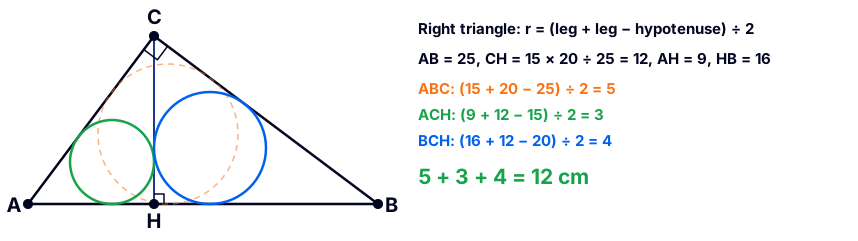
The hypotenuse is 25 cm, and the altitude is 15 × 20 ÷ 25 = 12 cm, cutting the hypotenuse into 9 and 16. In a right triangle the in-radius is (leg + leg − hypotenuse) ÷ 2: (15 + 20 − 25) ÷ 2 = 5, (9 + 12 − 15) ÷ 2 = 3, and (16 + 12 − 20) ÷ 2 = 4. The sum is 12 cm.
Why it works: the incircle touches both legs at the same distance r from the right angle, so each leg is r plus a tangent piece, and the two tangent pieces together make the hypotenuse: a + b − 2r = c. The altitude comes from the area two ways (15 × 20 = 25 × CH). Adding the three formulas, the sum is exactly the altitude. Common wrong answer: 5 (only the big triangle), or 7 (only the two small ones).
Problem 6
Problem 6: Answer 8749
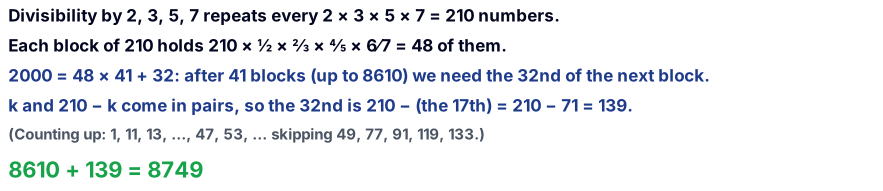
Divisibility by 2, 3, 5 and 7 depends only on the remainder by 2 × 3 × 5 × 7 = 210, so the list repeats in blocks of 210. Each block holds 210 × ½ × ⅔ × ⅘ × 6⁄7 = 48 numbers. 2000 = 48 × 41 + 32, so after 41 blocks (up to 8610) we need the 32nd number of the next block. In a block, k and 210 − k are both in the list or both out, so the 32nd is 210 minus the 17th from the start. Listing 1, 11, 13, 17, 19, 23, 29, 31, 37, 41, 43, 47, 53, 59, 61, 67, 71 (no 49!) gives the 17th as 71, so the 32nd is 139. Answer: 8610 + 139 = 8749.
Why it works: a number shares a factor with 210 exactly when 210 − it does, so each block is symmetric, and the 48 split into 24 below 105 and 24 above. Counting up instead works too, skipping 49, 77, 91, 119 and 133. Common wrong answer: 8747 (counting 49 as one of them), or 7499 (forgetting 7: blocks of 30 with 8 each).
Problem 7
Problem 7: Answer 45 steps
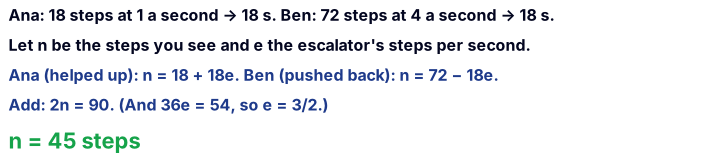
Ana is on the escalator for 18 ÷ 1 = 18 seconds, and Ben, the repair worker, for 72 ÷ 4 = 18 seconds. In those 18 seconds the escalator moves the same number of steps, say m. Ana’s steps plus m make the whole length, and Ben’s steps minus m make it too: 18 + m = 72 − m, so m = 27 and the length is 45 steps.
Why it works: walking with the escalator, it does part of the job for you; running against it, it undoes part of your work. Because the two are on it for the same time, the escalator’s share is the same and cancels when you add: 2n = 18 + 72. Check: the escalator moves 27 ÷ 18 = 1.5 steps a second. Common wrong answer: 36 (adding 18 to Ana’s 18), 54 (72 − 18), or 90 (18 + 72 without halving).
Problem 8
Problem 8: Answer 615 numbers
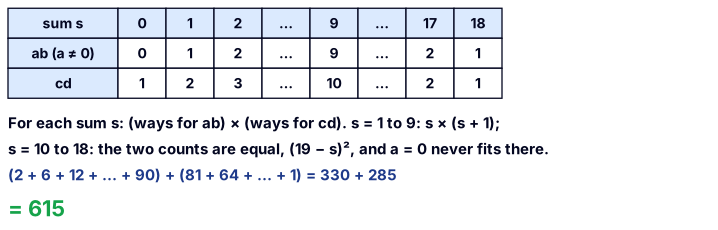
Sort by the common sum s. For s from 1 to 9, ab can be picked in s ways (a ≠ 0) and cd in s + 1 ways: 1·2 + 2·3 + … + 9·10 = 330. For s from 10 to 18 both counts are 19 − s: 9² + 8² + … + 1² = 285. Total 615.
Why it works: splitting by the shared sum turns one hard count into many small products. The first digit can’t be 0, which costs one choice for small sums only; for sums of 10 or more a 0 can’t appear in front anyway. Common wrong answer: 670 (allowing a = 0: 1² + 2² + … + 10² + … + 1² = 670).
Problem 9
Problem 9: Answer 25/4 cm, 5√2/4 cm
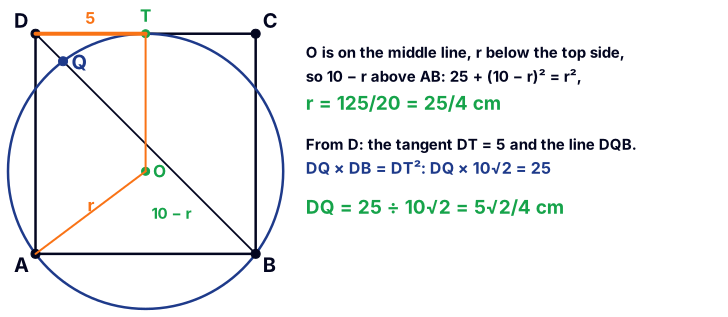
The center O is the same distance from A and B, so it is on the middle line of the square, 5 cm from AD. The circle touches CD at T, the middle of CD, and O is r below T, so 10 − r above AB. OA = r gives 5² + (10 − r)² = r², so 125 − 20r = 0 and r = 25/4 cm. For DQ: from D, the line DT just touches the circle, and the line DQB cuts it twice, so DQ × DB = DT². DT = 5 and DB = 10√2, so DQ = 25 ÷ 10√2 = 5√2/4 cm.
Why it works: the radius to a touching point is at a right angle to the side, so T is straight above O; joining O to A gives a right triangle with legs 5 and 10 − r. The second part is the tangent–secant rule (the “power” of D). Without it: put A at (0, 0); the circle is (x − 5)² + (y − 15/4)² = (25/4)², the diagonal is y = 10 − x, and they meet at B and at Q = (5/4, 35/4), which is 5/4 · √2 from D. Check: 5√2/4 × 10√2 = 100/4 = 25 = 5². Common wrong answer: 5 (half the side, a circle that doesn’t reach CD), 5√2 (half the diagonal), or 5√2/2.
Problem 10
Problem 10: Answer 29 pairs
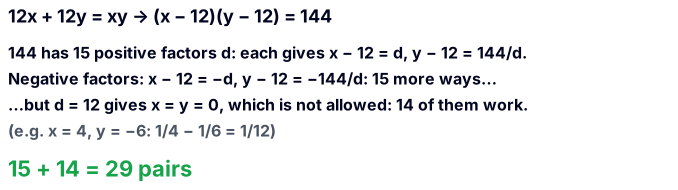
Multiply by 12xy: 12y + 12x = xy, so (x − 12)(y − 12) = 144. 144 has 15 positive factors, giving 15 pairs. Negative factor pairs give 15 more, but −12 × −12 makes x = y = 0, which is not allowed: 14. Total 15 + 14 = 29.
Why it works: adding 144 to xy − 12x − 12y completes a product, turning the equation into a list of factor pairs of 144. With negatives allowed, both factors can be negative too, but then x and y must stay nonzero. Check: x − 12 = −8, y − 12 = −18 gives (4, −6), and 1/4 − 1/6 = 1/12. Common wrong answer: 15 (positive pairs only), or 30 (not removing (0, 0)).
More CML practice for grade 7
We don’t have a CML guide for grade 7 yet. For more practice at this level, try our free MOEMS Division M problems, also write-in, or our AMC 8 practice problems. Practice for the other grades: Grade 2 · Grade 3 · Grade 4 · Grade 5 · Grade 6 · Grade 8. All seven grades, and two full practice meets, are on our Continental Math League practice problems page. For how the season works, read our CML parent’s guide and how to prepare for CML.
This guide is not affiliated with or endorsed by Continental Mathematics League. “Continental Mathematics League” is a trademark of its respective owners.