
Free practice
Free AMC 8 Practice Test with Answers (PDF)
A free, full-length AMC 8 practice test: 25 original questions in the real 40-minute, A–E format, with an answer key and every solution worked out.
AMC 8 full prep and practice guide: Grades 6–8
Printable PDF: all 25 questions on printable pages, then the answer key and every solution.
On this page · 4 sections
A free, full-length AMC 8 practice test: 25 original multiple-choice questions in the same shape as the real paper, with an answer key and a worked solution for every question. Take it here or print it as a PDF. None of the questions comes from a real AMC 8, so it works as a fresh mock test even for a student who has already worked through past papers.
The real AMC 8 is 25 questions in 40 minutes, with five choices (A–E) each and no calculator. The score is the number of correct answers, out of 25, and a wrong answer costs nothing, so a student should answer every question. Like the real paper, this test starts gently and gets harder: #1–5 are warm-ups, and #21–25 are the kind that separate the top scores.
How to take it like the real AMC 8
- Print it, or have scratch paper ready. Pencils, erasers, blank scratch paper and a ruler are fine; calculators, phones and smartwatches are not allowed in the real contest.
- Set a 40-minute timer and work alone, top to bottom. If a question stalls you for more than two minutes, guess, mark it and move on.
- Answer all 25. With no penalty for a wrong answer, a blank is always worse than a guess.
- Score it: one point per correct answer. On this page the solutions start right after question 25 and each one’s heading gives the answer, so don’t scroll past #25 until time is up. The PDF has a one-page answer key.
- Read every solution, including the ones you got right. Each one explains the trap behind the most tempting wrong answer, which is where most points are lost.
What a score means. For a student in 6th grade or below, 15 or more earns a place on MAA’s Achievement Roll, a good first-year target. MAA’s Honor Roll is roughly the top 5% of scores and the Distinguished Honor Roll roughly the top 1%; the cutoffs change every year with the paper. A score on a practice test is a guide, not a prediction: what matters is which kinds of questions cost points.
The 25 problems
Problem 1
Twenty students took a 5-question quiz. The table shows how many students got each number of questions right. How much greater is the mean number of questions right than the median number?

Choices: (A) 0.1 (B) 0.4 (C) 0.6 (D) 1 (E) 2.6
Problem 2
Ravi spent 40% of his savings on a bike. Then he spent 25% of the money he had left on a helmet. After that he had $126. How much did the bike cost?
Choices: (A) $42 (B) $84 (C) $112 (D) $144 (E) $168
Problem 3
A triangle has sides of length 6 cm and 11 cm, as shown, and the length of its third side is a whole number of centimeters. The perimeter of the triangle is an even number of centimeters. How many different lengths are possible for the third side?
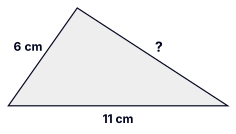
Choices: (A) 5 (B) 6 (C) 10 (D) 11 (E) 16
Problem 4
Machine A fills 45 bottles every 3 minutes, and machine B fills bottles twice as fast as machine A. Machine A starts alone, and 4 minutes later machine B starts too. How many minutes after machine A started will 960 bottles be filled?
Choices: (A) 20 (B) 24 (C) 28 (D) 32 (E) 64
Problem 5
ABCDEF is a regular hexagon, and triangle ACD is shaded, as shown. What fraction of the area of the hexagon is shaded?
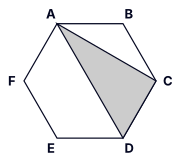
Choices: (A) 1/6 (B) 1/4 (C) 1/3 (D) 1/2 (E) 2/3
Problem 6
A delivery van starts at the warehouse W, visits the three stores A, B and C in any order, and returns to W. The map shows the six roads and their lengths in miles (it is not drawn to scale). What is the length of the shortest possible trip, in miles?
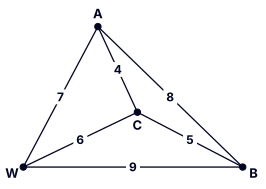
Choices: (A) 22 (B) 25 (C) 26 (D) 27 (E) 39
Problem 7
A fish tank has a square base, 20 cm by 20 cm, and holds water 6 cm deep. The solid metal cube shown, with edges of 10 cm, is then set on the bottom of the tank. By how many centimeters does the water level rise?
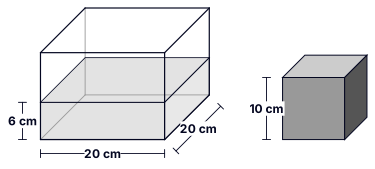
Choices: (A) 2 (B) 2.5 (C) 3 1/3 (D) 4 (E) 8
Problem 8
Two piles of snow start melting at the same moment. Pile A is 90 cm tall and melts away completely in 9 hours. Pile B is 60 cm tall and melts away completely in 12 hours. The height of each pile drops at a steady rate. While both piles still have snow, after how many hours is pile A exactly half as tall as pile B?
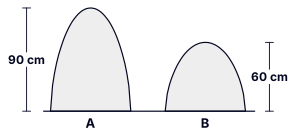
Choices: (A) 4.5 (B) 6 (C) 8 (D) 9 (E) 12
Problem 9
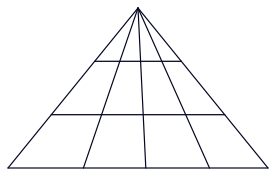
In the figure, three segments join the top corner of the large triangle to points on its bottom side, and two segments are drawn across it parallel to the bottom side. How many triangles of any size are in the figure?
Choices: (A) 10 (B) 12 (C) 20 (D) 27 (E) 30
Problem 10
What is the units digit of 1¹ + 2² + 3³ + 4⁴ + 5⁵ + 6⁶ + 7⁷ + 8⁸ + 9⁹ + 10¹⁰?
Choices: (A) 3 (B) 5 (C) 7 (D) 8 (E) 9
Problem 11
The chairs in rooms A and B are in the ratio 9 : 4. After 24 chairs are carried from room A to room B, the ratio becomes 3 : 4. How many chairs are there in the two rooms together?
Choices: (A) 24 (B) 39 (C) 52 (D) 63 (E) 91
Problem 12
What is the value of the sum 1/(1 × 3) + 1/(3 × 5) + 1/(5 × 7) + … + 1/(23 × 25)?
Choices: (A) 12/25 (B) 1/2 (C) 13/25 (D) 24/25 (E) 25/26
Problem 13
A list of numbers has mean 20. If the largest number is removed, the mean of the numbers left is 18. If instead the smallest number is removed, the mean of the numbers left is 21. The largest number is 3 times the smallest. What is the range of the list?
Choices: (A) 9 (B) 12 (C) 18 (D) 24 (E) 36
Problem 14
What is the smallest odd positive integer that has exactly 8 positive divisors?
Choices: (A) 27 (B) 45 (C) 81 (D) 105 (E) 135
Problem 15
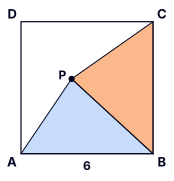
Point P is chosen at random inside square ABCD, which has side length 6, as shown. What is the probability that triangle ABP has an area greater than 6 and less than 12, and triangle BCP has an area less than 6?
Choices: (A) 1/9 (B) 1/6 (C) 2/9 (D) 1/3 (E) 4/9
Problem 16
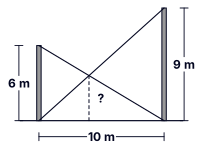
Two vertical poles stand on level ground, 10 m apart. One is 6 m tall and the other is 9 m tall. A rope is stretched tight from the top of each pole to the bottom of the other, as shown. How high above the ground do the two ropes cross, in meters?
Choices: (A) 3 (B) 3.6 (C) 4.5 (D) 5.4 (E) 7.5
Problem 17
In trapezoid ABCD, side AB is parallel to side DC. The diagonals AC and BD cross at P. Triangle ABP has area 25 and triangle CDP has area 9, as shown. What is the area of the trapezoid?
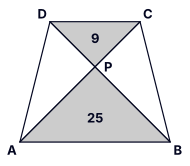
Choices: (A) 34 (B) 49 (C) 50 (D) 64 (E) 68
Problem 18
Each of the eight digits shown is used exactly once to write two four-digit numbers. What is the smallest possible positive difference between the two numbers?

Choices: (A) 247 (B) 249 (C) 445 (D) 469 (E) 1357
Problem 19
Ana and Ben flip a fair coin again and again. Ana wins as soon as two heads in a row appear (HH). Ben wins as soon as a tail is followed right away by a head (TH). What is the probability that Ana wins?
Choices: (A) 1/8 (B) 1/4 (C) 1/3 (D) 1/2 (E) 3/4
Problem 20
Mia writes two positive whole numbers, the second larger than the first. Every number after that is the sum of the two numbers just before it. The eighth number she writes is 2026. How many different pairs of starting numbers are possible?
Choices: (A) 1 (B) 7 (C) 8 (D) 19 (E) 20
Problem 21
Let L(n) be the least common multiple of the whole numbers 1, 2, 3, …, n. For example, L(4) = 12 and L(5) = 60. For how many whole numbers n from 2 to 30 is L(n) greater than L(n − 1)?
Choices: (A) 10 (B) 13 (C) 15 (D) 16 (E) 29
Problem 22
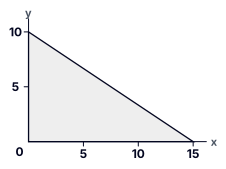
A point (x, y) is a lattice point if x and y are both integers. How many lattice points lie strictly inside the triangle with vertices (0, 0), (15, 0) and (0, 10), not on its sides?
Choices: (A) 59 (B) 61 (C) 63 (D) 65 (E) 75
Problem 23
A path goes from A to B on the grid shown. Each step goes one block right, one block up, or diagonally across one block, up and to the right, as shown. How many different paths are there from A to B?
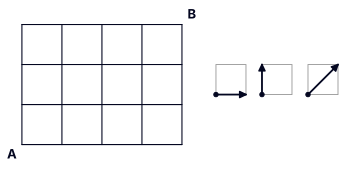
Choices: (A) 35 (B) 63 (C) 94 (D) 99 (E) 129
Problem 24
A game starts with a pile of n counters. Two players take turns, and on each turn a player removes 1, 3 or 4 counters. The player who takes the last counter wins. For how many values of n from 1 to 30 can the first player always win, however the second player plays?
Choices: (A) 9 (B) 21 (C) 22 (D) 24 (E) 30
Problem 25
Right triangle ABC has its right angle at C, hypotenuse AB = 50 and perimeter 120. The altitude from C meets AB at H, and M is the midpoint of AB, as shown. What is the area of triangle CHM?
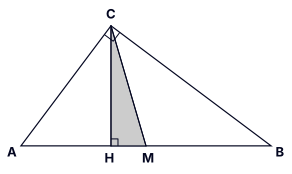
Choices: (A) 7 (B) 12 (C) 25 (D) 84 (E) 168
Solutions
Problem 1
Problem 1: Answer (C) 0.6
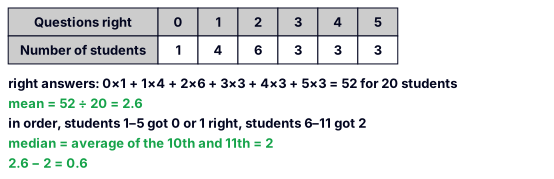
Total the right answers: 0 + 4 + 12 + 9 + 12 + 15 = 52 for 20 students, a mean of 2.6. In order, the 10th and 11th students both got 2 right, so the median is 2.
Why it works: a frequency table lists each value once with how many times it happened, so the total is each value times its count, added up. The median of 20 numbers is the average of the 10th and 11th in order: the first 5 students got 0 or 1 right, and students 6 to 11 got 2, so both middle students got 2. Then 2.6 − 2 = 0.6. Check: 52 ÷ 20 = 2.6 exactly. Common wrong answer: (A) 0.1, taking the median as 2.5, the middle of the row 0 to 5; (B) 0.4, counting to the wrong student and calling the median 3 (then 3 − 2.6); (E) 2.6, the mean itself.
Problem 2
Problem 2: Answer (C) $112
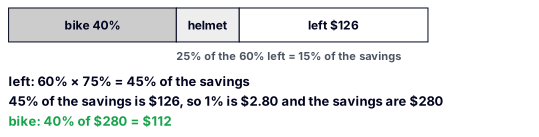
After the bike 60% is left, and the helmet takes a quarter of that, so 60% × 3/4 = 45% of the savings is $126. The savings were $280, and the bike was 40% of it: $112.
Why it works: the 25% is a percent of what was left, not of the savings, so the two percents multiply: 0.6 × 0.75 = 0.45. Then 1% of the savings is 126 ÷ 45 = $2.80, the savings are $280 and the bike cost 40 × $2.80 = $112. Check: $280 − $112 = $168, a quarter of $168 is $42 for the helmet, and $168 − $42 = $126. Common wrong answer: (D) $144, adding 40% and 25% and treating $126 as 35% of the savings; (B) $84, forgetting the helmet so that $126 is 60%; (A) $42, the helmet; (E) $168, the money left after the bike.
Problem 3
Problem 3: Answer (A) 5

The third side must be more than 11 − 6 = 5 and less than 11 + 6 = 17: the whole numbers 6 to 16. The perimeter 17 + side is even only for an odd side: 7, 9, 11, 13, 15.
Why it works: in any triangle each side is shorter than the other two together (the triangle inequality). With sides 6 and 11, the third side c needs c < 6 + 11 = 17 and 11 < 6 + c, so c > 5. That leaves the 11 whole numbers from 6 to 16. Since 6 + 11 = 17 is odd, the perimeter 17 + c is even exactly when c is odd. Check: c = 7 gives 6, 7, 11 with 6 + 7 = 13 > 11, and c = 15 gives 6 + 11 = 17 > 15. Common wrong answer: (D) 11, ignoring the even perimeter; (B) 6, taking the even values of c (an odd perimeter); (C) 10 or (E) 16, miscounting the ends of the range 6 to 16.
Problem 4
Problem 4: Answer (B) 24
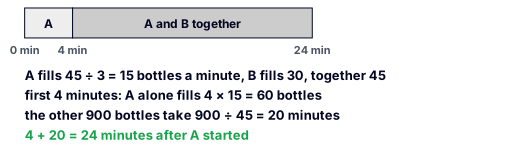
A fills 15 bottles a minute and B 30, so together 45 a minute. In its first 4 minutes A alone fills 60 bottles; the other 900 take 900 ÷ 45 = 20 minutes, ending 24 minutes after A started.
Why it works: turn each machine into a rate per minute first: 45 bottles in 3 minutes is 15 a minute, and twice as fast is 30 a minute. Rates of machines working at the same time add, so together they fill 45 a minute. Split the time into the part with A alone and the part with both. Check: 4 × 15 + 20 × 45 = 60 + 900 = 960. Common wrong answer: (A) 20, the time the two work together, not the time since A started; (C) 28, adding the 4 minutes a second time; (D) 32, machine B alone (960 ÷ 30); (E) 64, machine A alone (960 ÷ 15).
Problem 5
Problem 5: Answer (C) 1/3
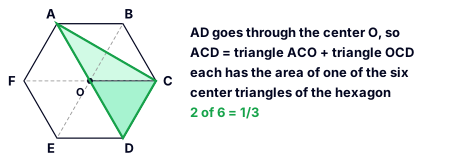
The diagonal AD passes through the center O, so triangle ACD splits into triangles ACO and OCD. Each has the area of one of the six equal triangles that meet at the center: 2 of 6, which is 1/3.
Why it works: joining the center O of a regular hexagon to its six corners makes six equilateral triangles of equal area. Triangle OCD is one of them. OABC is a rhombus made of two of them, and its diagonal AC cuts it into two equal halves, so triangle ACO is worth one center triangle too. Second route: ACDF is a rectangle made of the hexagon minus the corner triangles ABC and DEF (one center triangle each), so it is 4 of 6, and its diagonal AD halves it: 2 of 6. Check: ACD and ADF are each 1/3 of the hexagon and ABC and DEF each 1/6, and 1/3 + 1/3 + 1/6 + 1/6 = 1. Common wrong answer: (D) 1/2, mixing it up with triangle ACE; (E) 2/3, the whole rectangle ACDF; (A) 1/6, only triangle OCD.
Problem 6
Problem 6: Answer (B) 25
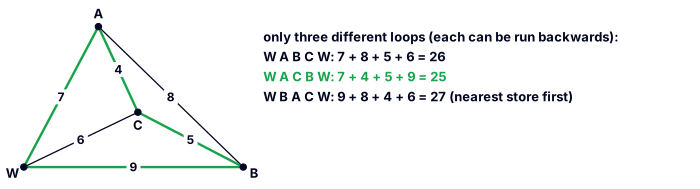
There are only three different loops through A, B and C (each can be driven in two directions): W A B C W = 26, W A C B W = 25 and W B A C W = 27. The shortest is 25 miles.
Why it works: the three stores can be visited in 3 × 2 × 1 = 6 orders, but each order and its reverse use the same roads, so there are 3 loops to add up. Listing them is quicker and safer than guessing: W to A (7), A to C (4), C to B (5), B to W (9) is 25. Check: the loop that starts with the two cheapest roads at W (7 and 6) is forced to use the long road A to B and costs 26; paying 9 at W instead lets the trip use the two short inner roads, 4 and 5. Common wrong answer: (A) 22, adding the four shortest roads, 4 + 5 + 6 + 7, which do not make one loop; (D) 27, always driving to the nearest store next (W to C, then A, then B, then back); (C) 26, the loop round the outside of C.
Problem 7
Problem 7: Answer (A) 2

The 2400 cm³ of water can only spread over the floor around the cube, 400 − 100 = 300 cm². That makes it 2400 ÷ 300 = 8 cm deep, still below the cube’s top, so the level rises 2 cm.
Why it works: the cube is taller than the water, so it is not covered: the water fills the space around it, a region 300 cm² across. The water’s volume does not change, 20 × 20 × 6 = 2400 cm³, so its new depth is 2400 ÷ 300 = 8 cm. Check the assumption: 8 cm < 10 cm, so the cube does stick out. Common wrong answer: (B) 2.5, treating the cube as under water and dividing its whole 1000 cm³ by 400; (C) 3 1/3, dividing 1000 by 300; (D) 4, the 10 − 6 cm of cube above the old water line; (E) 8, the new depth instead of the rise.
Problem 8
Problem 8: Answer (C) 8
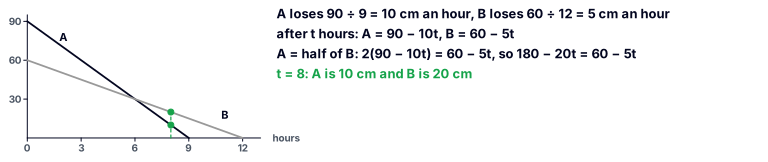
A loses 10 cm an hour and B loses 5 cm an hour, so after t hours they are 90 − 10t and 60 − 5t. A is half of B when 2(90 − 10t) = 60 − 5t, which gives t = 8.
Why it works: a steady drop means the height falls by the same amount each hour: 90 cm in 9 hours is 10 cm an hour, and 60 cm in 12 hours is 5 cm an hour. Then 180 − 20t = 60 − 5t, so 15t = 120 and t = 8. Check: after 8 hours A is 90 − 80 = 10 cm and B is 60 − 40 = 20 cm, and A is not gone yet (that takes 9 hours). Common wrong answer: (B) 6, the time when the two piles are the same height (30 cm); (A) 4.5, when A is half of its own starting height; (D) 9 and (E) 12, when A or B has melted away.
Problem 9
Problem 9: Answer (E) 30

Every triangle has its top at the top corner, two of the 5 lines from that corner as sides, and one of the 3 lines across as its bottom: 10 × 3 = 30.
Why it works: the lines across are parallel, so no triangle uses two of them; a triangle therefore needs two lines through the top corner, and three lines through one point make no triangle. Any 2 of the 5 lines from the top (10 pairs) and any 1 of the 3 lines across (the two segments and the bottom side) close a triangle. Check the top row alone: 10 triangles from the small band at the top, then 10 more ending at each lower line. Common wrong answer: (A) 10, counting only the triangles that reach the bottom side (or only those in the top band); (C) 20, forgetting the bottom side as a line across; (D) 27, leaving out the 3 triangles whose two sides are the big triangle’s own sides (9 pairs × 3); (B) 12, counting the 4 small triangles in each of the 3 bands.
Problem 10
Problem 10: Answer (C) 7
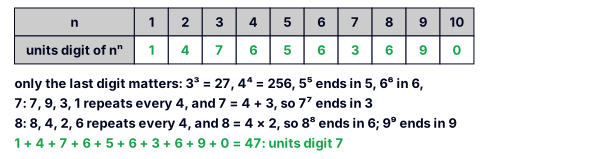
Only last digits matter. The terms end in 1, 4, 7, 6, 5, 6, 3, 6, 9 and 0, which add to 47, so the sum ends in 7.
Why it works: the units digit of a product depends only on the units digits of the factors, so each power can be followed by its last digit alone. 3³ = 27 and 4⁴ = 256; any power of 5 ends in 5 and any power of 6 in 6. For 7 the last digits cycle 7, 9, 3, 1 every 4 steps, and 7 is 3 past a multiple of 4, so 7⁷ ends in 3; for 8 the cycle is 8, 4, 2, 6, and 8 is a multiple of 4, so 8⁸ ends in 6; odd powers of 9 end in 9; 10¹⁰ ends in 0. Check: 7⁷ = 823543 does end in 3. Common wrong answer: (B) 5, adding 1 + 2 + … + 10 = 55 and forgetting the powers; (A) 3 or (E) 9, a slip in the 7 or 8 cycle.
Problem 11
Problem 11: Answer (E) 91

Moving chairs does not change the total. Room A starts with 9/13 of it and ends with 3/7 of it, so it lost 9/13 − 3/7 = 24/91 of the total, which is the 24 chairs: the total is 91.
Why it works: the two ratios cut the same total into different numbers of parts (13 and 7), so compare fractions of the total, not parts. Over a common denominator, 9/13 = 63/91 and 3/7 = 39/91, and the difference 24/91 is exactly what was carried out. With algebra: 4(9k − 24) = 3(4k + 24) gives 24k = 168, so k = 7 and the rooms held 63 and 28. Check: after the move they hold 39 and 52, and 39 : 52 = 3 : 4. Common wrong answer: (D) 63, the chairs first in room A; (A) 24, the chairs moved; (B) 39 or (C) 52, a room after the move.
Problem 12
Problem 12: Answer (A) 12/25

Each term splits in two: 1/(3 × 5) = ½ × (1/3 − 1/5), and so on. Added up, everything in the middle cancels, leaving ½ × (1 − 1/25) = 12/25.
Why it works: two odd numbers 2 apart have 1/a − 1/b = (b − a)/(ab) = 2/(ab), so each term 1/(ab) is half of 1/a − 1/b. Writing all twelve terms that way, −1/3 cancels +1/3, −1/5 cancels +1/5, up to −1/23 against +1/23, and only 1 and −1/25 survive. Check with the first two terms: 1/3 + 1/15 = 6/15 = 2/5, and ½ × (1 − 1/5) = 2/5. Common wrong answer: (D) 24/25, forgetting the ½; (B) 1/2, the value if the sum went on forever; (C) 13/25 or (E) 25/26, slips at the ends.
Problem 13
Problem 13: Answer (D) 24

Work with totals. With n numbers, the largest is 20n − 18(n − 1) = 2n + 18 and the smallest is 20n − 21(n − 1) = 21 − n. Then 2n + 18 = 3(21 − n) gives n = 9: 36 and 12, a range of 24.
Why it works: a mean times the count is a total, and removing one number takes exactly that number off the total, so each removal gives an equation for the number removed. The count n is unknown at first, which is why the last fact (the largest is 3 times the smallest) is needed. Check: 9 numbers total 180; without 36 the 8 left total 144, mean 18; without 12 they total 168, mean 21. Common wrong answer: (A) 9, the count of numbers; (E) 36 and (B) 12, the largest or the smallest; (C) 18, a mean.
Problem 14
Problem 14: Answer (D) 105

A number with 8 divisors is p⁷, p³ × q or p × q × r for different primes. Using odd primes only, the smallest of each kind are 3⁷ = 2187, 3³ × 5 = 135 and 3 × 5 × 7 = 105.
Why it works: if n = pᵃ × qᵇ × …, a divisor picks an exponent from 0 to a for p, from 0 to b for q, and so on, so n has (a + 1)(b + 1)… divisors. Eight is 8, 4 × 2 or 2 × 2 × 2, which gives the three shapes. An odd number cannot use the prime 2, so the smallest primes allowed are 3, 5 and 7. Check: 105 has the divisors 1, 3, 5, 7, 15, 21, 35 and 105. Common wrong answer: (E) 135, trying only the p³ × q shape; (B) 45, which has 6 divisors (3² × 5); (A) 27 and (C) 81, powers of 3 with 4 and 5 divisors.
Problem 15
Problem 15: Answer (A) 1/9
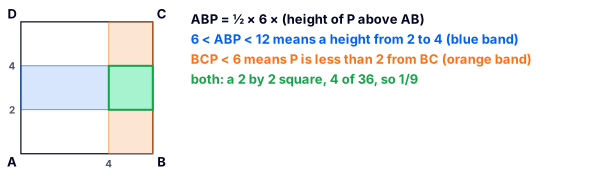
ABP has base 6, so its area is 3 times P’s height above AB: a height from 2 to 4. BCP < 6 puts P within 2 of BC. Both hold on a 2 by 2 square: 4/36 = 1/9.
Why it works: the area of a triangle is half its base times its height, and the height of triangle ABP is the distance from P to the line AB. So each area condition is really a distance condition, and each picks out a strip of the square: a horizontal band 2 units tall and a vertical band 2 units wide along BC. A random point is equally likely to be anywhere, so the probability is the share of the area: the bands cross in a 2 by 2 square out of 6 × 6 = 36. Check: each band alone is 12/36 = 1/3, and 1/3 × 1/3 = 1/9 because one band fixes only up–down and the other only left–right. Common wrong answer: (D) 1/3, using only one of the two conditions; (C) 2/9, taking BCP < 6 as P within 4 of BC (a 2 by 4 rectangle, 8/36); (E) 4/9, making both bands 4 wide (a 4 by 4 square, 16/36); (B) 1/6, taking the height band as 2 to 5 (a 2 by 3 rectangle, 6/36).
Problem 16
Problem 16: Answer (B) 3.6
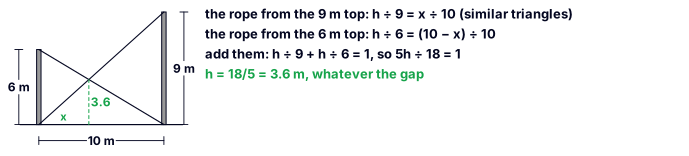
Let the ropes cross at height h, x meters from the 6 m pole. Similar triangles give h/9 = x/10 and h/6 = (10 − x)/10. Adding: h/9 + h/6 = 1, so h = 18/5 = 3.6 m.
Why it works: the rope from the top of the 9 m pole to the foot of the other makes a triangle with the ground that contains a smaller copy of itself under the crossing point, so h is to 9 as x is to 10; the other rope gives h to 6 as (10 − x) to 10. Adding the two equations makes the x’s cancel, which is why the 10 m never matters: h = 6 × 9 ÷ (6 + 9). Check: x = 4, and the rope from (0, 6) to (10, 0) is at height 6 − 0.6 × 4 = 3.6 there. Common wrong answer: (E) 7.5, averaging the two poles; (A) 3 and (C) 4.5, half of one pole; (D) 5.4, using the 10 m gap as 6 × 9 ÷ 10.
Problem 17
Problem 17: Answer (D) 64
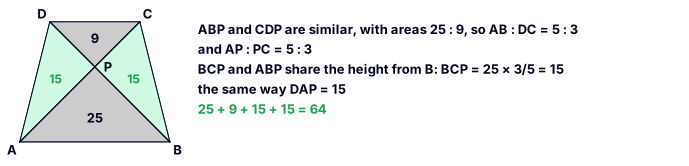
Triangles ABP and CDP are similar with areas 25 : 9, so AP : PC = 5 : 3. Triangle BCP shares its height from B with ABP, so it has area 25 × 3/5 = 15; so does DAP. Total 25 + 9 + 15 + 15 = 64.
Why it works: AB is parallel to DC, so the angles at P match and triangle ABP is a scaled copy of triangle CDP. Areas scale by the square of the lengths, and 25 : 9 = 5² : 3², so every length in ABP is 5/3 of the matching length in CDP, including AP against PC. Triangles with the same height have areas in the ratio of their bases, which gives BCP = 15 and DAP = 15. Shortcut: the trapezoid is (√25 + √9)² = 8² = 64. Check: the side triangles always have equal area, and 15 × 15 = 25 × 9. Common wrong answer: (E) 68, taking each side triangle as the average 17; (A) 34, adding only the two given areas; (B) 49, counting only one side triangle; (C) 50, doubling 25.
Problem 18
Problem 18: Answer (A) 247

Make the thousands digits differ by 1, then make the larger number as small as possible and the smaller as large as possible: 5123 − 4876 = 247.
Why it works: the thousands digits decide most of the difference, so they should be consecutive; then the difference is 1000 minus (the smaller number’s last three digits − the larger number’s last three digits), which is smallest when the larger number continues with the three smallest digits left and the smaller with the three largest. Which consecutive pair to use? With 4 and 3 the larger number gets 1, 2, 5 and the smaller 8, 7, 6: 4125 − 3876 = 249. With 5 and 4 the leftovers are 1, 2, 3 and 6, 7, 8: 5123 − 4876 = 247, the best (other pairs keep 1, 2 or 7, 8 away). Common wrong answer: (B) 249, choosing 4 and 3 in front; (C) 445, putting the small number’s digits in increasing order, 5123 − 4678; (D) 469, 2345 − 1876 with the smallest digits in front; (E) 1357, 5678 − 4321.
Problem 19
Problem 19: Answer (B) 1/4
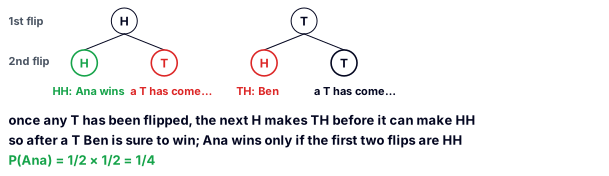
Once a tail has been flipped, the next head completes TH before HH can appear, so Ben wins. Ana wins only if the very first two flips are both heads: 1/2 × 1/2 = 1/4.
Why it works: for HH to come first, the first head of the pair HH must not follow a tail, otherwise that tail and head already made TH. So the HH must start at flip 1, and there can be no tail before it. Every game that starts with a tail, or with HT, has a tail in it and Ben wins as soon as the next head appears. Check: of the four ways the first two flips can go, HH is Ana’s, TH is Ben’s at once, and HT and TT are Ben’s later: 1 out of 4. Common wrong answer: (D) 1/2, assuming the two patterns are equally likely because each is two flips; (E) 3/4, Ben’s chance; (C) 1/3 and (A) 1/8, from listing outcomes that are not equally likely.
Problem 20
Problem 20: Answer (C) 8

Call the first two numbers a and b. The eighth is 8a + 13b, so 8a + 13b = 2026. That needs b = 2, 10, 18, …, up to 154 (20 pairs), and a < b leaves b = 98, 106, …, 154: 8 pairs.
Why it works: the numbers are a, b, a + b, a + 2b, 2a + 3b, 3a + 5b, 5a + 8b, 8a + 13b. For a to be a whole number, 2026 − 13b must be a multiple of 8; since 2026 and 13 leave remainders 2 and 5 on division by 8, 5b must leave 2, which happens for b = 2, 10, 18, …. For a > 0 we need 13b < 2026, so b ≤ 154, and for a < b we need 2026 − 13b < 8b, so b ≥ 97. Check: b = 98 gives a = (2026 − 1274) ÷ 8 = 94, and 94, 98, 192, 290, 482, 772, 1254, 2026. Common wrong answer: (E) 20, forgetting that the second number is larger; (D) 19 and (B) 7, off by one at an end; (A) 1, stopping at the first pair found.
Problem 21
Problem 21: Answer (D) 16
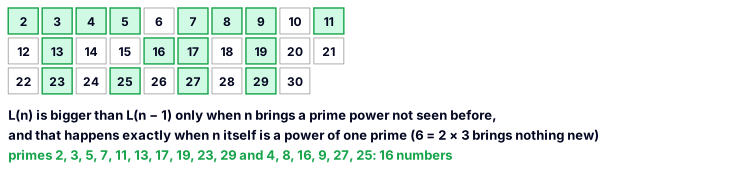
L(n) is bigger than L(n − 1) exactly when n is a power of a single prime. From 2 to 30: the 10 primes and 4, 8, 16, 9, 27, 25, so 16 values.
Why it works: L(n − 1) already contains the highest power of each prime up to n − 1. If n is a power of one prime, say 2⁴ = 16, then L(15) has only 2³, so the LCM must gain another factor 2. If n has two different primes, say 12 = 4 × 3, each of its prime powers is smaller than n and already divides L(n − 1), so nothing changes. Check: L(5) = 60, L(6) = 60 (6 = 2 × 3 brings nothing new), L(7) = 420. Common wrong answer: (A) 10, counting only the primes; (B) 13, missing 16, 25 and 27; (C) 15, missing one of the powers; (E) 29, every n.
Problem 22
Problem 22: Answer (B) 61
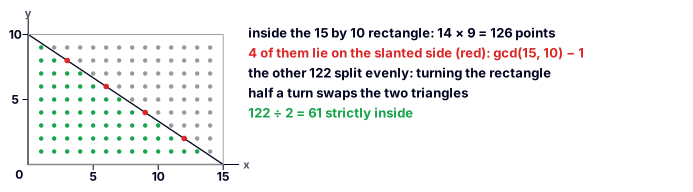
Complete the 15 by 10 rectangle: it has 14 × 9 = 126 lattice points inside. The slanted side passes through 4 of them, and the other 122 split evenly between the two triangles: 61.
Why it works: turning the rectangle half a turn about its center swaps the two triangles and sends lattice points to lattice points, so both triangles hold the same number. The slanted side goes from (15, 0) to (0, 10), dropping 2 for every 3 across, so it hits lattice points at (3, 8), (6, 6), (9, 4) and (12, 2): gcd(15, 10) − 1 = 4 of them. Check by columns: x = 1, 2, …, 14 allow y up to 9, 8, 7, 7, 6, 5, 5, 4, 3, 3, 2, 1, 1, 0 points strictly below the side: 61. Common wrong answer: (C) 63, halving 126 without taking out the points on the slanted side; (D) 65, adding them back in; (A) 59, taking them out twice; (E) 75, the area of the triangle.
Problem 23
Problem 23: Answer (E) 129
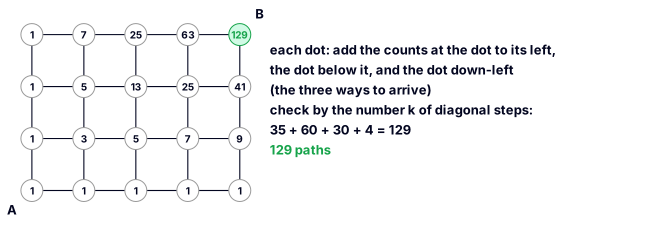
A path reaches a dot from the left, from below or diagonally from the lower left, so the number of paths to each dot is the sum of those three counts. Filling in the grid row by row gives 129 at B.
Why it works: every path to a dot has a last step, and the three kinds of last step split the paths into three groups that don’t overlap, so their counts add. The bottom row and left column are all 1s; the first row up reads 1, 3, 5, 7, 9; the next 1, 5, 13, 25, 41; the top 1, 7, 25, 63, 129. Second route: with k diagonal steps a path has 4 − k rights and 3 − k ups, and arranging them gives 35 + 60 + 30 + 4 = 129 for k = 0, 1, 2, 3. Common wrong answer: (A) 35, forgetting the diagonal steps; (B) 63, the count for a 3 by 3 grid; (C) 94, leaving out the 35 paths with no diagonal; (D) 99, adding only two of the three neighbors at some dots.
Problem 24
Problem 24: Answer (B) 21
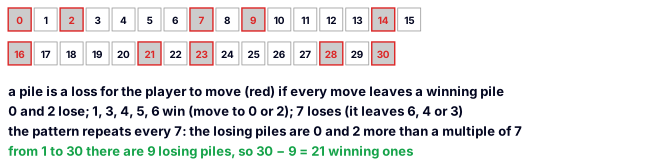
Work up from 0: a pile loses for the player to move if every move leaves a winning pile. The losing piles are 0 and 2 more than multiples of 7, nine of them from 1 to 30, so 21 win.
Why it works: a pile is winning if some move reaches a losing pile, and losing if no move does. 0 loses (no counters left: the opponent took the last one); 1, 3 and 4 win by moving to 0; 2 loses (it can only go to 1); 5 and 6 win by moving to 2; 7 loses, since 6, 4 and 3 all win. Each pile depends only on the 4 piles just below it, so once 7 to 10 match 0 to 3, the pattern lose, win, lose, win, win, win, win repeats every 7. Check: from 9 the moves reach 8, 6 and 5, all winning, so 9 loses. Common wrong answer: (A) 9, the number of losing piles; (C) 22, counting 30 as a win; (D) 24, a slip in the pattern; (E) 30, thinking the first player can always win.
Problem 25
Problem 25: Answer (D) 84
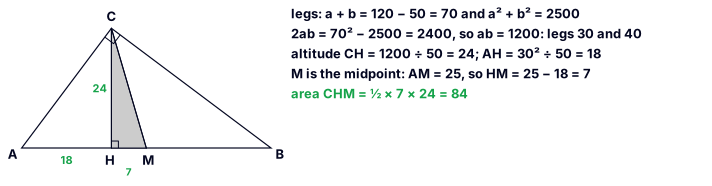
The legs add to 120 − 50 = 70, and 2ab = 70² − 50² = 2400, so the altitude is ab ÷ 50 = 1200 ÷ 50 = 24. CM is half the hypotenuse, 25, so HM = 7 and the area is ½ × 7 × 24 = 84.
Why it works: (a + b)² = a² + b² + 2ab, and a² + b² = 50² by Pythagoras, so 2ab = 4900 − 2500 = 2400 and ab = 1200 without finding the legs. Twice the area is both a × b and AB × CH, so CH = 1200 ÷ 50 = 24. The midpoint of the hypotenuse is the center of the circle through A, B and C, so CM = 25, and right triangle CHM has legs CH = 24 and HM = √(25² − 24²) = 7. Second route: the legs are 30 and 40 (they add to 70 and multiply to 1200), AH = 30² ÷ 50 = 18 by similar triangles, and HM = 25 − 18 = 7. Check: 18 × 32 = 576 = 24². Common wrong answer: (B) 12, taking HM as 25 − 24 = 1; (A) 7 and (C) 25, the lengths HM and CM instead of an area; (E) 168, forgetting the ½.
More AMC 8 practice tests and past papers
- Official AMC 8 sample test (free): MAA posts the 2023 AMC 8 as a free sample competition, with solutions. It is the best second timed run after this one.
- Official past tests (paid): MAA sells collections of past AMC 8 competitions in its store. Online archives of past problems are fine for extra practice; for rules and dates, use MAA’s own site.
- Our 10 free AMC 8 practice problems: write-in problems from mid-paper level to the hardest, each with a full solution. Good for working on one question at a time.
- Our AMC 8 prep guide: 12 chapters, 120 original practice problems with step-by-step solutions, and two more full 25-question practice tests in the real format.
Students in grades 6–8 often take MATHCOUNTS too; our MATHCOUNTS guide for parents explains how its rounds differ from the AMC 8.
Registration goes through a school or local host, not directly through MAA. For this season’s competition window and registration deadlines, see dates and deadlines in our AMC 8 parent’s guide. Our AMC 8 2027 page covers this season’s dates, how to find a host, and when results come out.
This guide is not affiliated with or endorsed by the Mathematical Association of America (MAA) or the American Mathematics Competitions. “AMC 8” is a trademark of its respective owners.