
Free practice
10 Math Kangaroo Practice Problems (Grades 1-2)
Ten original Math Kangaroo-style practice problems for 1st and 2nd graders, with pictures and solutions any parent can walk their child through.
Math Kangaroo full prep and practice guides: 1–2 3–4 5–6 7–8
Printable PDF: all 10 problems with room to work, then every answer explained.
On this page · 5 sections
Math Kangaroo is held once a year in March (see the Math Kangaroo 2027 date and registration timeline for this season’s date and how to sign up). First and second graders take the Grades 1-2 level, and kindergartners can join them at grade 1. If you’re looking for Math Kangaroo practice problems for grade 1 or grade 2, here is the test: 24 multiple-choice questions in 75 minutes, five answer choices each, worth 3, 4 or 5 points (eight of each, so the best score is 96). Wrong answers cost nothing, so your child should answer every one.
The official Grades 1-2 sample questions lean heavily on pictures, so each of the ten original problems below has one too, plus a worked solution with the most common wrong answer. Here your child writes each answer in instead of picking from five, so there’s no guessing. Let them try every problem alone, then go through the answers together. For levels and scoring in full, see our complete Math Kangaroo format guide.
How to Use These Sample Questions with a 6- or 7-Year-Old
A few things make practice go better at this age:
- Read each problem aloud together the first time, then let your child reread it. On contest day they’ll be reading on their own, so a second, independent read is good practice.
- Put out a pencil, paper, and a handful of coins or small toys. Most of these problems get easier the moment a child can draw them or move objects around.
- Skip the timer. Two or three problems in a 15-minute sitting is plenty for a first grader.
- Ask “how do you know?” before you check the answer. The explanation tells you more than the answer does.
The 10 problems
Problem 1
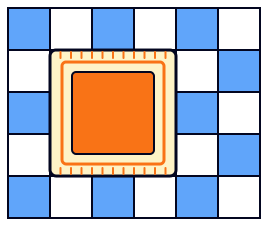
The floor has blue and white tiles in a pattern. A rug lies on top of some tiles. How many blue tiles are under the rug?
Problem 2
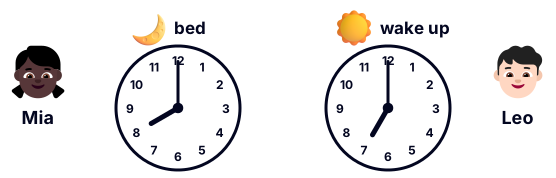
The clocks show when Mia goes to bed and when she wakes up the next morning. Leo goes to bed 2 hours later than Mia and wakes up 1 hour earlier. How many hours does Leo sleep?
Problem 3
Ben lays 3 paper strips in a row. The strips are all the same. Each strip lies a little on top of the next one, the same amount each time. How long is each overlap?
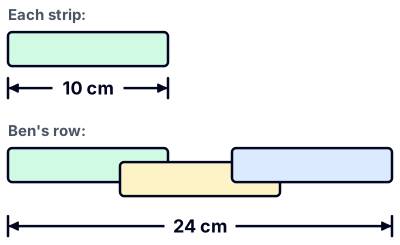
Tip: First think: how long would the row be if the strips did not overlap?
Problem 4
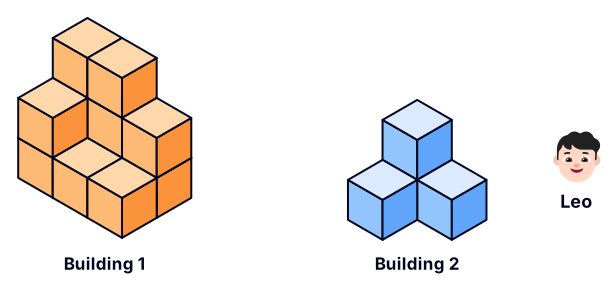
Every cube sits on the floor or on another cube. No stack is hidden behind another. Leo moves cubes from one building to the other until both have the same number. What is the fewest cubes he can move?
Problem 5
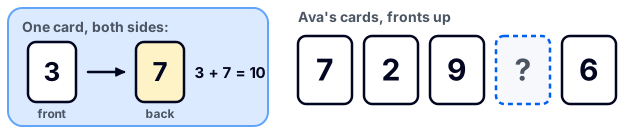
On every card, the numbers on its two sides add up to 10, like the example. The backs of Ava’s 5 cards add up to 22. What number is on the hidden front?
Problem 6
For 10 days, Sam eats one snack each day, as the card shows. He eats 9 strawberries in all. How many bananas does he eat?

Problem 7
The small gear turns all the way around 3 times. How many times does the big gear turn all the way around?
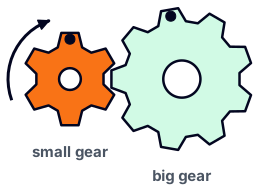
Fact: When gears turn, each tooth pushes one tooth of the other gear.
Problem 8
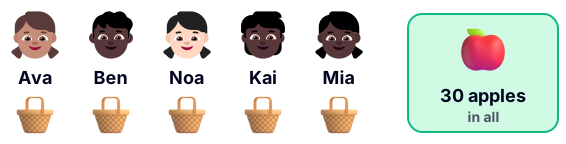
Five friends picked the apples. Each friend picked a different number of apples, and each picked at least 3. What is the most apples one friend can have picked?
Problem 9
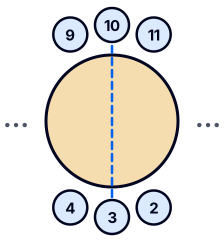
★ Challenge. Chairs stand evenly around a round table, numbered 1, 2, 3 and so on, in order. Only some chairs are drawn. Chair 3 is right across from chair 10. Which chair is right across from chair 13?
Problem 10
★ Challenge. Rosa colors exactly 2 more white squares yellow. Then the cat must be able to walk to the fish on yellow squares, stepping over sides, not corners. How many different ways can Rosa pick her 2 squares?
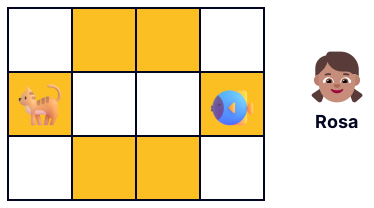
Tip: Find the easy ways first. Then look for ways that mix two paths.
Solutions
Problem 1
Problem 1: Answer 5 tiles
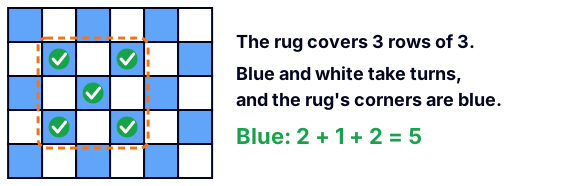
The rug covers 3 rows of 3 tiles. Blue and white take turns, so the rows under it go blue-white-blue, white-blue-white, blue-white-blue. That is 2 + 1 + 2 = 5!
For the grown-up: two steps. First find the size of the hidden block from the tiles you can see around it (3 across, 3 down, so 9 tiles). Then carry the pattern inside: the tile in the rug’s top-left corner is blue, because it sits diagonally from the blue top-left tile of the floor, and tiles that touch corners have the same color. Check: 5 blue and 4 white make the 9 hidden tiles. Common wrong answer: 4 (half of 9 rounded down, or starting the pattern with white), or 9 (all the tiles under the rug).
Problem 2
Problem 2: Answer 8 hours
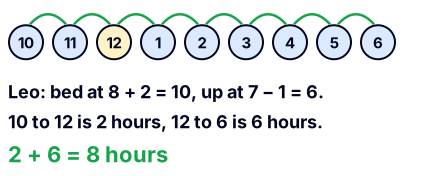
Mia goes to bed at 8, so Leo goes at 10. Mia wakes at 7, so Leo wakes at 6. From 10 to 12 is 2 hours, from 12 to 6 is 6 more. 2 + 6 = 8!
For the grown-up: first read Mia’s clocks and move each time (2 hours later: 10 o’clock; 1 hour earlier: 6 o’clock). Then count the hours across 12, where the clock starts again, so you can’t just subtract. Check: Mia sleeps 11 hours (8 to 7), and Leo loses 2 hours at night and 1 in the morning, 11 − 3 = 8. Common wrong answer: 4 (10 − 6, as if he woke before bed), 11 (Mia’s sleep), or 14 (adding the 3 hours instead of taking them away).
Problem 3
Problem 3: Answer 3 cm
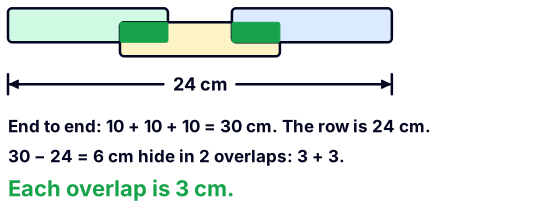
End to end, 3 strips would be 10 + 10 + 10 = 30 cm. The row is only 24 cm, so 6 cm are hiding. There are 2 overlaps, 3 + 3 = 6. Each one is 3 cm!
For the grown-up: three steps. Find the length with no overlap, compare it with the real row to see how much is hidden, then share that between the overlaps. There are only 2 overlaps for 3 strips (one between each pair), like 2 gaps between 3 fence posts. Check: 10 + 7 + 7 = 24 (the first strip, then 7 cm of each new strip sticks out). Common wrong answer: 2 (sharing the 6 cm among 3 overlaps), or 6 (the total hidden, not one overlap).
Problem 4
Problem 4: Answer 4 cubes
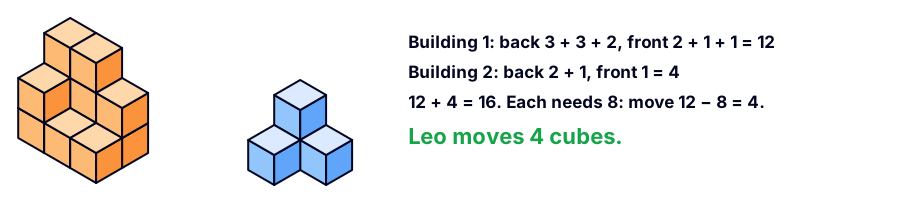
Building 1 has 3 + 3 + 2 at the back and 2 + 1 + 1 in front: 12 cubes. Building 2 has 4. Together 16, so each needs 8. Leo moves 12 − 8 = 4!
For the grown-up: first count each building stack by stack: a cube on top means there are cubes under it, even when you can’t see them (every cube sits on the floor or on another cube, and no stack hides behind another). Then even out: each building gets half of 16. Moving 4 makes the big one 4 smaller and the small one 4 bigger, which closes a gap of 8. Check: 12 − 4 = 8 and 4 + 4 = 8. Common wrong answer: 8 (the difference, but each cube moved changes both buildings), or 3 (counting only the cubes you can see).
Problem 5
Problem 5: Answer 4
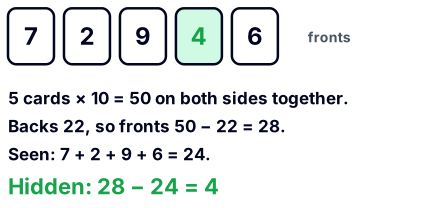
Each card makes 10, so all 5 cards make 50 on both sides. The backs make 22, so the fronts make 50 − 22 = 28. The fronts I see make 7 + 2 + 9 + 6 = 24. The hidden one is 28 − 24 = 4!
For the grown-up: the idea is to think about all the cards at once: fronts plus backs make 5 × 10 = 50, so knowing the backs’ total gives the fronts’ total. A second way: the four backs you can work out are 3, 8, 1 and 4, which make 16, so the hidden card’s back is 22 − 16 = 6 and its front is 10 − 6 = 4. Check: the backs 3, 8, 1, 6, 4 make 22. Common wrong answer: 6 (the hidden card’s back, not its front), or 28 (the total of all five fronts, stopping one step early).
Problem 6
Problem 6: Answer 14 bananas
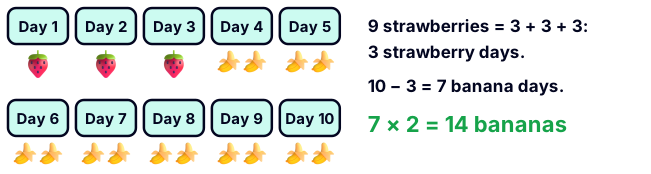
9 strawberries is 3 + 3 + 3, so 3 strawberry days. The other 10 − 3 = 7 days are banana days. 7 days of 2 bananas is 14!
For the grown-up: three steps. Turn the strawberries into days, find the days that are left, then turn those days into bananas. Each day is one snack or the other, never both, so the days split into two groups. Check: 3 days × 3 = 9 strawberries and 7 days × 2 = 14 bananas, 10 days in all. Common wrong answer: 7 (the number of banana days, not bananas), or 2 (one day’s bananas).
Problem 7
Problem 7: Answer 2 times

The small gear has 6 teeth. 3 turns push 6 + 6 + 6 = 18 teeth. The big gear has 9 teeth, and 18 = 9 + 9. It turns 2 times!
For the grown-up: gears don’t move “turn for turn”; they move tooth for tooth. So count teeth: the small gear pushes 18 teeth past the meeting point, and the big gear needs 9 of them for each full turn. Check with the dots: after one small turn the big gear has moved 6 of its 9 teeth, after two turns 12 (one turn and 3 more), after three turns 18 (exactly two turns). Common wrong answer: 3 (as if both gears turn the same), or 4 or 5 (thinking the big gear turns more because it is bigger).
Problem 8
Problem 8: Answer 12 apples
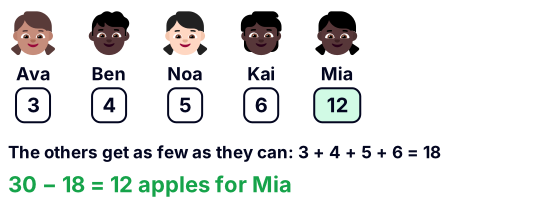
To give one friend the most, give the other four as few as they can: 3, 4, 5 and 6. That is 18. 30 − 18 = 12!
For the grown-up: the key idea is “make the others small”. Every apple the other four don’t take can go to the fifth friend, so give them the smallest amounts allowed: all different and at least 3 means 3, 4, 5, 6. Check: 3 + 4 + 5 + 6 + 12 = 30, all five are different, and 12 is the biggest; if one friend had 13, the other four would need 17, but they need at least 18. Common wrong answer: 26 (giving the others 1 each, ignoring both rules), or 18 (giving the others 3 each and forgetting they must be different).
Problem 9
Problem 9: Answer chair 6
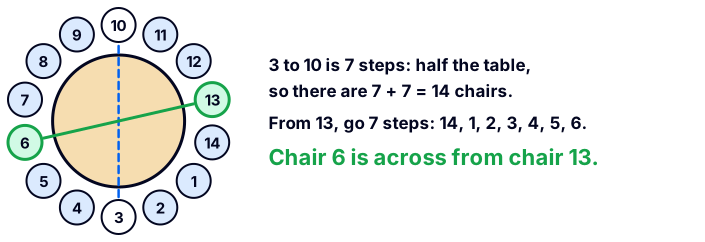
From chair 3 to chair 10 is 7 steps, and that is half the table. So there are 7 + 7 = 14 chairs. From 13, go 7 steps: 14, 1, 2, 3, 4, 5, 6. Chair 6!
For the grown-up: “right across” cuts the circle into two equal halves, so 7 steps is half the table: 14 chairs. Then go half the table from 13, remembering that chair 1 comes after chair 14. Check: 6 + 7 = 13, so 13 is 7 steps from 6 the other way too. Common wrong answer: 20 (13 + 7, not starting again after 14), 16 (counting chairs 3 to 10 as 8 and doubling), or 12 (only the 6 chairs between 3 and 10 on each side).
Problem 10
Problem 10: Answer 7 ways

The 3 easy ways: straight across the middle, over the top, under the bottom. Then 4 mixed ways: start in the middle and finish over the top or under, or start over the top or under and finish in the middle. 3 + 4 = 7!
For the grown-up: one new square is never enough, so every way uses both. The middle square beside the cat already touches the yellow squares above and below it, so it joins either path, and the same holds beside the fish. List in order: middle + middle, top + top, bottom + bottom, then the 4 mixed pairs. Any other pair leaves a gap. Common wrong answer: 3 (only the straight paths), or 5 (missing some mixed ways).
Tips for 1st and 2nd Graders Before Test Day
- Practice reading problems independently. Math Kangaroo expects students to read and work on their own at their grade level. Start by reading problems together, then gradually let your child take over the first read.
- Always guess. There’s no penalty for wrong answers, so a child should never leave a question blank, even one they don’t understand.
- Practice with pencil and scratch paper, not a calculator. Calculators and smartphones aren’t allowed during the test, and at in-person centers the proctor hands out scratch paper and a pencil. Drawing a quick picture of the problem is a skill worth building now.
- If your child tests online, Math Kangaroo says it’s fine for a parent to help younger children set up and open the test, but the parent shouldn’t stay in the room once the test starts. A practice run at the same desk helps.
- Use the official practice materials too. Math Kangaroo’s Grades 1-2 practice page offers past exams and practice sets sorted by 3-, 4-, and 5-point difficulty, which show your child what the real picture-based questions look like.
- Keep sessions short. Two or three problems, three or four times a week, beats one long Saturday session.
For a month-by-month plan, our sister post on how to prepare for Math Kangaroo walks through the whole season. If you’re still deciding which contests make sense at this age, see our best math competitions for 2nd graders.
More Math Kangaroo Practice for Grades 1-2
If your child enjoyed these, our Math Kangaroo Prep Guide for Grades 1-2 has 12 chapters, one question type at a time, 120 original problems with their points marked like the real paper, two full 24-question practice tests, and every answer explained. There’s a free sample if you’d like to try it first.
You can also browse our Math Kangaroo practice tests and questions page for free practice at every grade level.
This guide is not affiliated with or endorsed by Math Kangaroo USA or Kangourou sans Frontières. “Math Kangaroo” is a trademark of its respective owners.