Free practice
10 Math Kangaroo Practice Problems (Grades 3-4)
Ten original Math Kangaroo-style practice problems for grades 3-4, from warm-ups to the hardest 5-point kind, with every answer explained.
Math Kangaroo full prep and practice guides: 1–2 3–4 5–6 7–8
Free practice, other grades: 1–2 5–6 7–8
Other contests, grades 3–4: Noetic 3 Noetic 4 MOEMS Div E CML 3 CML 4
Printable PDF: all 10 problems with room to work, then every answer explained.
On this page · 3 sections
Ten original Math Kangaroo practice problems for grades 3–4, each with a worked solution and the most common wrong answer, also as a printable PDF. Problems 1–3 warm up, 4–8 are contest level, and the two ★ problems are as hard as the hardest on the paper.
The real Levels 3–4 paper has 24 multiple-choice questions in 75 minutes, five answer choices each. Questions 1–8 are worth 3 points, 9–16 are worth 4 and 17–24 are worth 5, so the top score is 96, and a wrong answer costs nothing. Here your child writes each answer in instead of picking from five, so there is nothing to guess from. Math Kangaroo is held on the third Thursday in March; see the Math Kangaroo 2027 date and registration timeline for fees and how to sign up.
For levels and scoring in full, see our Math Kangaroo format guide. For the official sample questions and past papers, see where to find Math Kangaroo past papers.
The 10 problems
Problem 1
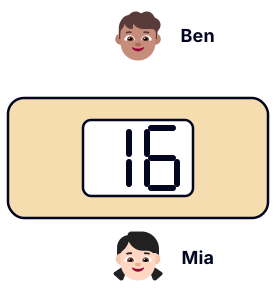
Mia and Ben sit on opposite sides of a table. Mia reads the number 16 on the card between them. Ben sees the same card upside down, so he reads a different number. How much bigger is Ben’s number than Mia’s?
Problem 2
Leo starts with one sheet of paper. Each time, he takes one piece and cuts it into 4 smaller pieces. The picture shows the first 2 times. How many pieces does he have after 6 times?

Problem 3
Ivy folds this net into a cube. She puts the cube on the table with the 6 on the bottom. What is the sum of the numbers on the four side faces?
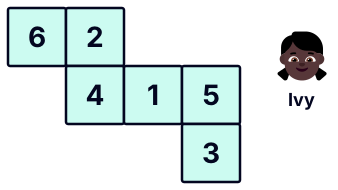
Fact: Two faces that are opposite each other on a cube never touch.
Problem 4
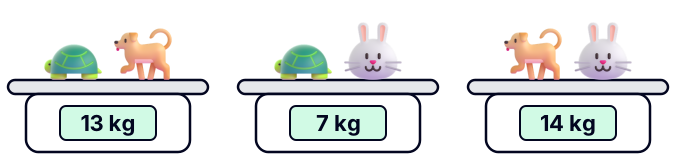
Each pet was weighed together with one other pet, as the scales show. How much does the dog weigh?
Problem 5
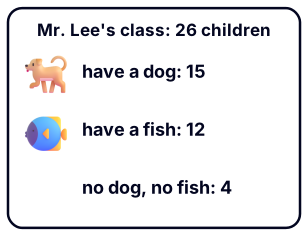
Every child in Mr. Lee’s class was asked two questions: “Do you have a dog?” and “Do you have a fish?” The board shows the answers. How many children have both a dog and a fish?
Problem 6
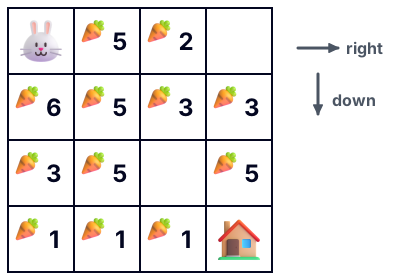
The rabbit hops from its square to its house, one square at a time, always to the right or down. The number in each square tells how many carrots are there. It eats all the carrots on every square it lands on. What is the largest number of carrots it can eat?
Problem 7
Sam writes a whole number in every box. Any 3 boxes next to each other add up to 15. What number goes in the box with the star?
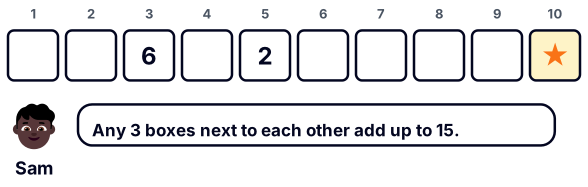
Trick: Compare boxes 1, 2, 3 with boxes 2, 3, 4. Which boxes do they share?
Problem 8
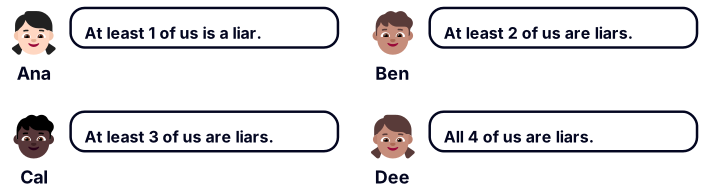
Each of these four children either always tells the truth or always lies. How many of them are liars?
Problem 9
★ Challenge. Tom builds numbers from matchsticks, making each digit as shown. He uses exactly 11 matchsticks, with none left over. What is the largest number he can build?

Problem 10
★ Challenge. Ella paints each of the 6 boards of her fence red or blue. No two red boards may be next to each other. All blue is allowed. Two fences are different if any board has a different color. How many different fences can she paint?
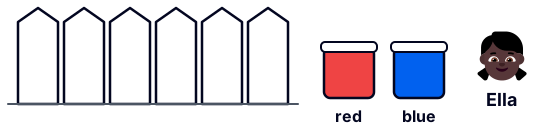
Tip: Sort the fences: no red board, then 1 red board, then 2 red boards, and so on.
Solutions
Problem 1
Problem 1: Answer 75

Upside down, the 6 looks like a 9, and it moves to the front. Ben reads 91. 91 − 16 = 75!
For the grown-up: turning a card upside down does two things at once: the digits swap ends (the last digit is now on Ben’s left), and each digit turns over (1 stays 1, 6 becomes 9). Children usually catch one change and miss the other. Check with a real card: write 16 in digital-clock style, turn it round and read it. Common wrong answer: 45 (61 − 16: swapping the digits but not turning the 6), or 3 (19 − 16: turning the 6 but leaving it at the back).
Problem 2
Problem 2: Answer 19 pieces

Each time, one piece becomes 4 pieces: that is 3 more. 1, 4, 7, 10, 13, 16, 19!
For the grown-up: look at what changes each time, not at which piece is cut: one piece turns into four, so the count grows by 3 every time. From 1 sheet, 6 times gives 1 + 6 × 3 = 19. Check with the picture: after 1 time there are 4 pieces and after 2 times 7, which is 1 + 3 and 1 + 3 + 3. Common wrong answer: 24 (6 × 4, as if each time made 4 new pieces out of nothing), or 22 (starting from 4 and then adding 3 six more times).
Problem 3
Problem 3: Answer 14
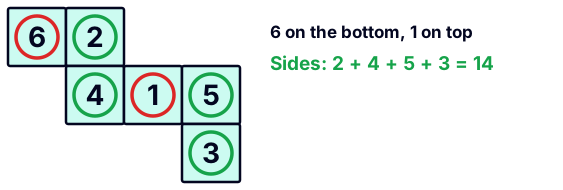
Fold it: the 1 lands on top, across from the 6. The sides are 2, 4, 5 and 3: 2 + 4 + 5 + 3 = 14!
For the grown-up: stand the 6 on the table and fold the rest up around it. The 2 and the 4 fold up as two walls, the 1 folds over as the lid, the 5 hangs down from the lid, and the 3 folds around from the 5 as the last wall. Shortcut once the top is known: the six numbers add up to 21, and 21 − 6 − 1 = 14. Check: 4 and 5 are two apart in a straight row, so they are opposite walls; 2 and 3 are the other pair of walls. Common wrong answer: 15 (21 − 6, forgetting the top), or 11 (taking the 4 as the top because it is close to the 6 in the net).
Problem 4
Problem 4: Answer 10 kg
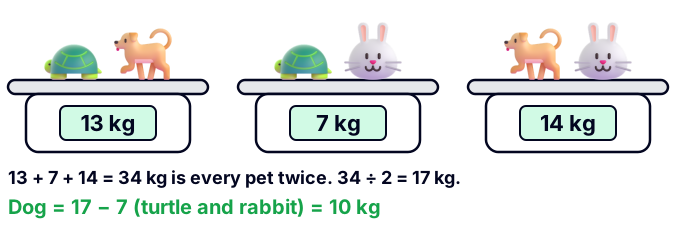
13 + 7 + 14 = 34 kg weighs every pet twice. So the three pets together weigh 17 kg. Take away the turtle and the rabbit (7 kg): the dog is 10 kg!
For the grown-up: each pet stands on exactly two of the three scales, so adding all three readings gives two turtles, two dogs and two rabbits. Half of that, 17 kg, is one of each, and the scale with the turtle and the rabbit tells what to take away. Check: dog 10, so the turtle is 13 − 10 = 3 and the rabbit 7 − 3 = 4, and dog + rabbit = 14, as the third scale says. Common wrong answer: 17 (all three pets, one step short), or 7 (14 − 7, which is how much heavier the dog is than the turtle).
Problem 5
Problem 5: Answer 5 children
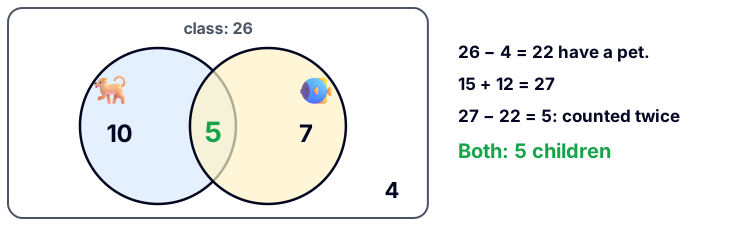
26 − 4 = 22 children have a pet. But 15 + 12 = 27. The 5 extra are children counted twice: they have both!
For the grown-up: adding the dog owners and the fish owners counts every child with both pets twice, once in each group. Only 22 children are in the groups at all (the other 4 have neither), so the 27 − 22 = 5 extra counts are the children with both. Two overlapping circles show it: 10 with only a dog, 5 with both, 7 with only a fish, 4 outside. Check: 10 + 5 + 7 + 4 = 26, dogs 10 + 5 = 15, fish 7 + 5 = 12. Common wrong answer: 1 (27 − 26, forgetting the 4 children with neither), or 3 (15 − 12, the difference between the groups).
Problem 6
Problem 6: Answer 22 carrots
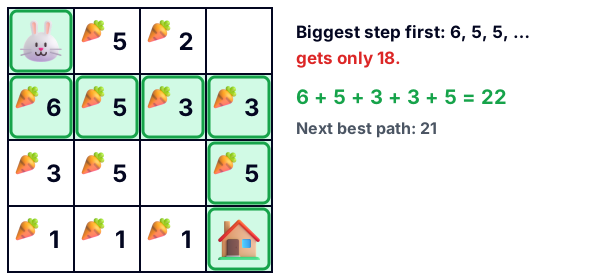
Grabbing the biggest square each time (6, 5, 5, …) gets only 18. Going down to the 6 and then right along the second row: 6 + 5 + 3 + 3 + 5 = 22!
For the grown-up: the trap is greed: taking the bigger neighbour at every hop walks into the bottom row of 1s. A sure method is to write in each square the most carrots the rabbit can have when it lands there: that is the square’s own carrots plus the bigger of the numbers above it and to its left. Filling the grid row by row ends with 22 at the house. Check: the next best route (down, right, down through the 5s, then right) collects 21, and there are only 20 routes in all. Common wrong answer: 18 (the greedy route), 20 (the three 5s in the middle column) or 21 (the runner-up route).
Problem 7
Problem 7: Answer 7
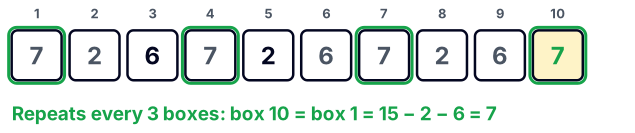
Boxes 1, 2, 3 and boxes 2, 3, 4 both make 15 and share boxes 2 and 3, so box 4 = box 1. The numbers repeat every 3 boxes. Box 10 = box 1 = 15 − 2 − 6 = 7!
For the grown-up: two groups of three that overlap in two boxes and have the same total must differ in the same number, so box 4 = box 1, box 5 = box 2, and so on. Box 10 is in the family of boxes 1, 4 and 7; box 5 says box 2 is 2; box 3 is 6; so box 1 is 15 − 2 − 6 = 7. Check: in 7, 2, 6, 7, 2, 6, 7, 2, 6, 7 every three boxes in a row add up to 15. Common wrong answer: 2 or 6 (copying a number already shown), or 9 (15 − 6, using only one of the two numbers).
Problem 8
Problem 8: Answer 2 liars
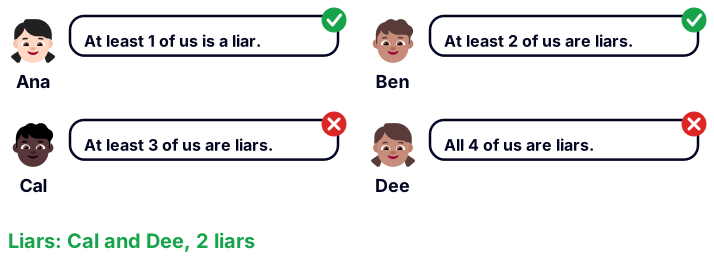
Dee can’t tell the truth, so she lies. So there is a liar: Ana is right. If Cal were right, there would be 3 liars, but only Ben and Dee are left. So Cal lies too. That makes 2 liars, so Ben is right!
For the grown-up: start with the sentence that defeats itself: if Dee told the truth, all four, Dee too, would be liars. After that, each sentence is settled in turn, from the smallest number up: a liar exists, so Ana is truthful; Cal would need 3 liars from Ben and Dee alone, so he lies; then Ben’s “at least 2” is true. Check: with exactly 2 liars, Ana and Ben say true things and Cal and Dee say false things, as they must. Common wrong answer: 1 (spotting Dee and stopping), or 3 (believing Cal).
Problem 9
Problem 9: Answer 71111

More digits make a bigger number. A 1 needs only 2 sticks, so 5 digits at most: 11111 uses 10. The last stick turns the first 1 into a 7: 71111!
For the grown-up: two ideas. A number with more digits is always bigger, so use the cheapest digit, 1 (2 sticks): 11 sticks allow at most 5 digits. Five 1s use 10 sticks, and the 11th must go somewhere: adding it to a 1 makes a 7 (3 sticks), and the 7 goes in front, where it counts most. Check: 3 + 2 + 2 + 2 + 2 = 11. Common wrong answer: 11117 (the 7 at the end), 11111 (a stick left over), or 95 (big digits, but only two of them).
Problem 10
Problem 10: Answer 21 fences
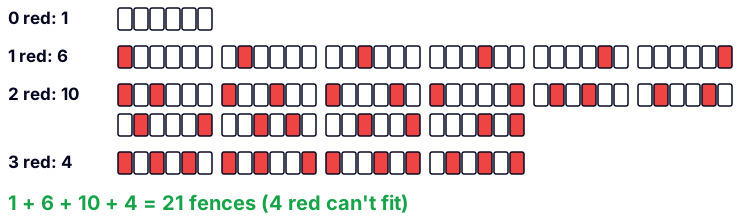
Sort by red boards. 0 red: 1 fence. 1 red: 6. 2 red: 10. 3 red: 4. 4 red can’t fit. 1 + 6 + 10 + 4 = 21!
For the grown-up: sorting by the number of reds means nothing is missed or counted twice. For 2 reds, list by the first red: board 1 goes with 3, 4, 5 or 6, board 2 with 4, 5 or 6, board 3 with 5 or 6, board 4 with 6: 4 + 3 + 2 + 1 = 10. Three reds fit only as 1-3-5, 1-3-6, 1-4-6 or 2-4-6. Check: fences of 1, 2, 3, 4, 5, 6 boards give 2, 3, 5, 8, 13, 21, each the sum of the two before. Common wrong answer: 64 (2 colours for each board, ignoring the rule), or 20 (forgetting the all-blue fence).
More Math Kangaroo practice for Grades 3-4
Want more practice at this level? Our Math Kangaroo Prep Guide for Grades 3–4 has topic-by-topic explanations, dozens more practice problems with full solutions, and test-taking strategies matched to the Math Kangaroo format. There’s a free sample if you’d like to see it first.
For even more, our Math Kangaroo practice tests and questions page has a free set for every grade band, the format by grade, and where to find the official past papers.
This guide is not affiliated with or endorsed by Math Kangaroo USA or Kangourou sans Frontières.