ISEB Pre-Test Maths: Format, Timing and How to Prepare
The ISEB Common Pre-Test maths section is a 40-minute online, adaptive, multiple-choice test on Year 5 content. Here is how it works, the free official practice, and a calm plan to prepare.
· 11 min read
11+ dates and scores: Essex 11+ (CSSE) 2027 CSSE pass mark Independent school dates
On this page · 8 sections
The ISEB Pre-Test maths section is a 40-minute online test of multiple-choice questions on National Curriculum content up to the end of Year 5. It is adaptive: each question is picked according to how your child answered the last ones. It is one of four ISEB Common Pre-Tests (English, maths, verbal reasoning and non-verbal reasoning), which many independent senior schools use as the first stage of 11+ entry. Most children sit it once, in Year 6, and every school they apply to sees the same results.
ISEB Pre-Test maths at a glance
| ISEB Pre-Test maths | |
|---|---|
| Time | 40 minutes (50 minutes with 25% extra time) |
| Format | Online, adaptive, multiple choice |
| Content | National Curriculum maths up to the end of Year 5 |
| Number of questions | Varies from child to child |
| Going back | Not allowed: no skipping and no changing an answer |
| Calculator | No. Pen and paper for rough work, which is not marked |
| Where | On a PC or laptop at an invigilation centre: a junior or prep school, or an approved centre such as the British Council |
| How often | Once per academic year; if a child sits it twice, the first result stands |
| Score | Age-standardised against a sample of independent-school pupils; the average is 100 |
All four tests together take 2 hours 15 minutes. They can be sat on one day or split across several. ISEB publishes no pass mark: each senior school decides how to use the scores. Some follow them with their own written papers and interviews.
Sources: ISEB’s information for families, the Pre-Tests Framework (PDF) and ISEB’s test-administration guide for centres.
What “adaptive” means for your child
The system checks your child’s level after each answer and chooses the next question to suit it. A child who gets questions right sees harder ones, so a hard question is often a sign of doing well. Four practical points follow:
- Hard questions are normal. Tell your child in advance that everyone meets questions they can’t do.
- Check before clicking. There is no going back, so a quick check of the units and the question wording matters more than on paper.
- Don’t guess wildly. ISEB says the system “can anticipate when an answer might have been selected at random”. A sensible estimate beats a random click.
- It can end early. The test stops once it has an accurate score, so finishing before the clock does not mean anything went wrong.
What maths is on the Pre-Test
ISEB’s Framework lists six areas, all from the Year 5 programme or earlier:
- number and place value;
- calculations (addition, subtraction, multiplication, division);
- fractions, decimals and percentages;
- measurement;
- geometry;
- statistics.
“Some questions will assess mathematical fluency in the form of arithmetic questions, others will require solving mathematical problems, possibly including more than one of the topics.” Year 6 strands such as ratio and algebra are outside that list. Our 11 plus maths syllabus page has the full Year 5 checklist.
The written stage that follows at many schools is different. St Paul’s Girls’ School, for example, uses the Pre-Test first and then sets a written maths paper covering “the National Curriculum through KS2”, with multi-part problem solving and working shown. If your child has a written stage ahead, see hard 11 plus maths questions and our independent school 11+ dates table.
ISEB Pre-Test practice: what is free
ISEB’s pages offer no past papers to download, and because the test is adaptive, each child sees a different set of questions. So if you are searching for free ISEB Pre-Test practice papers, these are the official options:
| Resource | Cost | What it gives you |
|---|---|---|
| ISEB Test Walkthrough | Free | The real test player: instructions, overlays and font sizes, and the style of questions, so your child knows how to select an answer |
| Pre-Tests Admissions Toolkit | Free | Registration help, preparation guides and ISEB’s “Preparing your child” PDF |
| Bond Online Premium Plus (OUP with CENTURY) | 7-day free trial, then paid | The only practice platform with questions developed and endorsed by ISEB |
| ISEB Pre-Tests (11+) Prep Pack | Paid (see the table below) | More than 65 resources from ISEB across the four subjects |
Do the Walkthrough at least once, so your child has clicked an answer, used rough paper beside a screen and seen the timer before the real day.
How to prepare for the ISEB Pre-Test
ISEB’s own view is that the Pre-Tests follow the National Curriculum, so “additional preparation is not required”. Its maths advice for parents is short: read every question carefully, because many mistakes come from misreading or using the wrong operation, and practise times tables. A calm plan for the last eight weeks:
- Weeks 1 to 2: times tables and written methods. Ten minutes a day on tables to 12 × 12, plus column methods and short division.
- Weeks 3 to 5: Year 5 topics. One area a day from the list above, five or six questions each; Problems 1 to 6 below cover one area each. Give fractions, decimals and percentages two extra days.
- Weeks 6 to 7: on-screen practice. Multiple-choice questions on a laptop with rough paper beside it, no going back. Do the ISEB Walkthrough here.
- Week 8: one 40-minute timed session, then light practice only.
Keep sessions short. If your child is also sitting written papers, keep those separate, since they reward shown working and Year 6 content.
The six questions below are our own, written at Year 5 level: one for each area of ISEB’s Framework, each with four options like the real test. They show the content, not the real test’s screens. Ask your child to pick one option and not go back, as on the day. Each answer names the most common wrong option, which is usually the trap the question was built around.
The problems
Problem 1
Which number is the largest?
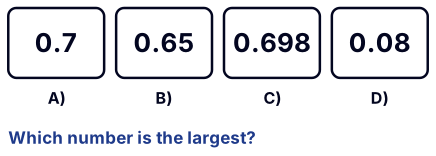
A) 0.7 B) 0.65 C) 0.698 D) 0.08
Tip: Give every number the same number of decimal places before you compare them.
Problem 2
A coach holds 52 pupils. 315 pupils are going on a school trip. How many coaches are needed?
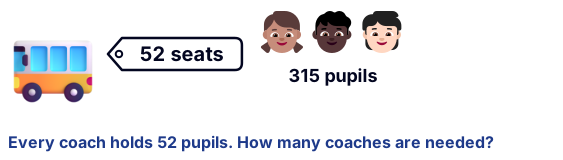
A) 6 B) 7 C) 6 r 3 D) 60
Watch out: A remainder is not an answer to ‘how many coaches’. Ask what happens to the pupils left over.
Problem 3
25% of a number is 45. What is the number?
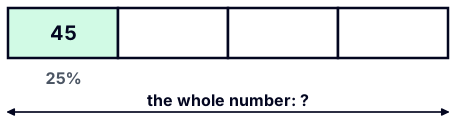
A) 11.25 B) 70 C) 135 D) 180
Problem 4
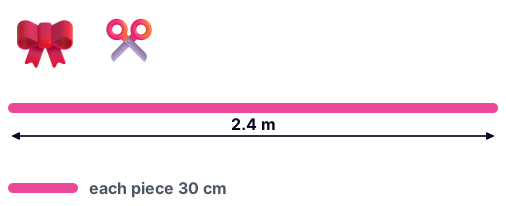
A ribbon 2.4 m long is cut into pieces 30 cm long. How many pieces are there?
A) 8 B) 12 C) 80 D) 0.08
Watch out: One length is in metres and the other in centimetres. Change them to the same unit first.
Problem 5
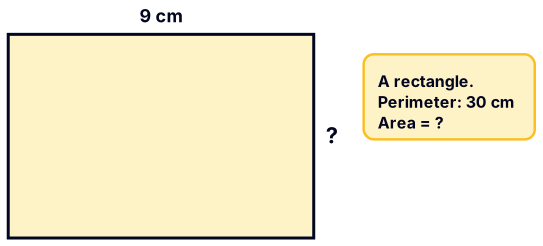
A rectangle has a perimeter of 30 cm. It is 9 cm long. What is its area?
A) 54 cm² B) 108 cm² C) 189 cm² D) 270 cm²
Tip: A rectangle has two long sides and two short sides. Sketch it and write all four lengths on it.
Problem 6
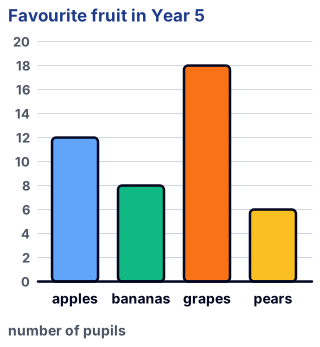
The bar chart shows the favourite fruit of the pupils in Year 5. How many more pupils chose grapes than chose bananas and pears together?
A) 4 B) 10 C) 12 D) 32
Watch out: The question compares grapes with bananas and pears together. Add those two first, then find the difference.
Solutions
Problem 1
Problem 1: Answer A (0.7)
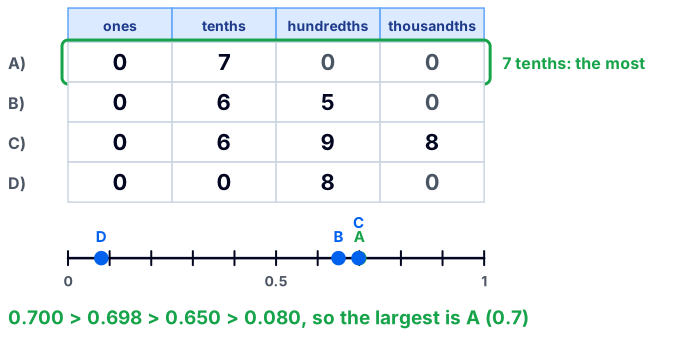
Write them all with three decimal places: 0.700, 0.650, 0.698, 0.080. Look at the tenths first: 7 tenths beats 6 tenths and 0 tenths. So 0.7 is the largest!
For the grown-up: adding zeros at the end of a decimal doesn’t change it, and lining numbers up in a place-value table makes the comparison digit by digit, starting from the left. Check on a number line: 0.7 sits just to the right of 0.698, with 0.65 a little further left and 0.08 close to 0. Common wrong answer: C (0.698), from reading the digits after the point as whole numbers, so that 698 looks bigger than 7.
Problem 2
Problem 2: Answer B (7)
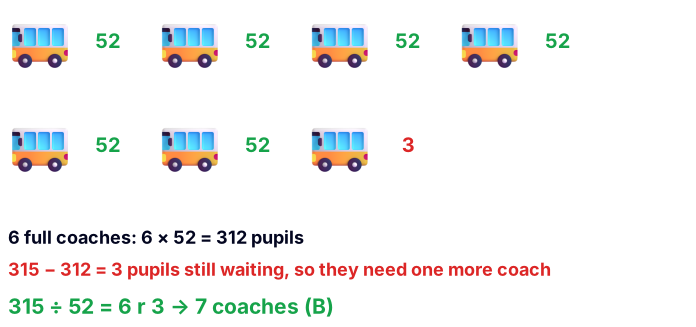
6 coaches carry 6 × 52 = 312 pupils. That leaves 315 − 312 = 3 pupils with no seat. They need a coach too, so the answer is 7!
For the grown-up: 315 ÷ 52 = 6 remainder 3, and in a ‘how many do we need’ question the remainder means rounding up; in a ‘how many full ones’ question it would mean rounding down. Check: 7 coaches hold 364 seats, enough for 315, and 6 hold only 312. Common wrong answer: A (6), rounding down and leaving 3 pupils at school, or C (6 r 3), giving the division instead of the number of coaches.
Problem 3
Problem 3: Answer D (180)
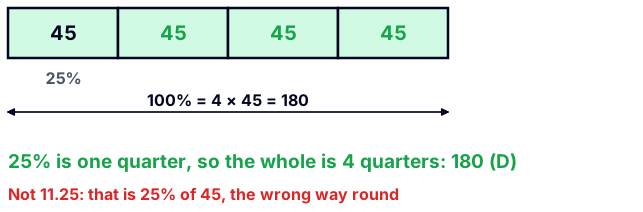
25% is one quarter. One quarter is 45, so all four quarters make 4 × 45 = 180!
For the grown-up: a bar split into four equal parts turns a percentage question into a fraction question: knowing one part, multiply up to the whole. Check: 25% of 180 is 180 ÷ 4 = 45. Common wrong answer: A (11.25), from finding 25% of 45 instead of the number that 45 is 25% of; or C (135), stopping at three quarters.
Problem 4
Problem 4: Answer A (8)
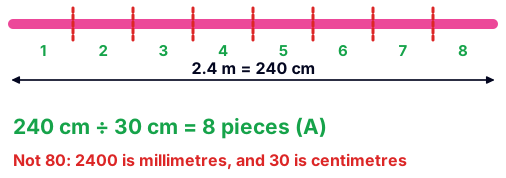
Make the units match first: 2.4 m = 240 cm. Then 240 ÷ 30 = 8 pieces!
For the grown-up: 1 m = 100 cm, so 2.4 m = 240 cm; only then can the two lengths be divided. Check: 8 × 30 cm = 240 cm. Common wrong answer: C (80), from changing 2.4 m to 2400 (millimetres) but dividing by 30 as if it were centimetres; D (0.08), from dividing 2.4 by 30 with mixed units.
Problem 5
Problem 5: Answer A (54 cm²)
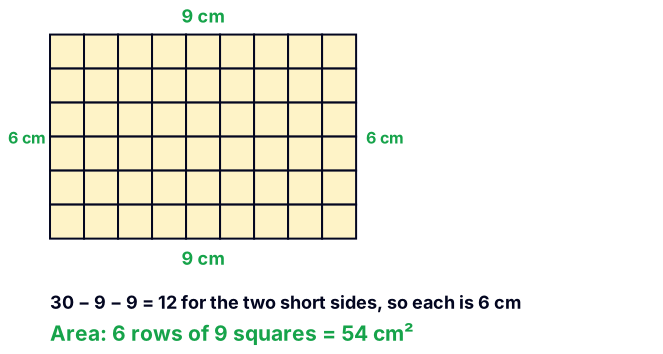
The two long sides are 9 + 9 = 18 cm. That leaves 30 − 18 = 12 cm for the two short sides, so each one is 6 cm. Area: 9 × 6 = 54 cm²!
For the grown-up: perimeter is the distance all the way round (four sides), area is the squares inside; the question needs the first to find a missing side, then the second. Check: 9 + 6 + 9 + 6 = 30. Common wrong answer: B (108 cm²), taking 12 cm as one short side; C (189 cm²), from 30 − 9 = 21 as the width; D (270 cm²), multiplying the perimeter by the length.
Problem 6
Problem 6: Answer A (4)
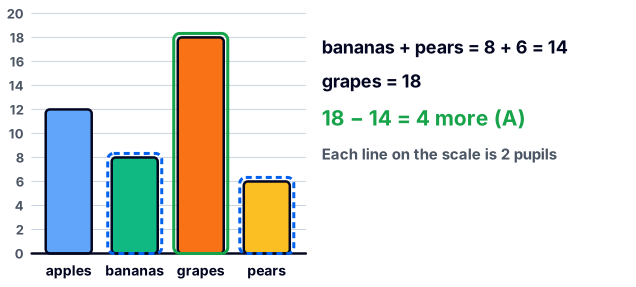
Each line on the scale is 2 pupils. Bananas 8 and pears 6 make 14 together. Grapes is 18. 18 − 14 = 4 more!
For the grown-up: two steps: add the two smaller bars, then compare with the grapes; reading the scale correctly comes first. Check: 14 + 4 = 18. Common wrong answer: B (10) or C (12), comparing grapes with only one of the two fruits; D (32), adding all three instead of finding the difference.
Dates and deadlines
As of November 2026. The session dates are from ISEB’s Common Pre-Tests page (checked 4 November 2026); check it and each school’s admissions page before booking.
| 2026–27 session | Date |
|---|---|
| Guardian Portal opened for registration | Tuesday 9 June 2026 |
| Live testing started | Tuesday 1 September 2026 |
| Testing ends | Late May 2027 |
| Parent registration fee | Free (ISEB) |
| ISEB Pre-Tests (11+) Prep Pack | £149 |
| Example school deadline: St Paul’s Girls’ School | Pre-Test done by Thursday 19 November 2026 |
Each senior school sets its own deadline inside the window, and your child’s invigilation centre gives the actual test date. Register through ISEB’s Guardian Portal once, whichever schools you apply to.
Math Explorers Club is not affiliated with or endorsed by ISEB, Oxford University Press, CENTURY or any school named here. All questions on this page are our own.