
Hard 11 Plus Maths Questions: What Top Schools Ask
What the written maths papers at selective independent schools look like, in our own words, plus 8 original hard 11+ problems with full solutions.
· 12 min read
11+ dates and scores: Essex 11+ (CSSE) 2027 CSSE pass mark Independent school dates
On this page · 5 sections
Hard 11 plus maths questions at top independent schools are rarely about content beyond Year 6. They are hard because they take several steps, put familiar maths in an unfamiliar setting, and expect the working on the page. This post describes how those written papers work, in our own words, then gives 8 original problems in that style with full solutions. None of them is taken from a real paper.
For exam dates school by school, see independent school 11+ dates.
How top independent schools test maths
Many leading London schools now run an online first stage, often the ISEB Common Pre-Test, and most still set a written maths paper, either for a shortlist or for every candidate. A few examples, from each school’s own admissions pages:
As of November 2026 (check the school’s site before relying on it):
| School | First stage | Written maths | What the school says |
|---|---|---|---|
| St Paul’s School | ISEB online pre-test for all Year 6 candidates | Written English and maths at the school in December, for those invited back | No past papers; a syllabus is published |
| St Paul’s Girls’ School | ISEB Common Pre-Test | One paper in two sections: the first starts with “fairly straight-forward ‘sums’” before harder problems; the second has multi-part questions | Working must be shown; two sample papers published |
| Westminster Under School | ISEB Common Pre-Test | Written maths and English for shortlisted children, at the school | “Particularly interested” in applying maths “in the context of problem solving” |
| Latymer Upper | None: every registered child sits the papers | One 60-minute maths paper | Sample papers, no answers or mark scheme |
| Merchant Taylors’ | Short online test (20-min maths, 10-min verbal reasoning) as well | 45-minute written maths paper | Example maths papers published |
| Alleyn’s | Does not use the ISEB Pre-Test | Written maths in early January | Two maths sample papers published |
If your child’s school uses the ISEB Pre-Test first, our ISEB Pre-Test maths post covers that stage.
What makes these questions hard
- Several steps. A question might need a fraction of a remainder, then a subtraction, then working backwards, as in Problem 2 below. Each step is Year 5 or 6 maths.
- Information to organise. Counting problems reward listing in a fixed order so nothing is missed (Problem 7).
- Working that earns credit. St Paul’s Girls’ School says a wrong answer without working gets no credit, so a tidy method matters as much as the answer.
- Algebra without the word “algebra”. Many problems are easiest with a missing number or a bar model (Problems 1, 4 and 5). Our 11 plus algebra questions post builds that skill first.
8 hard 11 plus maths questions
Pencil and paper, no calculator. Allow about 8 minutes for each, and ask your child to write every step before looking at the solutions further down. Each solution starts with a short version for your child, then a note for you with a check and the wrong answers children most often give.
Problem 1
Ratio. A bag holds red and blue counters in the ratio 3 : 5. Mia adds 12 red counters, and now there are equal numbers of red and blue. How many counters are in the bag now?
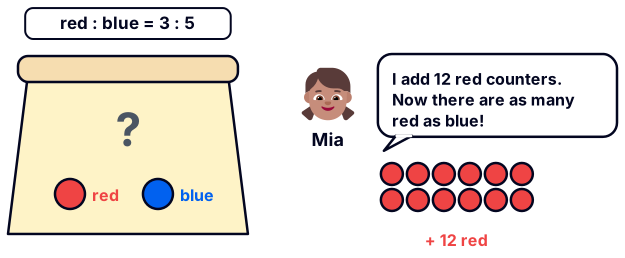
Watch out: The question asks about the bag now, after the 12 red counters go in.
Problem 2
Fractions of what is left. Ella spends 1/4 of her money on a book, then 2/5 of what is left on a game. She spends £6 on lunch and has £12 left. How much did she start with?

Tip: Start from the end, where you know an amount, and work backwards.
Problem 3
Averages. The mean of five numbers is 12. One number is removed, and the mean of the other four is 10. A second number is removed, and the mean of the last three is 11. What were the two numbers removed?
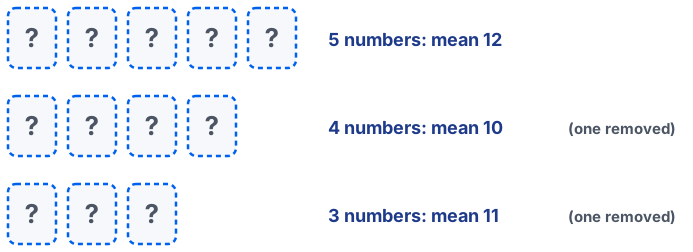
Trick: Turn every mean into a total: total = mean × how many numbers.
Problem 4
Angles. In triangle ABC, AB = AC. Angle A is 30° larger than angle B. Find angle A.
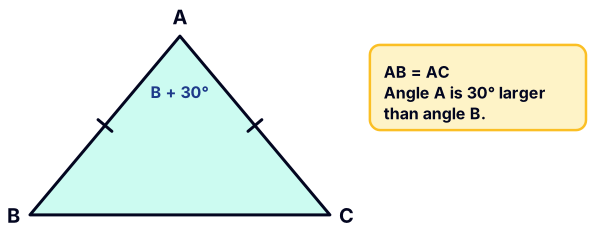
Watch out: The two equal angles sit opposite the two equal sides. Which angles are those?
Problem 5
Area. A square is cut into four identical rectangles by three straight lines parallel to one of its sides. Each rectangle has a perimeter of 30 cm. What is the area of the square?
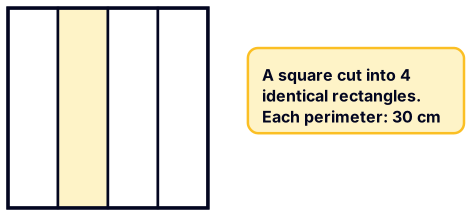
Tip: Call the side of the square s and write the length and width of one rectangle in terms of s.
Problem 6
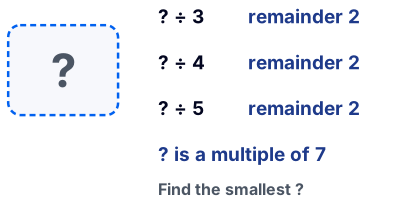
Remainders. A whole number leaves a remainder of 2 when it is divided by 3, by 4 or by 5. It is also a multiple of 7. What is the smallest number it could be?
Problem 7
Counting. How many three-digit numbers have digits that add up to 5?
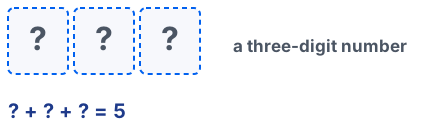
Tip: List them in a fixed order, by the first digit, so you can see that none is missing.
Problem 8
★ Speed. Tom walks to school at 4 km/h and arrives 5 minutes late. If he walks at 6 km/h, he arrives 5 minutes early. How far is it to school?
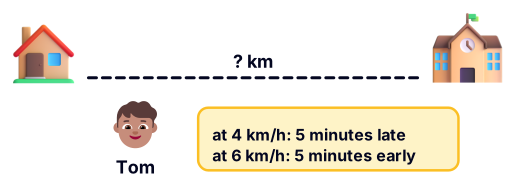
Watch out: 5 minutes late and 5 minutes early are not 5 minutes apart.
Solutions
Problem 1
Problem 1: Answer 60 counters
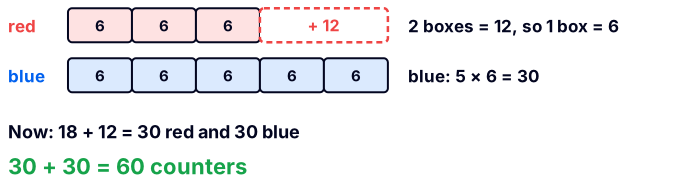
Draw red as 3 boxes and blue as 5. The 12 new red counters fill the 2-box gap, so 1 box is 6. Now red is 5 boxes too: 30 red and 30 blue make 60!
For the grown-up: a ratio is a number of equal shares, and adding counters to one colour leaves the other colour’s shares alone, so the gap of 2 shares is exactly the 12 counters. Check: before, 18 red and 30 blue is 3 : 5; after, 30 red and 30 blue. Common wrong answer: 48 (the bag before Mia added the counters), 12 (the gap) or 6 (one share).
Problem 2
Problem 2: Answer £40
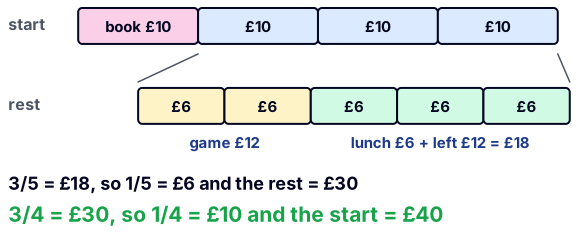
Work backwards. Lunch and the money left make £6 + £12 = £18. That is 3/5 of what she had after the book, so 1/5 is £6 and she had £30. £30 is 3/4 of the start, so 1/4 is £10 and she started with £40!
For the grown-up: “2/5 of what is left” is a fraction of the £30, not of the £40, so the bar is cut twice: first into quarters, then the rest into fifths. Check forwards: book £10 leaves £30; game £12 leaves £18; lunch £6 leaves £12. Common wrong answer: £30 (what was left after the book, not the start), or no whole-pound answer at all from adding 1/4 + 2/5 = 13/20 as if both were fractions of the start (then 7/20 of the start would be £18, which gives about £51.43).
Problem 3
Problem 3: Answer 20 and 7
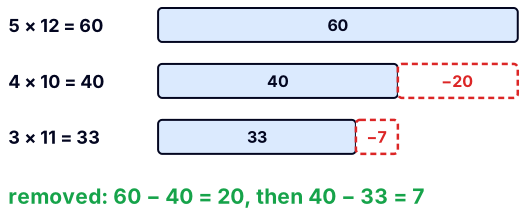
Turn each mean into a total. 5 × 12 = 60, 4 × 10 = 40, 3 × 11 = 33. The first number taken away is 60 − 40 = 20. The second is 40 − 33 = 7!
For the grown-up: a mean hides its total, and only totals can be subtracted. Check: 60 − 20 − 7 = 33, and 33 ÷ 3 = 11. Common wrong answer: 2 and 1 (subtracting the means), or 27 (taking the second total from 60 instead of from 40).
Problem 4
Problem 4: Answer 80°
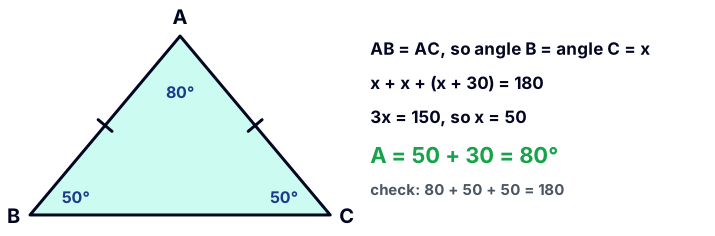
AB = AC, so the equal angles are B and C. Call each one x. Angle A is x + 30. So x + x + x + 30 = 180, 3x = 150 and x = 50. Angle A is 50 + 30 = 80°!
For the grown-up: in an isosceles triangle the equal angles are opposite the equal sides: AB is opposite C and AC is opposite B. Check: 80 + 50 + 50 = 180, and 80 is 30 more than 50. Common wrong answer: 70° (making A and C the equal angles: A + A + (A − 30) = 180), or 50° (angle B, not A).
Problem 5
Problem 5: Answer 144 cm²
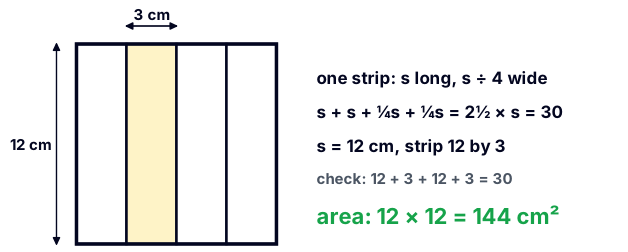
Call the side s. One strip is s long and s ÷ 4 wide. Its perimeter is s + s + ¼s + ¼s = 2½ lots of s. 2½ × s = 30, so s = 12 cm. Area: 12 × 12 = 144 cm²!
For the grown-up: only the width is cut into quarters; the length of each strip is the whole side. Check: 12 + 3 + 12 + 3 = 30. Common wrong answer: 56.25 cm² (taking 30 ÷ 4 = 7.5 cm as the side), or 225 cm² (taking half the perimeter, 15 cm, as the side).
Problem 6
Problem 6: Answer 182
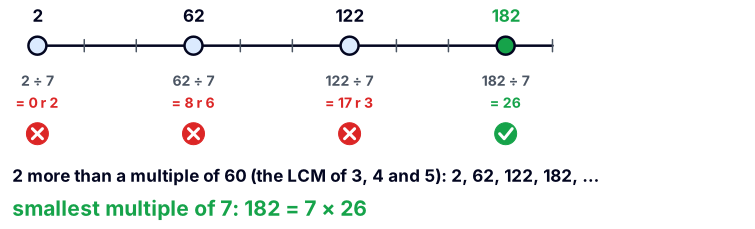
Take 2 away and the number divides by 3, 4 and 5, so by 60. The number is 2, 62, 122, 182, … Test each for 7: only 182 = 7 × 26 works!
For the grown-up: “remainder 2 on division by 3, 4 and 5” means the number is 2 more than a common multiple, and the lowest common multiple of 3, 4 and 5 is 60. Check: 182 = 3 × 60 + 2, and 182 ÷ 7 = 26. Common wrong answer: 62 (fits the remainders but is not a multiple of 7). Multiplying the divisors happens to give the LCM here (3 × 4 × 5 = 60), but for 4 and 6 it would give 24 instead of 12.
Problem 7
Problem 7: Answer 15
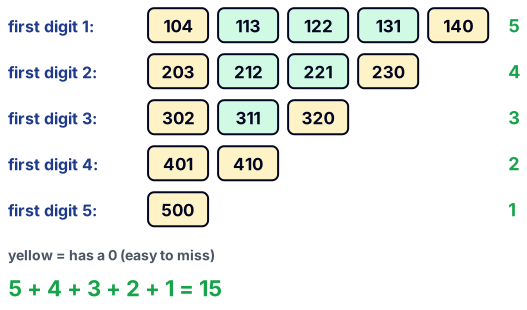
The first digit can’t be 0. List by the first digit: 1 gives 5 numbers, 2 gives 4, 3 gives 3, 4 gives 2 and 5 gives 1. 5 + 4 + 3 + 2 + 1 = 15!
For the grown-up: once the first digit is fixed, the middle digit runs down from what is left to 0, and the last digit is then forced, so each row is one longer than the row below it. Check: 9 of the 15 contain a 0 (104, 140, 203, 230, 302, 320, 401, 410, 500) and are easy to miss. Common wrong answer: 21 (allowing 0 as a first digit, e.g. 050), or 6 (only the numbers with no 0).
Problem 8
Problem 8: Answer 2 km
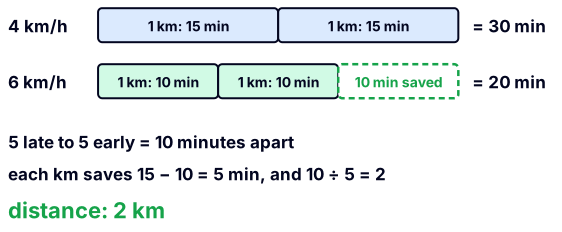
5 minutes late and 5 minutes early are 10 minutes apart. At 4 km/h one kilometre takes 15 minutes; at 6 km/h it takes 10. Each kilometre saves 5 minutes, so 10 minutes saved means 2 km!
For the grown-up: compare time per kilometre, not speeds, and the problem becomes “how many 5-minute savings make 10 minutes?”. Check: 2 km at 4 km/h is 30 minutes; at 6 km/h it is 20 minutes, 10 minutes apart. Common wrong answer: 1 km (using a 5-minute difference), or 20 (the faster walk’s minutes, not a distance).
How to practise hard 11+ maths
- One hard problem per session, with the working written out as if for a marker. Then ask your child to explain it out loud.
- Keep a list of slips, not just wrong answers. Most marks on these papers go on misreading (“of what is left”) or a missed case. The “Common wrong answer” line under each solution above is a good place to start that list.
- Use the schools’ own sample papers from their admissions pages for timing practice. Link to them; the schools hold the copyright.
- Build the topics first. Our 11 plus maths questions and 11 plus ratio questions cover the core. For grammar school written papers, see Sutton SET stage 2 maths and FSCE 11 plus maths.
Math Explorers Club is not affiliated with or endorsed by the Independent Schools Examinations Board (ISEB), the Sutton SET schools, FSCE or any school named here, including St Paul’s School, St Paul’s Girls’ School, Westminster Under School, Latymer Upper School, Merchant Taylors’ School and Alleyn’s. All problems on this page are our own.