
11 Plus Ratio Questions with Worked Answers
Ten original 11+ ratio questions, from simplifying a ratio to independent-school stretch problems, with child-friendly working and the wrong answer most children give.
· 13 min read
11+ dates and scores: Essex 11+ (CSSE) 2027 CSSE pass mark Independent school dates
On this page · 6 sections
These 11 plus ratio questions start where a Year 5 child is comfortable and climb to multi-step stretch problems of the standard found on harder independent-school papers. Each one has a worked answer written for a child, plus the wrong answer children most often give, so you can see where the thinking slipped. All ten are our own questions, written for this page.
Work without a calculator, as on the Essex (CSSE) maths paper. Allow about 20 minutes for all ten.
What 11+ ratio questions test
Ratio sits in the Year 6 “Ratio and proportion” part of the National Curriculum for England. Children are expected to:
- solve problems about the relative sizes of two quantities using multiplication and division facts;
- solve “unequal sharing and grouping” problems using fractions and multiples;
- solve problems with similar shapes when the scale factor is known or can be found.
The curriculum notes say Year 6 pupils “might use the notation a:b”. Writing a ratio in its simplest form and splitting an amount in a given ratio are formally Key Stage 3 skills, so it is worth teaching them before the exam: several problems below use them. The Essex (CSSE) test is sat in September of Year 6, before most schools have taught ratio at all, and recent CSSE papers have still included sharing problems, best buys and rates.
The three methods your child needs
| Method | When to use it | What to say to your child |
|---|---|---|
| Find one part | Any sharing question | “Add the parts, divide the total by that, then multiply.” |
| Scale both sides | Recipes, maps, “for every” | “Whatever you do to one side, do to the other. Multiply, never add.” |
| Make one side match | The ratio changes, or two ratios share a person | “Find the thing that didn’t change and make its number the same in both ratios.” |
Drawing a bar (a strip of equal boxes, one box per part) makes the first method visible. Most of the wrong answers below come from skipping that drawing.
Each problem below has a picture of the situation. Try all ten first, then check the solutions: each one shows the bar or table to draw, a short explanation for your child, and a note for you on the wrong answer children most often give.
The problems
Problem 1
A bag holds 12 red counters and 18 blue counters. Write the ratio of red counters to blue counters in its simplest form.
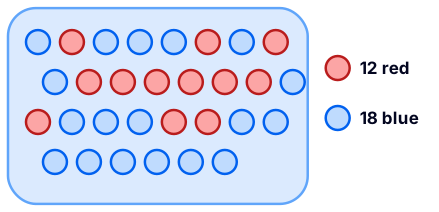
Watch out: The question names red first, so red’s number goes first.
Problem 2
Mia and Leo share £35 in the ratio 3 : 4. How much does Leo get?

Problem 3
A flapjack recipe uses 5 tablespoons of honey for every 2 cups of oats. How many tablespoons of honey are needed for 8 cups of oats?
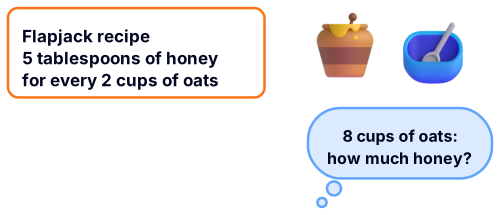
Tip: In a ratio, both sides grow by multiplying, never by adding the same amount.
Problem 4
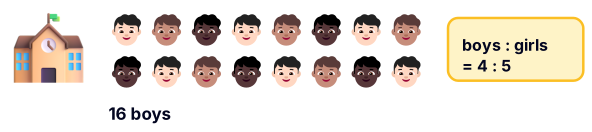
In a class, the ratio of boys to girls is 4 : 5. There are 16 boys. How many children are in the class?
Problem 5
Sam and Priya share some sweets in the ratio 7 : 3. Sam gets 24 more sweets than Priya. How many sweets are there altogether?
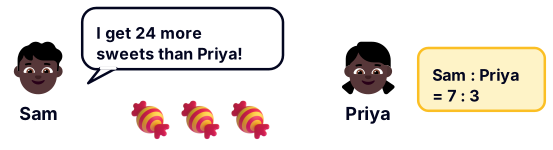
Tip: Draw Sam’s bar and Priya’s bar. Which boxes are the 24 extra sweets?
Problem 6
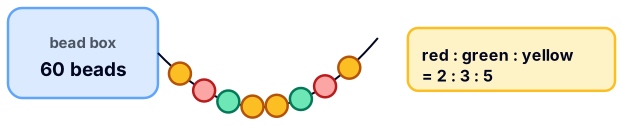
A necklace has red, green and yellow beads in the ratio 2 : 3 : 5. There are 60 beads. How many more yellow beads than red beads are there?
Problem 7
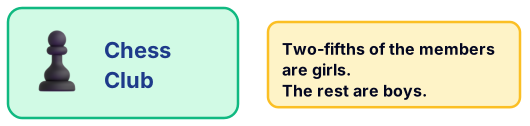
Two-fifths of the members of a chess club are girls. The rest are boys. What is the ratio of girls to boys?
Watch out: A fraction compares a part with the whole. This ratio compares one part with the other part.
Problem 8
A jar holds red and blue marbles in the ratio 3 : 5. Six red marbles are added, and the ratio becomes 3 : 4. No blue marbles were added. How many blue marbles are there?
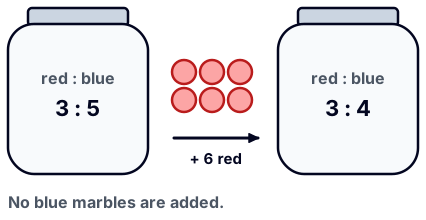
Trick: Find the colour that did not change and make its number the same in both ratios.
Problem 9
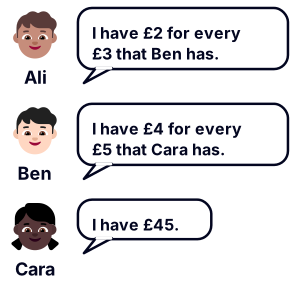
★ Stretch. Ali has £2 for every £3 that Ben has. Ben has £4 for every £5 that Cara has. Cara has £45. How much does Ali have?
Problem 10
★ Stretch. Tom’s age and his mum’s age are in the ratio 1 : 4. In 6 years’ time the ratio will be 1 : 3. How old is Tom now?
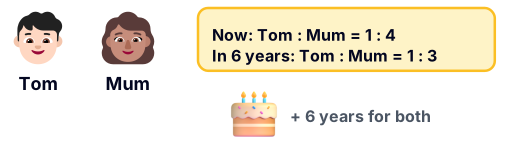
Trick: Tom and his mum both get older by the same amount, so the gap between their ages never changes.
Solutions
Problem 1
Problem 1: Answer 2 : 3
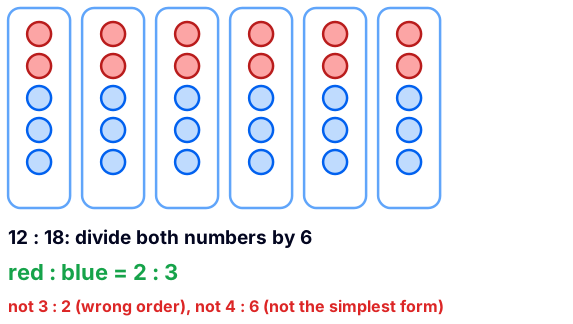
12 and 18 are both in the 6 times table. Share the counters into 6 equal groups: each group has 2 red and 3 blue. So red : blue = 2 : 3!
For the grown-up: dividing both numbers by their highest common factor (6) gives the simplest form in one step; dividing by 2 and then by 3 also works. Check: 2 × 6 = 12 and 3 × 6 = 18. Common wrong answer: 3 : 2 (the order flipped: red was asked for first), or 4 : 6 (the same ratio, but not in its simplest form, so it can lose the mark).
Problem 2
Problem 2: Answer £20
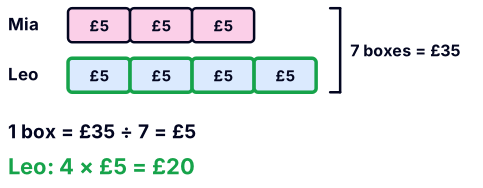
Draw Mia’s bar with 3 boxes and Leo’s with 4. That is 7 boxes for £35, so one box is £35 ÷ 7 = £5. Leo has 4 boxes: 4 × £5 = £20!
For the grown-up: add the parts, find one part, then multiply. Check: Mia gets 3 × £5 = £15, and £15 + £20 = £35. Common wrong answer: £15 (Mia’s share: underline whose share is asked for), or £5 (one part only).
Problem 3
Problem 3: Answer 20 tablespoons
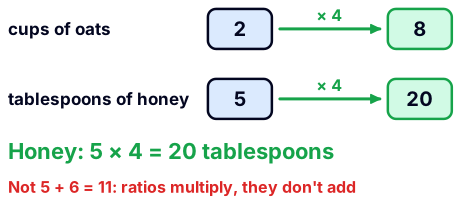
2 cups became 8 cups: that is times 4. Do the same to the honey: 5 × 4 = 20 tablespoons!
For the grown-up: a recipe keeps its taste only if every ingredient is multiplied by the same number. Check: 20 : 8 simplifies to 5 : 2, the recipe’s ratio. Common wrong answer: 11 (the oats went up by 6, so the child adds 6 to the honey too). 11 : 8 is a much runnier flapjack than 5 : 2.
Problem 4
Problem 4: Answer 36 children
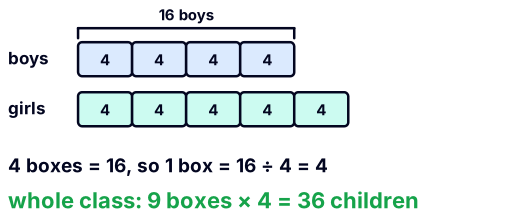
The boys are 4 boxes, and 4 boxes hold 16 boys, so one box is 4 children. The whole class is 4 + 5 = 9 boxes: 9 × 4 = 36 children!
For the grown-up: the 16 tells you the size of one part; the question then asks for all the parts. Check: 16 boys and 5 × 4 = 20 girls make 36, and 16 : 20 = 4 : 5. Common wrong answer: 20 (the girls only), or 144 (16 × 9, using 16 as one part instead of four).
Problem 5
Problem 5: Answer 60 sweets
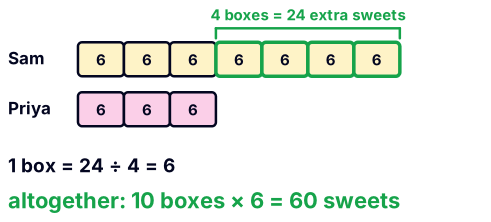
Sam has 7 boxes and Priya has 3, so Sam has 4 boxes more. Those 4 boxes are the 24 extra sweets: one box is 24 ÷ 4 = 6. All 10 boxes: 10 × 6 = 60 sweets!
For the grown-up: 24 is the difference, not the total, so it matches the difference in parts (7 − 3 = 4). Check: Sam 42, Priya 18; 42 − 18 = 24 and 42 : 18 = 7 : 3. Common wrong answer: trying to share 24 in the ratio 7 : 3 (it won’t divide by 10, a clue that 24 isn’t the total), or 42 (Sam’s sweets only).
Problem 6
Problem 6: Answer 18 more yellow beads
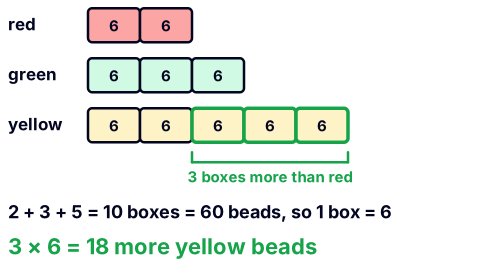
2 + 3 + 5 = 10 boxes for 60 beads, so one box is 6 beads. Yellow has 5 − 2 = 3 boxes more than red: 3 × 6 = 18 more yellow beads!
For the grown-up: a three-part ratio works exactly like a two-part one: add all the parts first. Check: red 12, green 18, yellow 30 make 60, and 30 − 12 = 18. Common wrong answer: 3 (the difference in parts, before finding how many beads a part is), or 30 (all the yellow beads, not how many more).
Problem 7
Problem 7: Answer 2 : 3
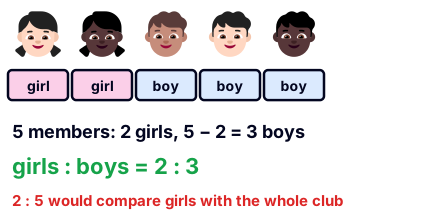
Imagine the club has 5 members. Two-fifths are girls, so 2 are girls and 3 are boys. Girls : boys = 2 : 3!
For the grown-up: the denominator is the whole; the ratio needs the other part, which is 5 − 2 = 3. Any club size gives the same answer: with 20 members, 8 girls and 12 boys is still 2 : 3. Common wrong answer: 2 : 5 (girls compared with the whole club, which is the fraction again), or 3 : 2 (the order flipped).
Problem 8
Problem 8: Answer 40 blue marbles
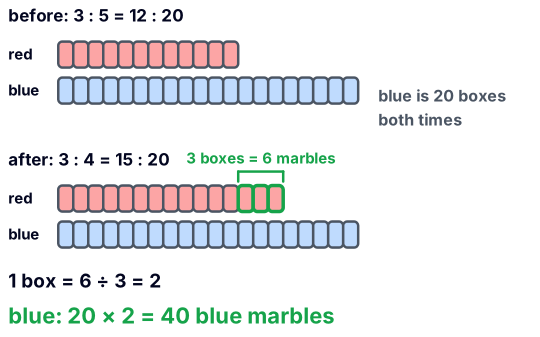
The blue marbles didn’t change, so make blue the same in both ratios. 3 : 5 = 12 : 20 and 3 : 4 = 15 : 20. Red went from 12 boxes to 15: those 3 boxes are the 6 new marbles, so one box is 2. Blue is 20 boxes: 20 × 2 = 40!
For the grown-up: the parts of 3 : 5 and 3 : 4 are different sizes until the unchanged side is made equal (20 is the smallest number both 5 and 4 go into). Check: 24 red and 40 blue is 3 : 5; add 6 red to get 30 : 40, which is 3 : 4. Common wrong answer: 30 (seeing blue go from 5 to 4, deciding that change of one part is the 6 marbles, then 5 × 6), or 24 (the red marbles at the start).
Problem 9
Problem 9: Answer £24
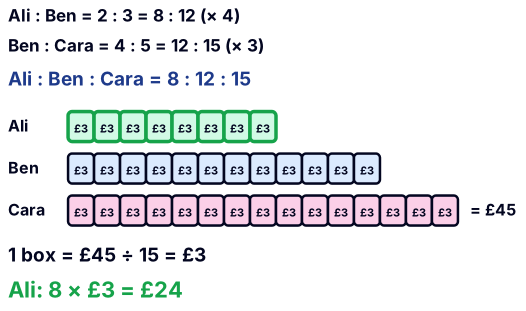
Ben is in both ratios, so give him the same number in both: 2 : 3 = 8 : 12 and 4 : 5 = 12 : 15. Now Ali : Ben : Cara = 8 : 12 : 15. Cara’s 15 boxes are £45, so a box is £3. Ali has 8 boxes: 8 × £3 = £24!
For the grown-up: 12 is the smallest number both 3 and 4 go into, which links the two ratios through Ben. Check: Ali £24, Ben £36, Cara £45; 24 : 36 = 2 : 3 and 36 : 45 = 4 : 5. Common wrong answer: £18 (joining the ratios as Ali : Cara = 2 : 5 without matching Ben first), or £36 (Ben’s money).
Problem 10
Problem 10: Answer 12 years old
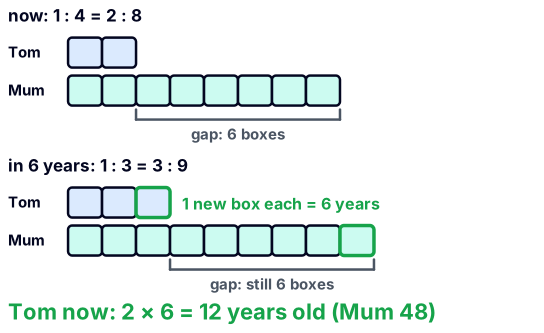
The gap between their ages never changes. In 1 : 4 the gap is 3 parts; in 1 : 3 it is 2 parts. Make both gaps 6 parts: now 2 : 8, later 3 : 9. Tom grows from 2 parts to 3, and that 1 part is the 6 years. Tom is 2 × 6 = 12 now!
For the grown-up: both ages go up by 6, so the difference is the thing that stays the same, just as the blue marbles did in problem 8. Check: Tom 12, Mum 48 (1 : 4); in 6 years 18 and 54, which is 1 : 3. Common wrong answer: 6 (deciding one part is 6 years straight away: Tom 6 and Mum 24 become 12 and 30, which is 2 : 5, not 1 : 3), or 48 (Mum’s age).
How to use these at home
- Ask for the drawing. For Problems 2 and 4 to 6, a bar with labelled boxes should be on the page before any sum; for Problems 8 and 10, two drawings, one before and one after; for Problem 9, three bars lined up under each other.
- Mark, then redo. Note which questions went wrong and set the same type again three days later with new numbers (for Problem 2, share £48 in the ratio 3 : 5 instead of £35 in 3 : 4, for example).
- Time only once it’s accurate. On a paper like CSSE’s, where only the answer is marked and working earns nothing, accuracy matters more than speed at first. A ratio left as 4 : 6 when the question asks for the simplest form can cost the mark.
More 11+ maths practice
- 11 plus percentage questions with worked answers: the same format for percentages.
- 11 plus algebra questions and 11 plus maths questions by topic.
- Hard 11 plus maths questions for independent-school stretch.
- CSSE maths past papers: where to get the official papers free, and the CSSE 11+ 2027 hub for dates and format.
Math Explorers Club is not affiliated with or endorsed by the Consortium of Selective Schools in Essex (CSSE) or any school named here. All questions on this page are our own.