
11 Plus Percentage Questions with Worked Answers
Ten original 11+ percentage questions, from 10% of an amount to reverse percentages, with child-friendly working and the wrong answer most children give.
· 11 min read
11+ dates and scores: Essex 11+ (CSSE) 2027 CSSE pass mark Independent school dates
On this page · 6 sections
These 11 plus percentage questions work like a free worksheet: ten original questions that start with finding 10% of an amount and finish with problems of the standard found on harder independent-school papers. Every question has a picture, a worked answer written for a child, and a note for you on the wrong answer children most often give. All ten are our own questions, written for this page.
Work without a calculator, as on the Essex (CSSE) maths paper. Allow about 20 minutes. If you want to print it as an 11 plus percentage worksheet, print the page and cover the answers.
What 11+ percentage questions test
Percentages are taught in Year 5 and Year 6 under the National Curriculum for England:
| Year | What children are expected to do |
|---|---|
| Year 5 | Know that per cent means “number of parts per 100”; write a percentage as a fraction out of 100 and as a decimal |
| Year 5 | Know the percentage and decimal equivalents of 1/2, 1/4, 1/5, 2/5, 4/5 and fractions with a denominator that is a multiple of 10 or 25 |
| Year 6 | Calculate percentages (for example of measures) and use percentages to compare |
Percentage increase, decrease and “original value” problems are formally Key Stage 3 content, but selective papers set them anyway. Every free Essex (CSSE) maths paper so far (2021, 2022 and 2023 entry) has percentage questions worth 3 or 4 of its 60 marks, and between them they include a price rise, two discounts in a row and a reverse percentage (the price before a discount or rise). Problems 5 to 8 below practise those kinds of question; Problems 9 and 10 are stretch.
The methods your child needs
Build from 10% and 1%. Without a calculator, almost every percentage is a sum of easy pieces:
| To find | Do this | Example: £240 |
|---|---|---|
| 50% | halve | £120 |
| 25% | halve, then halve again | £60 |
| 10% | divide by 10 | £24 |
| 5% | half of 10% | £12 |
| 1% | divide by 100 | £2.40 |
So 35% is 10% + 10% + 10% + 5%, and 99% is 100% − 1%.
Know the fraction pairs by heart: 1/2 = 50%, 1/4 = 25%, 3/4 = 75%, 1/5 = 20%, 1/8 = 12.5%, 1/10 = 10%.
Think “what percentage is left”. After a 30% discount you pay 70%. After a 15% rise you have 115%. This turns two steps into one and is the key to the reverse questions.
Try each problem below before you read its solution. The solutions come after all ten, each with a picture of the working and the wrong answer children most often give.
The problems
Problem 1
A bag holds 80 sweets. 35% of the sweets are red. How many red sweets are there?
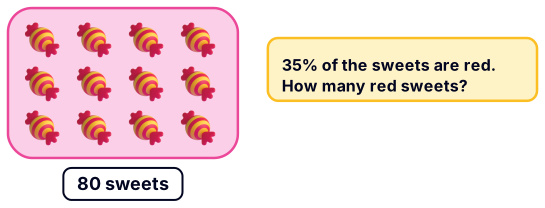
Tip: Find 10% first, then halve it to get 5%.
Problem 2
Put these in order, smallest first: 0.4, 3/8, 35%.
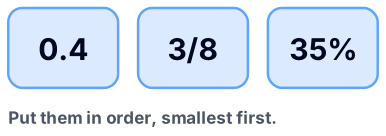
Tip: Change all three into percentages before you compare them.
Problem 3
A bag holds 2 kg of flour. 30% of the flour is used for baking. How many grams of flour are left?
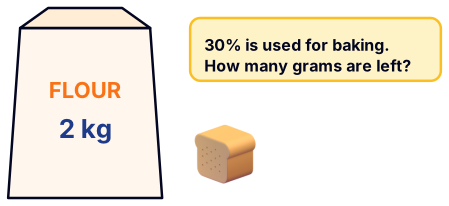
Watch out: The question asks for what is left, and in grams.
Problem 4
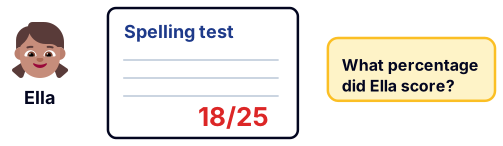
Ella scored 18 out of 25 in a spelling test. What percentage did she score?
Problem 5
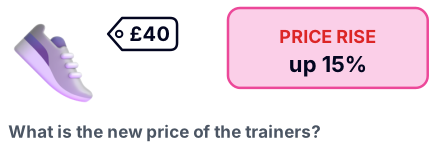
A pair of trainers costs £40. The price goes up by 15%. What is the new price?
Problem 6
Shop A sells a school bag for £60 with 25% off. Shop B sells the same bag for £56 with 20% off. Which shop is cheaper, and by how much?
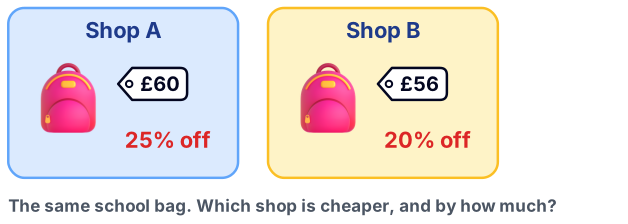
Watch out: Work out both sale prices before you decide.
Problem 7
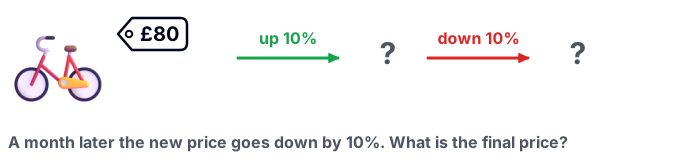
A bike costs £80. Its price goes up by 10%. A month later, the new price goes down by 10%. What is the final price?
Problem 8
In a sale, every price is cut by 20%. A toy robot now costs £36. What did it cost before the sale?

Trick: After 20% off, the sale price is 80% of the old price.
Problem 9
★ Challenge. At a school, 60% of the pupils are girls. 25% of the girls and 50% of the boys walk to school. What percentage of all the pupils walk to school?
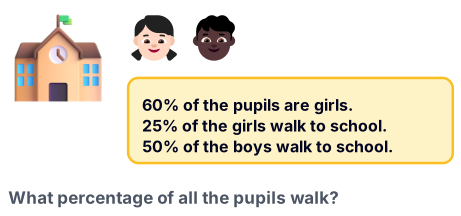
Tip: Pretend the school has exactly 100 pupils.
Problem 10
★ Challenge. A shop raises all its prices by 25%. Later it brings every price back to what it was before. By what percentage must it lower the new prices?
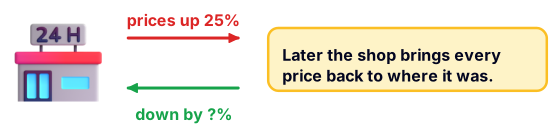
Trick: Choose an easy starting price, such as £100.
Solutions
Problem 1
Problem 1: Answer 28 sweets
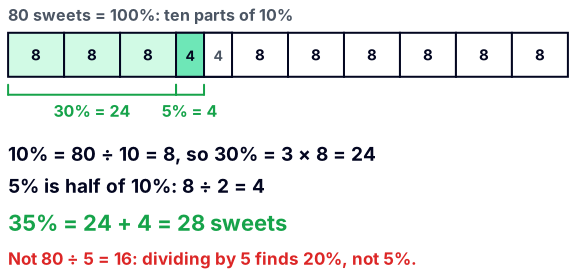
10% of 80 is 8, so 30% is 24. 5% is half of 10%: 4. 24 + 4 = 28 red sweets!
For the grown-up: 35% = 10% + 10% + 10% + 5%, and every piece comes from 10%, so no calculator is needed. Check: 35% is a bit more than a third, and 28 is a bit more than a third of 80. Common wrong answer: 40, from finding “5%” as 80 ÷ 5 = 16. Dividing by 5 gives 20%, not 5%.
Problem 2
Problem 2: Answer 35%, 3/8, 0.4
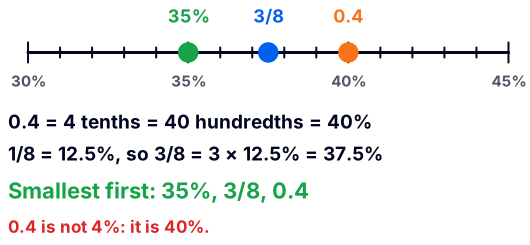
Make them all percentages. 0.4 is 40%. 1/8 is 12.5%, so 3/8 is 37.5%. Smallest first: 35%, 3/8, 0.4!
For the grown-up: comparing is only safe once all three are in the same form; percentages are the easiest here because 35% is already one. 1/8 = 12.5% is worth knowing by heart (half of 1/4 = 25%). Common wrong answer: putting 0.4 first, by reading it as 4%. 0.4 is four tenths, which is 40 hundredths.
Problem 3
Problem 3: Answer 1,400 g
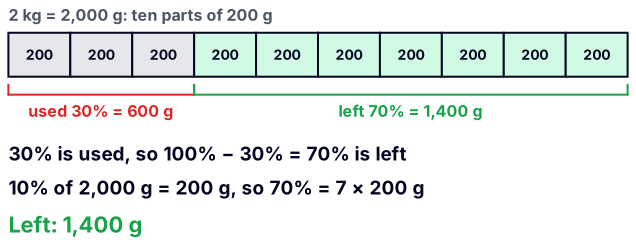
2 kg is 2,000 g. 30% is used, so 70% is left. 10% is 200 g, so 70% is 7 × 200 = 1,400 g!
For the grown-up: working with the percentage left (100% − 30% = 70%) saves the subtraction at the end. Check: 600 g used + 1,400 g left = 2,000 g. Common wrong answer: 600 g (the flour used, not what is left), or 1.4 (the right amount in kilograms, when the answer box asks for grams).
Problem 4
Problem 4: Answer 72%
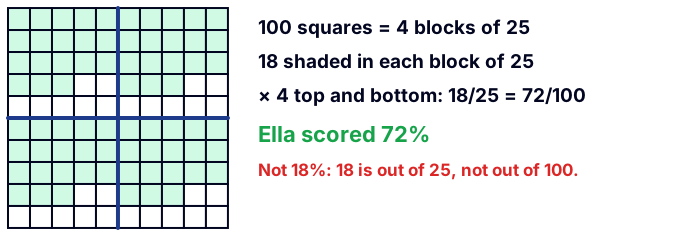
Per cent means out of 100. 25 × 4 = 100, so do the same to the top: 18 × 4 = 72. Ella scored 72%!
For the grown-up: a fraction keeps its value when top and bottom are multiplied by the same number, so 18/25 = 72/100 = 72%. This works whenever the bottom number divides into 100 (2, 4, 5, 10, 20, 25, 50). Check: 72% is a bit under three quarters, and 18 is a bit under three quarters of 25. Common wrong answer: 18%, treating a mark out of 25 as if it were out of 100.
Problem 5
Problem 5: Answer £46
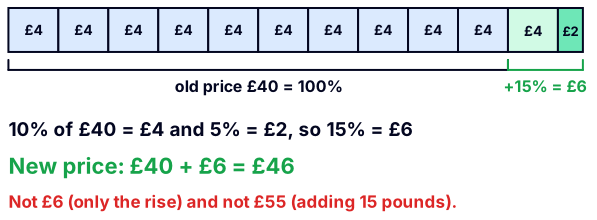
10% of £40 is £4, and 5% is £2. So 15% is £6. New price: £40 + £6 = £46!
For the grown-up: a rise has two steps: find the increase, then add it to the old price. Faster: the new price is 115% of the old one, 11.5 lots of £4. Common wrong answer: £6 (only the increase), or £55 (adding 15 pounds instead of 15%).
Problem 6
Problem 6: Answer Shop B, by 20p
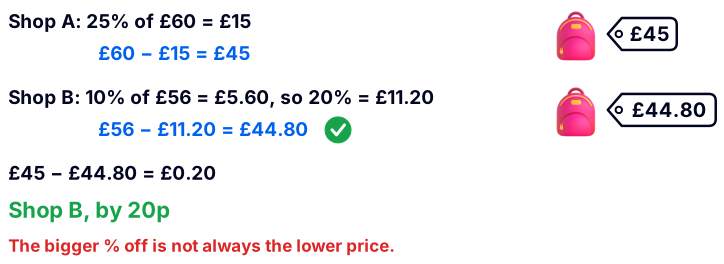
Shop A: 25% of £60 is £15, so £45. Shop B: 20% of £56 is £11.20, so £44.80. £45 − £44.80 = 20p. Shop B is cheaper by 20p!
For the grown-up: a percentage off depends on the price it is taken from, so the only fair comparison is the two final prices. 20% of £56 = 2 × 10% = 2 × £5.60. Common wrong answer: Shop A, because “25% off” sounds like the better deal; or Shop B “by £4”, comparing the starting prices.
Problem 7
Problem 7: Answer £79.20
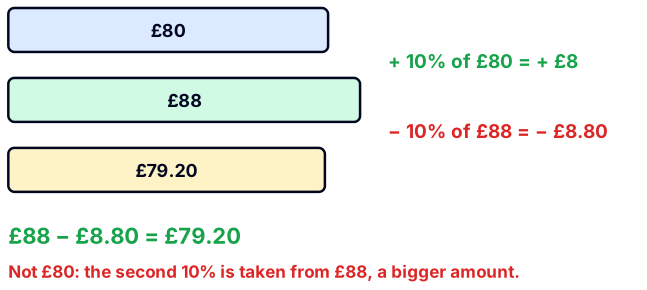
Up 10%: £80 + £8 = £88. Down 10% of £88: £8.80. £88 − £8.80 = £79.20!
For the grown-up: the second 10% is taken from £88, not from £80, so it removes more than the first one added. Each change is a multiplication (× 1.1, then × 0.9), and 1.1 × 0.9 = 0.99: the final price is 99% of the start, £80 − 80p. Common wrong answer: £80, thinking the two changes cancel.
Problem 8
Problem 8: Answer £45
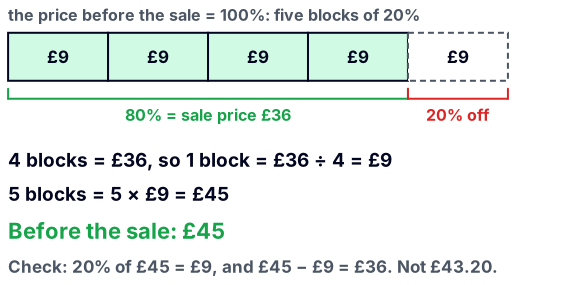
20% off leaves 80% of the old price. 80% is four blocks of 20%, so one block is £36 ÷ 4 = £9. The old price is five blocks: 5 × £9 = £45!
For the grown-up: the 20% was taken from the old price, which is unknown, so work backwards from “£36 is 80%”. Check: 20% of £45 is £9, and £45 − £9 = £36. Reverse percentages like this one appear on real CSSE papers. Common wrong answer: £43.20, from adding 20% of £36 (£7.20) back on.
Problem 9
Problem 9: Answer 35%
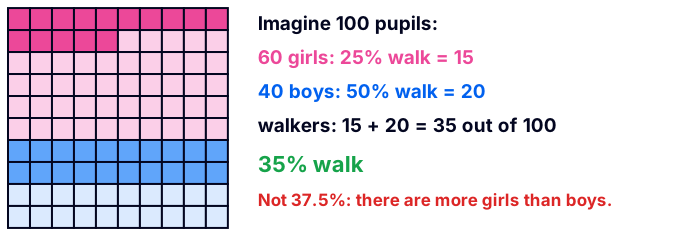
Imagine 100 pupils: 60 girls and 40 boys. 25% of 60 is 15 girls. 50% of 40 is 20 boys. 15 + 20 = 35 walkers out of 100, so 35%!
For the grown-up: with 100 pupils every count is also a percentage, so the answer can be read off directly. Any school size gives the same answer. Common wrong answer: 37.5%, the average of 25% and 50%, which would only be right with equal numbers of girls and boys; or 75%, adding the two percentages.
Problem 10
Problem 10: Answer 20%
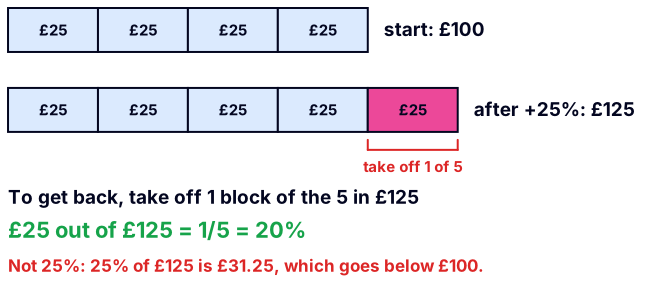
Start at £100. Up 25%: £125. To get back to £100, take off £25. £25 out of £125 is 1/5, which is 20%!
For the grown-up: a decrease is measured from the new, bigger price, so the same £25 is a smaller percentage of £125 than of £100. In blocks: the rise adds 1 block to 4, and the cut removes 1 block of 5. Common wrong answer: 25%. Taking 25% off £125 removes £31.25 and leaves £93.75, below where the shop started.
Using this as a worksheet
- Problems 1 to 4 match the Year 5 and Year 6 curriculum and suit every 11+ paper.
- Problems 5 to 8 (a rise, a discount comparison, two changes in a row, a reverse percentage) are the kinds of percentage question the CSSE paper sets. Set them once the first four are reliably right.
- Problems 9 and 10 are stretch, at the level of the harder independent-school papers.
- Redo wrong ones with new numbers three days later: change £40 and 15% in Problem 5 to £60 and 35%, for example.
- Ask for one check on each answer, as in Problem 8. On the CSSE paper marks go on the answer only and working earns nothing, so a quick check is the cheapest mark your child can win back.
More 11+ maths practice
- 11 plus ratio questions with worked answers: the same format for ratio and proportion.
- 11 plus algebra questions and 11 plus maths questions by topic.
- Hard 11 plus maths questions and the 11 plus maths syllabus.
- CSSE maths past papers for the official papers, and the CSSE 11+ 2027 hub for dates and format.
Math Explorers Club is not affiliated with or endorsed by the Consortium of Selective Schools in Essex (CSSE) or any school named here. All questions on this page are our own.