
Free practice
Noetic Math Contest Practice Problems: Grade 7
Ten original Noetic-style problems for grade 7, at real contest difficulty, with every answer explained for parents.
Noetic full prep and practice guides: 2 3 4 5 6 7 8
Free practice, other grades: 2 3 4 5 6 8
Other contests, grade 7: Math Kangaroo 7–8 MOEMS Div M CML 7 AMC 8
Printable PDF: all 10 problems with room to work, then every answer explained.
On this page · 3 sections
Ten original practice problems for the Grade 7 Noetic Learning Math Contest, written by us at real contest difficulty. None comes from a real Noetic test: Noetic Learning sells its past tests rather than posting them free, so these ten are free to read here and to print as a PDF. Every one has a worked solution, with a note for you on the most common wrong answer.
The Noetic Grade 7 test has 20 problems like these, and you get 45 minutes with no calculator. You write in every answer, and a wrong answer costs nothing, so never leave a line blank. The first problems take two or three steps; the last ones need a real idea. Try each problem on your own before you look at the answers.
The 10 problems
Problem 1
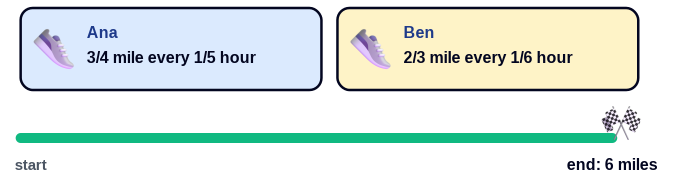
Ana and Ben start together at the beginning of a 6-mile trail and each walks at a steady speed. Ana walks 3/4 of a mile every 1/5 of an hour. Ben walks 2/3 of a mile every 1/6 of an hour. When Ben reaches the end of the trail, how far behind him is Ana?
Problem 2
The floor plan shows Kai’s L-shaped bedroom. On the plan, 1 cm stands for 0.5 m. Carpet costs $32 for each square meter. How much does it cost to carpet the whole floor?
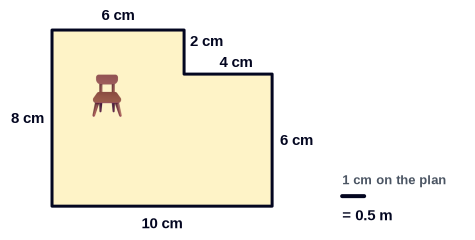
Watch out: When every length is multiplied by a number, an area is multiplied by that number twice.
Problem 3
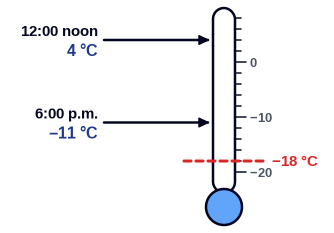
A new freezer is switched on at 12:00 noon, when the thermometer inside shows 4 °C. At 6:00 p.m. it shows −11 °C. The temperature falls by the same amount every hour until it reaches −20 °C. Lena reads the thermometer only on the hour. At what time does she first read a temperature below −18 °C?
Problem 4
A pizza shop sells round pizzas by their diameter. A 12-inch pizza costs $9.00 and a 16-inch pizza costs $12.80. Both are equally thick. The 16-inch pizza gives more square inches of pizza for each dollar. How many percent more?
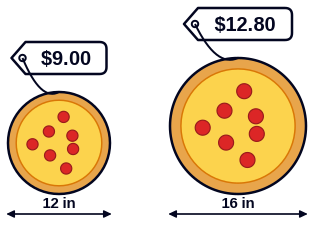
Fact: A circle’s area is π × r × r, where the radius r is half of the diameter.
Problem 5
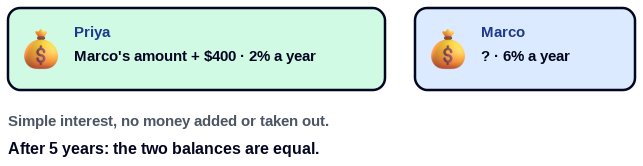
Priya put $400 more into her savings account than Marco put into his. Priya’s account pays 2% simple interest a year, and Marco’s pays 6% simple interest a year. Neither of them adds or takes out any money. After 5 years, their two accounts hold exactly the same amount. How much did Marco put in?
Problem 6
The weather forecast gives the chance of rain on Friday, Saturday and Sunday, as shown. Whether it rains on one day does not change the chances on the other days. What is the probability that it rains on exactly one of the three days?
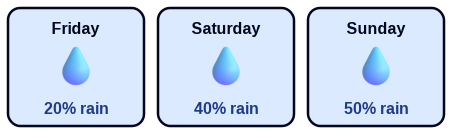
Tip: For several separate events, multiply the chances along each path of a tree, then add the paths you want.
Problem 7
Tara’s mom is 30 years older than Tara. When you square Mom’s age and square Tara’s age, the two squares differ by 1,320. How old is Tara’s mom?
Problem 8
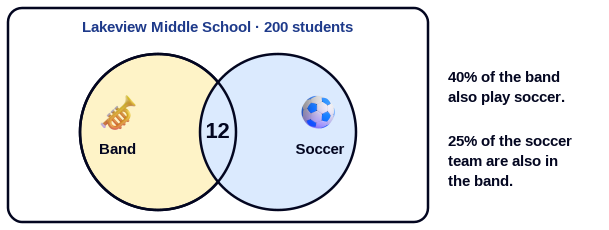
At Lakeview Middle School, 40% of the band members also play on the soccer team, and 25% of the soccer players are also in the band. Exactly 12 students do both. The school has 200 students. What percent of the students are in neither the band nor the soccer team?
Problem 9
★ Challenge. Five different integers are multiplied, and the product is 36. The integers may be positive or negative. What is the largest possible sum of the five integers?

Problem 10
★ Challenge. Four friends each choose one of three ice-cream flavors: vanilla, chocolate and mint. Each friend chooses at random, each flavor is equally likely, and no one’s choice depends on anyone else’s. What is the probability that all three flavors are chosen?

Solutions
Problem 1
Problem 1: Answer 3/8 mile
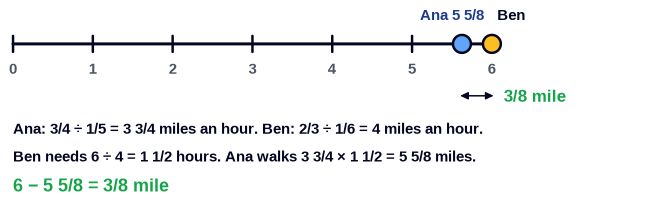
Ana: 3/4 ÷ 1/5 = 3¾ miles an hour. Ben: 2/3 ÷ 1/6 = 4 miles an hour. Ben needs 1½ hours; in that time Ana walks 5⅝ miles, so she is 3/8 mile behind.
Why it works: a speed is distance ÷ time, even when both are fractions: dividing by 1/5 is multiplying by 5, so Ana walks 3/4 × 5 = 15/4 miles an hour, and Ben walks 2/3 × 6 = 4. Ben’s 6 miles take 6 ÷ 4 = 1½ hours, and Ana covers 15/4 × 3/2 = 45/8 = 5⅝ miles in that time. Check: Ana would need 6 ÷ 15/4 = 1.6 hours, 0.1 hour (6 minutes) more than Ben, and in 6 minutes she walks 3¾ × 0.1 = 0.375 = 3/8 mile. Common wrong answer: 1/10 (the time difference in hours, not a distance), or 1/12 (3/4 − 2/3, as if those were the speeds).
Problem 2
Problem 2: Answer $576
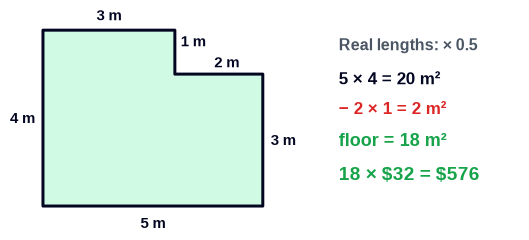
Turn every plan length into meters first (halve it): 5 × 4 = 20 m², take away the 2 × 1 = 2 m² corner: 18 m². 18 × $32 = $576.
Why it works: the scale is about lengths. Each plan centimeter is half a meter, so a plan square centimeter is ½ × ½ = ¼ square meter, not ½. Working in real meters avoids the trap: the room is a 5 m by 4 m rectangle with a 2 m by 1 m corner missing, 20 − 2 = 18 m², and 18 × 32 = 576. Check: the plan area is 80 − 8 = 72 cm², and 72 × ¼ = 18 m². Common wrong answer: $1,152 (plan area 72 × 0.5 = 36 m², the length scale used for an area), or $640 (forgetting the missing corner: 20 m² × $32).
Problem 3
Problem 3: Answer 9:00 p.m.
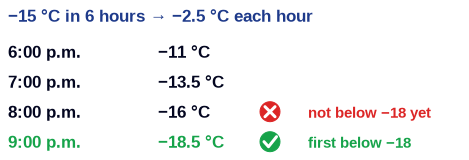
From 4 °C to −11 °C is a fall of 15 °C in 6 hours: 2.5 °C every hour. 8:00 p.m. shows −16 °C, still above −18; 9:00 p.m. shows −18.5 °C, the first reading below.
Why it works: the change from noon to 6 p.m. is −11 − 4 = −15 °C, and −15 ÷ 6 = −2.5 °C an hour. After h hours the reading is 4 − 2.5h, and 4 − 2.5h < −18 means 2.5h > 22, so h > 8.8. The temperature crosses −18 °C at 8:48 p.m., but Lena reads only on the hour, so her first reading below −18 °C is at 9:00 p.m. (−18.5 °C, still above the −20 °C where it stops). Check: 4 − 2.5 × 8 = −16 and 4 − 2.5 × 9 = −18.5. Common wrong answer: 8:00 p.m. (rounding 8.8 hours down), 8:48 p.m. (the crossing time, not a reading), or 10:00 p.m. (a fall of 2 °C an hour, counted on from −11 °C at 6 p.m.).
Problem 4
Problem 4: Answer 25%
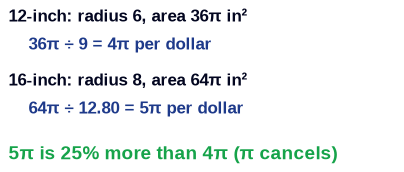
Radii 6 and 8: areas 36π and 64π. Per dollar: 36π ÷ 9 = 4π and 64π ÷ 12.80 = 5π. 5π is a quarter more than 4π: 25%.
Why it works: the amount of pizza is the area, π × r × r, and the radius is half the diameter. The small pizza gives 36π ÷ 9 = 4π square inches for each dollar; the big one gives 64π ÷ 12.8 = 5π. The π is in both and cancels when you compare: 5π ÷ 4π = 1.25, so 25% more. Check: the 16-inch is 64/36 = 16/9 as much pizza for 12.80/9 = 64/45 times the price, and 16/9 ÷ 64/45 = 5/4 = 1.25 again. Common wrong answer: a “the small one is better” answer from comparing diameters per dollar (12 ÷ 9 = 1.33 against 16 ÷ 12.8 = 1.25), or 33% (16 is a third more than 12), or 42% (the price difference).
Problem 5
Problem 5: Answer $2,200
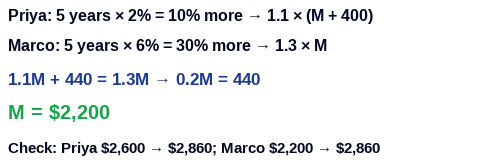
In 5 years Priya’s money grows 10% and Marco’s 30%. Call Marco’s deposit M: 1.1(M + 400) = 1.3M, so 440 = 0.2M and M = $2,200.
Why it works: simple interest is paid on the first deposit only, so 5 years at 2% adds 10% and 5 years at 6% adds 30%. Priya starts with M + 400, so she ends with 1.1M + 440; Marco ends with 1.3M. Setting them equal leaves 0.2M = 440, and M = 2,200. Check: Priya $2,600 grows to $2,860, Marco $2,200 grows to $2,860. Common wrong answer: $2,600 (Priya’s deposit), $10,000 (400 ÷ 4%, as if the gap closed by 4% of the total each year), or $2,000 (0.2M = 400, forgetting that Priya’s extra $400 earns interest too).
Problem 6
Problem 6: Answer 46%
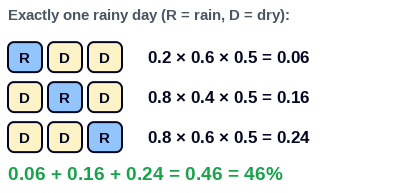
Exactly one rainy day happens in three ways: only Friday 0.2 × 0.6 × 0.5 = 0.06, only Saturday 0.8 × 0.4 × 0.5 = 0.16, only Sunday 0.8 × 0.6 × 0.5 = 0.24. Add: 0.46 = 46%.
Why it works: each way is a path in a tree with one rainy day and two dry ones; the chance of a dry day is 1 minus the chance of rain. Since the days don’t affect each other, the chances along a path multiply, and the three paths can’t happen together, so their chances add. Check: the eight paths of the tree add to 1, and “no rain” (0.24), “two rainy days” (0.26) and “three” (0.04) make up the other 0.54. Common wrong answer: 110% (adding the three chances: more than 100% is a warning sign), 24% (only the most likely path), or 4% (all three rainy).
Problem 7
Problem 7: Answer 37 years
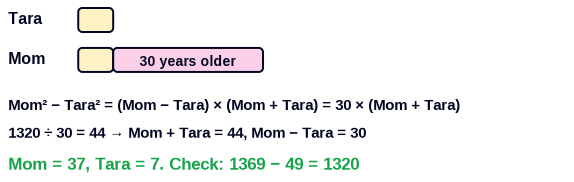
Mom² − Tara² = (Mom − Tara)(Mom + Tara) = 30 × (Mom + Tara) = 1,320, so the ages add to 44. With a gap of 30: Mom is 37 and Tara is 7.
Why it works: a difference of two squares is the difference times the sum. You can also call Tara’s age t: (t + 30)² − t² = 60t + 900 = 1,320, so 60t = 420 and t = 7, Mom 37. Check: 37 × 37 = 1,369 and 7 × 7 = 49, and 1,369 − 49 = 1,320. Common wrong answer: 44 (the sum of the ages), 7 (Tara’s age), or 22 (halving 44 and forgetting the gap).
Problem 8
Problem 8: Answer 67%
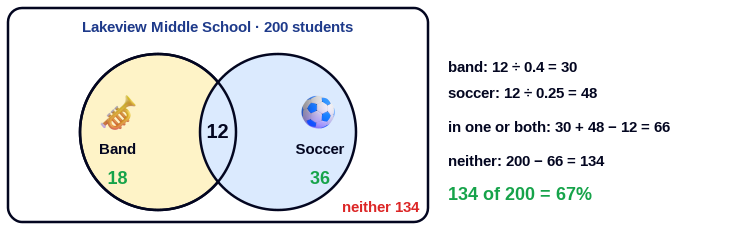
12 is 40% of the band, so the band has 30. 12 is 25% of the soccer team, so it has 48. In one or both: 30 + 48 − 12 = 66. Neither: 134 of 200 = 67%.
Why it works: the 12 students in both groups are a part of each group, but a different percent of each, because the groups have different sizes: 12 ÷ 0.4 = 30 and 12 ÷ 0.25 = 48. Adding the two groups counts the 12 twice, so take them away once: 66 students are in at least one. The rest, 200 − 66 = 134, are in neither, and 134 ÷ 200 = 0.67. Check: band only 18, both 12, soccer only 36, neither 134, and 18 + 12 + 36 + 134 = 200. Common wrong answer: 61% (taking away 30 + 48 = 78 without removing the double count), 33% (the students in at least one), or 35% (adding 40% and 25%).
Problem 9
Problem 9: Answer 9
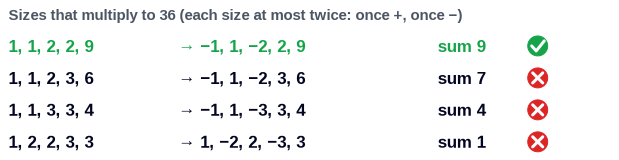
Five different integers can use each size at most twice (as + and −), and their sizes must multiply to 36. The only choices are 1, 1, 2, 2, 9 / 1, 1, 2, 3, 6 / 1, 1, 3, 3, 4 / 1, 2, 2, 3, 3; with an even number of minus signs the best is 1, −1, 2, −2, 9: sum 9.
Why it works: ignore the signs first. 36 cannot be split into five different positive whole numbers (1 × 2 × 3 × 6 is already 36), so some sizes must repeat, and a size can appear at most twice: once positive and once negative. Listing the ways to write 36 as a product of five sizes with no size more than twice gives just the four lists above. In each list a repeated size forces one minus sign, and the product must stay positive, so the minus signs must come in an even number; then make the biggest numbers positive. The sums are 9, 7, 4 and 1, so the largest is 9. Check: 1 × (−1) × 2 × (−2) × 9 = 36. Common wrong answer: 12 (only four numbers, 1, 2, 3, 6), 13 (adding a second 1, which is not different), or 7 (stopping at 1, −1, −2, 3, 6).
Problem 10
Problem 10: Answer 4/9
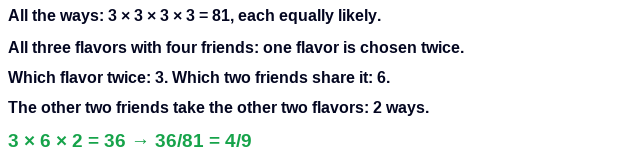
There are 3⁴ = 81 equally likely ways. Using all three flavors, one flavor is picked twice: choose that flavor (3), the two friends who pick it (6), and who gets the other two flavors (2). 3 × 6 × 2 = 36, and 36/81 = 4/9.
Why it works: each friend has 3 choices, so 3 × 3 × 3 × 3 = 81 outcomes, all equally likely. With four friends and three flavors all used, exactly one flavor is chosen by two friends and the other two flavors by one each. Counting the other way gives the same: the ways that miss vanilla are 2⁴ = 16, and the same for each flavor, 48, but “everyone chose mint” was counted under “no vanilla” and “no chocolate”, so the three one-flavor ways are counted twice: 48 − 3 = 45 miss a flavor, and 81 − 45 = 36. Common wrong answer: 11/27 (33/81, taking away 48 without adding back the 3), 2/9 or 2/27 (forgetting the 2 ways for the last two friends, or the 6 pairs), or 1/3 (guessing from three flavors).
More Noetic practice for grade 7
For more at this level, our Noetic Grade 7 prep guide has 16 chapters, 160 original multi-step problems and two full 20-question practice tests, with a free sample to try first. Practice for the other grades: Grade 2 · Grade 3 · Grade 4 · Grade 5 · Grade 6 · Grade 8. For the format, the awards and a four-week plan, read our Noetic Learning Math Contest preparation guide.
This guide is not affiliated with or endorsed by Noetic Learning. “Noetic Learning Math Contest” is a trademark of its respective owners.