Free practice
Noetic Math Contest Practice Problems: Grade 8
Ten original Noetic-style problems for grade 8, at real contest difficulty, with every answer explained for parents.
Noetic full prep and practice guides: 2 3 4 5 6 7 8
Free practice, other grades: 2 3 4 5 6 7
Other contests, grade 8: Math Kangaroo 7–8 MOEMS Div M CML 8 AMC 8
Printable PDF: all 10 problems with room to work, then every answer explained.
On this page · 3 sections
Ten original practice problems for the Grade 8 Noetic Learning Math Contest, written by us at real contest difficulty. None comes from a real Noetic test: Noetic Learning sells its past tests rather than posting them free, so these ten are free to read here and to print as a PDF. Every one has a worked solution, with a note for you on the most common wrong answer.
The Noetic Grade 8 test has 20 problems like these, and you get 45 minutes with no calculator. You write in every answer, and a wrong answer costs nothing, so never leave a line blank. The first problems take two or three steps; the last ones need a real idea. Try each problem on your own before you look at the answers.
The 10 problems
Problem 1
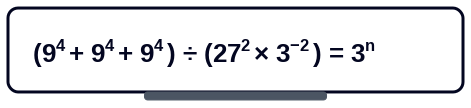
Write (9⁴ + 9⁴ + 9⁴) ÷ (27² × 3⁻²) as a power of 3. What is n?
Fact: A negative exponent means “one over”: 3⁻² = 1/3² = 1/9.
Problem 2
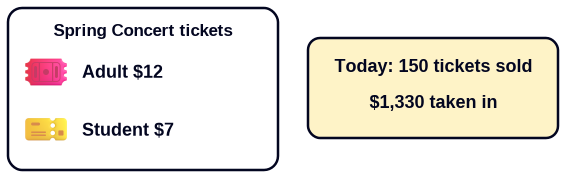
A school sold 150 tickets for its spring concert and took in $1,330. Adult tickets cost $12 and student tickets cost $7. How many more student tickets than adult tickets were sold?
Problem 3
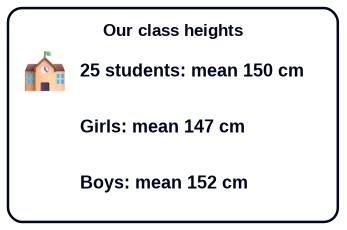
A class of 25 students measured their heights. The mean height of the whole class is 150 cm. The mean height of the girls is 147 cm, and the mean height of the boys is 152 cm. How many girls are in the class?
Problem 4
A straight line passes through the points (3, 2) and (9, −2). The line and the two axes make a triangle. What is the area of that triangle?
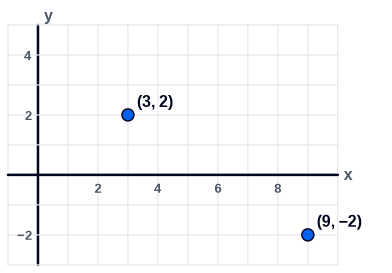
Tip: A line meets the y-axis where x = 0 and the x-axis where y = 0.
Problem 5
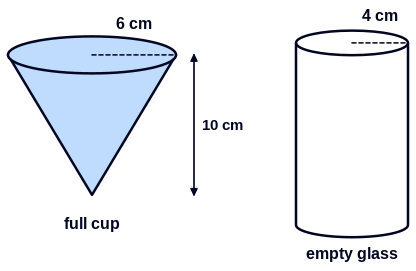
A paper cup shaped like a cone is 10 cm deep, and its round top has a radius of 6 cm. It is filled to the top with water. All the water is poured into an empty glass shaped like a cylinder with a radius of 4 cm. How deep is the water in the glass?
Problem 6
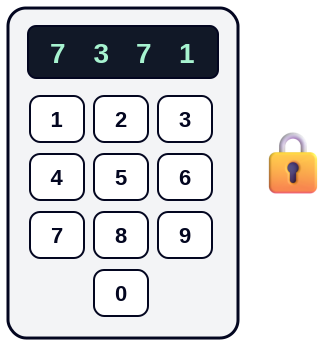
A lock uses a 4-digit code made from the digits 0 to 9, such as 0417 or 2552. How many codes have exactly two digits the same, with the other two digits different from that digit and from each other? (7371 is one of them; 7377 and 7373 are not.)
Problem 7
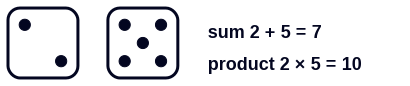
Two fair six-sided dice are rolled. What is the probability that the sum of the two numbers is a prime number and the product of the two numbers is even? Give the answer as a fraction in lowest terms.
Problem 8
Each side of a rhombus is 10 cm long, and one of its diagonals is 12 cm long. What is the height of the rhombus, the distance between two of its opposite sides?
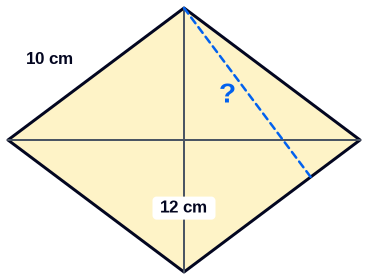
Fact: The diagonals of a rhombus cut each other in half at right angles.
Problem 9
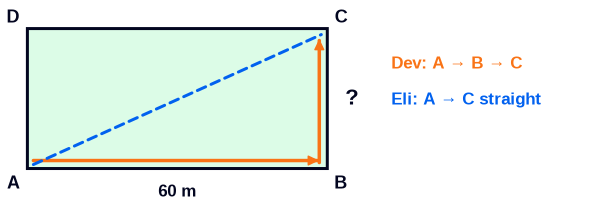
★ Challenge. Dev and Eli start together at corner A of a rectangular field and both finish at the opposite corner C at the same moment. Dev runs along two sides of the field; Eli walks straight along the diagonal. Dev runs 7 m for every 5 m Eli walks. The longer side of the field is 60 m, and the picture is not drawn to scale. How long is the shorter side?
Problem 10
★ Challenge. A machine takes a number x and gives back f(x) = ax + b, where a and b are fixed numbers and a is positive. When any number is put through the machine twice, the result is 9x + 8. What is f(10)?

Solutions
Problem 1
Problem 1: Answer n = 5
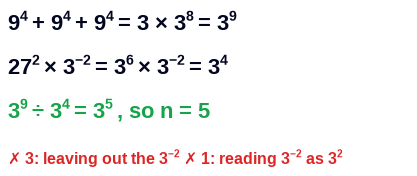
Write everything as a power of 3. The top is 3 × 9⁴ = 3 × 3⁸ = 3⁹. The bottom is 27² × 3⁻² = 3⁶ × 3⁻² = 3⁴. So the whole thing is 3⁹ ÷ 3⁴ = 3⁵.
Why it works: three equal terms added are 3 times one of them, and 9⁴ = (3²)⁴ = 3⁸, so the top is 3¹ × 3⁸ = 3⁹. In the bottom, 27² = (3³)² = 3⁶, and multiplying by 3⁻² subtracts 2 from the exponent: 3⁴. Dividing powers of 3 subtracts exponents: 9 − 4 = 5. Check: 19,683 ÷ 81 = 243 = 3⁵. Common wrong answer: 3 (leaving out the 3⁻², so 3⁹ ÷ 3⁶), 1 (reading 3⁻² as 3², so 3⁹ ÷ 3⁸), or 8 (adding the three 9⁴ as 27⁴ = 3¹²).
Problem 2
Problem 2: Answer 38 tickets

Pretend all 150 are student tickets: $1,050. The other $280 comes from adults, $5 extra each: 56 adults, so 94 students, and 94 − 56 = 38.
Why it works: this is the system a + s = 150, 12a + 7s = 1,330, solved the quick way: each adult ticket brings $5 more than a student ticket, so the $280 above $1,050 counts the adults. Check: 56 × $12 = $672 and 94 × $7 = $658, together $1,330, and 56 + 94 = 150. Common wrong answer: 56 (the number of adult tickets, not the difference), 94 (the student tickets), or 266 (dividing $1,330 by 5).
Problem 3
Problem 3: Answer 10 girls
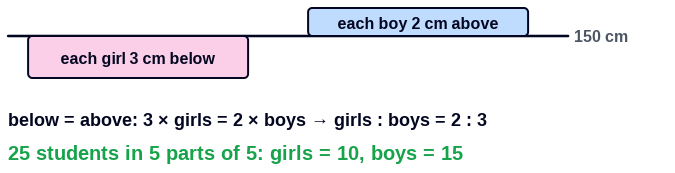
Each girl is 3 cm below the class mean and each boy is 2 cm above it. The amounts below and above must balance, so girls : boys = 2 : 3. 25 students in 5 parts: 10 girls.
Why it works: the class mean is the balance point, so all the centimetres below it equal all the centimetres above it: 3 × girls = 2 × boys. That makes girls to boys 2 : 3, and 25 ÷ 5 = 5 students a part. Check: 10 × 147 + 15 × 152 = 1,470 + 2,280 = 3,750, and 3,750 ÷ 25 = 150. Common wrong answer: 15 (the boys, from swapping the ratio), or 12.5 (dividing 25 by 2 because 150 is between 147 and 152).
Problem 4
Problem 4: Answer 12 square units
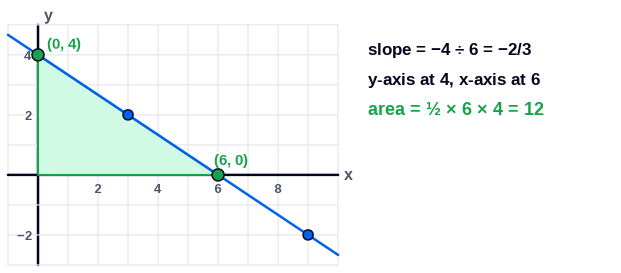
The line drops 4 for every 6 across: slope −2/3. Going 3 left from (3, 2) it rises 2, so it meets the y-axis at 4. Going 3 right from (3, 2) it drops 2, so it meets the x-axis at 6. Area = ½ × 6 × 4 = 12.
Why it works: from (3, 2) to (9, −2) the line goes 6 right and 4 down, so every 3 steps right it goes 2 down; that puts the crossings at (0, 4) and (6, 0), and the triangle between the line and the axes is a right triangle with legs 6 and 4. Check: y = −2/3 x + 4 gives 2 at x = 3 and −2 at x = 9. Common wrong answer: 24 (forgetting the half), 10 (adding the legs), or 18 (taking the x-axis crossing at 9).
Problem 5
Problem 5: Answer 7.5 cm
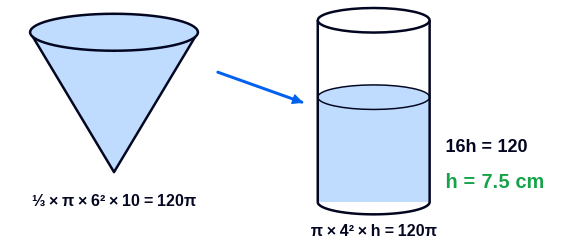
The cone holds ⅓ × π × 6² × 10 = 120π cm³. In the glass the water is a cylinder π × 4² × h = 16πh. So 16h = 120 and h = 7.5 cm.
Why it works: a cone holds one third of the cylinder with the same base and height, so the cup holds ⅓ × 36π × 10 = 120π. Pouring keeps the volume the same, and the water in the glass is a cylinder of radius 4, so 16π × h = 120π. The π cancels: h = 120 ÷ 16 = 7.5. Check: 16π × 7.5 = 120π. Common wrong answer: 22.5 (forgetting the ⅓, so 360π ÷ 16π), or 30 (taking 4 cm as the glass’s diameter, so 120π ÷ 4π).
Problem 6
Problem 6: Answer 4,320 codes
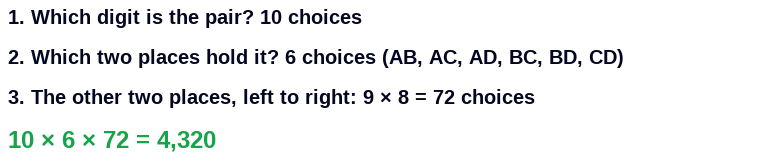
Choose the digit that appears twice (10 ways), the two places it goes (6 ways), then fill the other two places left to right with two different digits (9 × 8 = 72). 10 × 6 × 72 = 4,320.
Why it works: build each code in steps where every code is made exactly once. The two places for the pair are one of 6 position pairs (1–2, 1–3, 1–4, 2–3, 2–4, 3–4). The first empty place can take any of the 9 other digits and the second any of the 8 left, and since the places are in order, 3 then 1 and 1 then 3 are different codes. Check: 4,320 + 5,040 (all different) + 270 (two pairs) + 360 (a digit three times) + 10 (four times) = 10,000. Common wrong answer: 2,160 (halving the 9 × 8 as if the order of the other two didn’t matter), 5,040 (all different digits), or 4,590 (counting two-pair codes such as 7373 too).
Problem 7
Problem 7: Answer 7/18
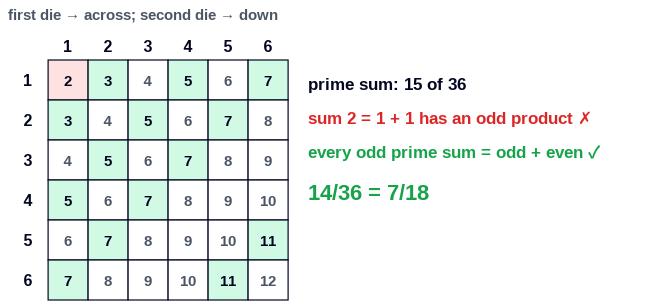
15 of the 36 rolls have a prime sum. Every odd prime sum comes from an odd and an even number, so the product is even. Only the sum 2 (1 + 1) has an odd product. 14/36 = 7/18.
Why it works: the 36 rolls are equally likely. Prime sums: 2 (1 way), 3 (2), 5 (4), 7 (6), 11 (2), 15 in all. An odd sum always comes from one odd and one even number, so its product is even; the only even prime sum, 2 = 1 + 1, has the odd product 1. That leaves 14 rolls. Common wrong answer: 5/12 (the prime sums only, 15/36), 7/9 (reading “and” as “or”: 28 of 36), or 14/36 (right, but not in lowest terms).
Problem 8
Problem 8: Answer 9.6 cm
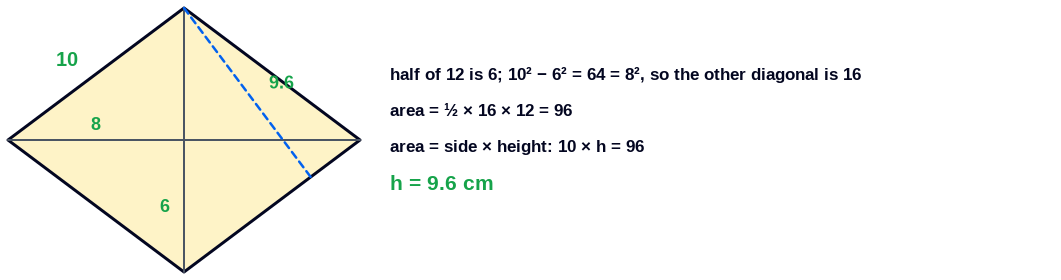
Half of the 12 cm diagonal is 6. With the side 10 as the long side of a right triangle, the other half-diagonal is √(10² − 6²) = 8, so the other diagonal is 16. The area is ½ × 16 × 12 = 96. A rhombus is also a parallelogram: area = side × height, so 10 × h = 96 and h = 9.6 cm.
Why it works: the diagonals cut each other in half at right angles, so the four small triangles are 6-8-10 right triangles with the side as the long side. The area found two ways, half the product of the diagonals (96) and side × height (10 × h), must agree. Check: 6² + 8² = 100 = 10² ✓ and 10 × 9.6 = 96 ✓. Common wrong answer: 12 or 8 (taking a diagonal or a half-diagonal as the height); 6 (using the side as the other diagonal: ½ × 12 × 10 = 60, then 60 ÷ 10); 4.8 (dividing 48, half the area, by 10).
Problem 9
Problem 9: Answer 45 m
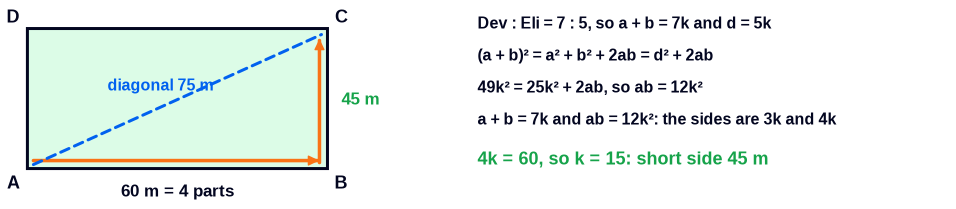
Same time, so Dev’s two sides and Eli’s diagonal are 7 : 5. That forces sides of 3 parts and 4 parts; 60 m is 4 parts, so the short side is 45 m.
Why it works: in the same time, distances are in the ratio of speeds, so a + b = 7k and the diagonal d = 5k. By the Pythagorean theorem a² + b² = d², and (a + b)² = a² + b² + 2ab, so 49k² = 25k² + 2ab and ab = 12k². Two numbers that add to 7k and multiply to 12k² are 3k and 4k. The longer side is 4k = 60, so k = 15 and the shorter side is 3k = 45 m. Check: 45 + 60 = 105 and the diagonal is 75; 105 : 75 = 7 : 5. Common wrong answer: 80 (making 60 the shorter side), 75 (the diagonal), or 84 (multiplying 60 by 7/5 as if the ratio were between the two sides).
Problem 10
Problem 10: Answer f(10) = 32
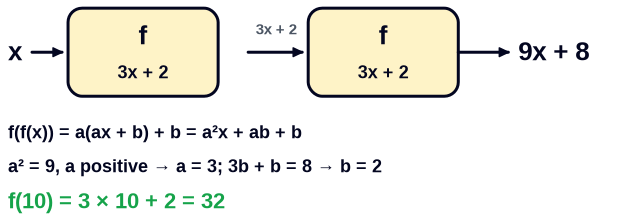
Through the machine twice, x becomes a(ax + b) + b = a²x + ab + b. That must be 9x + 8 for every x, so a² = 9 and ab + b = 8. With a positive, a = 3, then 4b = 8 and b = 2. So f(x) = 3x + 2 and f(10) = 32.
Why it works: the second pass multiplies the whole output ax + b by a and adds b again. Two straight-line rules agree for every x only when their x-parts and their constants match. a = −3 also squares to 9 (with b = −4), which is why the problem says a is positive. Check: 3(3x + 2) + 2 = 9x + 8. Common wrong answer: −34 (using a = −3, b = −4), or 98 (putting 10 through 9x + 8, which is the machine twice, not once).
More Noetic practice for grade 8
For more at this level, our Noetic Grade 8 prep guide has 16 chapters, 160 original multi-step problems and two full 20-question practice tests, with a free sample to try first. For multiple-choice practice at this level, try our free AMC 8 practice problems. Practice for the other grades: Grade 2 · Grade 3 · Grade 4 · Grade 5 · Grade 6 · Grade 7. For the format, the awards and a four-week plan, read our Noetic Learning Math Contest preparation guide.
This guide is not affiliated with or endorsed by Noetic Learning. “Noetic Learning Math Contest” is a trademark of its respective owners.