11 Plus Algebra Questions With Worked Answers
Ten original 11+ algebra questions, from missing numbers to two-unknown word problems, with worked answers and the wrong answer children most often give.
· 13 min read
11+ dates and scores: Essex 11+ (CSSE) 2027 CSSE pass mark Independent school dates
On this page · 5 sections
These 10 original 11 plus algebra questions are written for children in Year 5 and Year 6. They start with missing-number sums and finish with two-unknown word problems of the kind that turn up on harder grammar and independent school papers. The worked solutions come after all ten problems, so you can print the page and keep the answers back. Each answer also gives the wrong answer children most often write, because that is usually where the marks go.
No calculator: the Essex 11+ (CSSE) maths paper doesn’t allow one, so practise every question with pencil and paper.
What algebra the 11+ expects
In the national curriculum, algebra is a Year 6 topic. Years 1 to 5 have no algebra section at all, so a child sitting the 11+ in September of Year 6 may meet some of it for the first time while preparing. The Year 6 programme of study lists five skills. Here is where each one appears below.
| Year 6 curriculum statement | Problems |
|---|---|
| Use simple formulae | 2, 3 |
| Generate and describe linear number sequences | 5 |
| Express missing number problems algebraically | 1, 4, 6, 9, 10 |
| Find pairs of numbers that satisfy an equation with 2 unknowns | 7, 8 |
| Enumerate possibilities of combinations of 2 variables | 8 |
The Essex (CSSE) paper goes further than this list: its free past papers include equations with the unknown on both sides and problems with three linked unknowns, so Problems 6 to 10 below are worth the time even for a child who finds the warm-ups easy. For the full list of topics, see our 11 plus maths syllabus post.
How to use these questions
- One or two a day, pencil and paper, 5 to 10 minutes each.
- Write the working, even when the paper only marks the answer. The CSSE mark schemes give one mark for each correct answer, so only the answer scores. Some independent schools work the other way: St Paul’s Girls’ School says a wrong answer “cannot be given any credit if it is not supported by working”. Written working is also the easiest way to find your own mistake.
- Check every answer by putting it back into the question. Problem 1 below shows how.
Problems 1 to 3 are warm-ups for Year 5 and early Year 6, Problems 4 to 7 are core Year 6 algebra, and the three starred stretch problems (8 to 10) are at the level of harder grammar and independent school papers. Each one has a picture of the situation, and some have a tip or a warning underneath.
The problems
Problem 1
Solve 4n + 9 = 37. What is n?
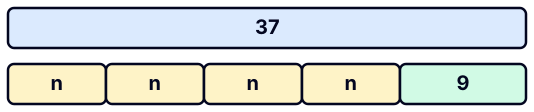
Tip: Undo the steps in reverse order: the last thing done to n is the first thing you undo.
Problem 2
A taxi charges £3 to start, then £2 for every mile. The cost in pounds is C = 3 + 2m, where m is the number of miles. How much does a 7-mile journey cost?
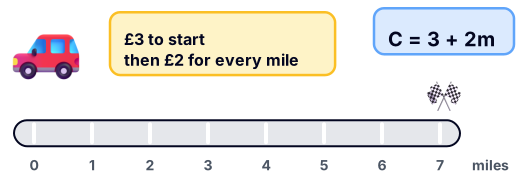
Watch out: In a formula, multiply before you add.
Problem 3
If a = 4 and b = 3, work out 2a² − 3b.

Watch out: In 2a², only the a is squared.
Problem 4
I think of a number. I double it, add 5, then multiply the result by 3. My answer is 51. What was my number?

Problem 5
A sequence starts 5, 9, 13, 17, … and keeps going in the same way. What is the 20th term?
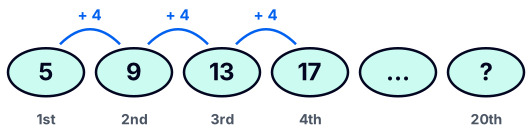
Watch out: From the 1st term to the 20th, count the jumps, not the terms.
Problem 6
Two triangles and a circle weigh 19 g altogether. One triangle and one circle weigh 12 g. All the triangles weigh the same, and so do all the circles. How much does one triangle weigh, and how much does one circle weigh?
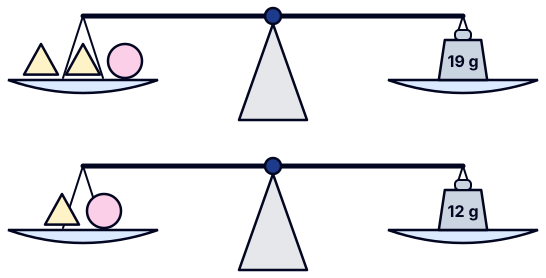
Tip: Compare the two balances: what is on the top one that is not on the bottom one?
Problem 7
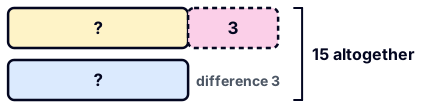
Two numbers add up to 15. Their difference is 3. What are the two numbers?
Problem 8
★ Stretch. x and y are whole numbers greater than 0, and 3x + 2y = 20. Find every possible pair of values for x and y.
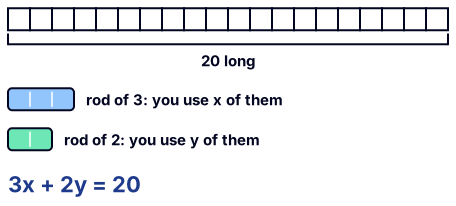
Tip: Think of x rods 3 long and y rods 2 long that make a line exactly 20 long. Try x = 1, 2, 3, … in order so you miss none.
Problem 9
★ Stretch. A pen costs 15p more than a pencil. Four pencils and three pens cost £2.62 altogether. How much does one pencil cost?
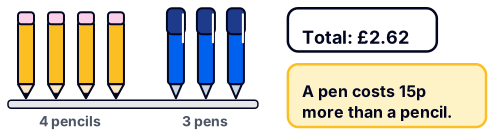
Tip: Change £2.62 to pence before you start.
Problem 10
★ Stretch. Sam is three times as old as his sister Lily. In 5 years’ time, Sam will be twice as old as Lily. How old is Lily now?
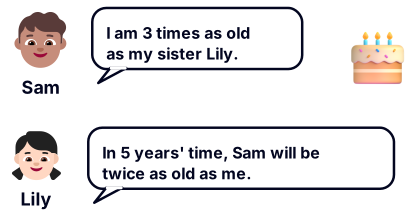
Watch out: In 5 years, both of them are 5 years older.
Solutions
Problem 1
Problem 1: Answer n = 7
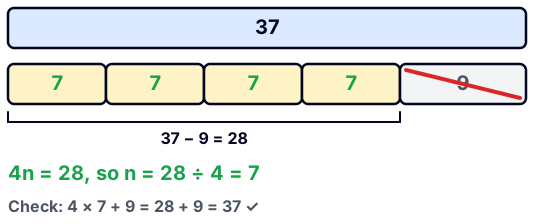
Take the 9 off first: 37 − 9 = 28. Four n’s make 28, so one n is 28 ÷ 4 = 7!
For the grown-up: n was multiplied by 4 and then 9 was added, so undo in reverse: subtract 9, then divide by 4. Check by putting the answer back in: 4 × 7 + 9 = 28 + 9 = 37. Common wrong answer: 11.5, from adding the 9 instead of taking it away (37 + 9 = 46, then 46 ÷ 4). An answer that isn’t a whole number is a good sign to check again.
Problem 2
Problem 2: Answer £17
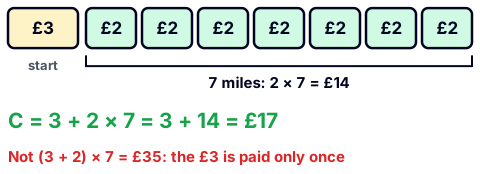
Seven miles at £2 is 2 × 7 = £14. Add the £3 start: 3 + 14 = £17!
For the grown-up: 2m means 2 × m, and multiplication comes before addition, so C = 3 + 2 × 7 = 3 + 14 = 17. The picture shows why: the £3 is paid once, the £2 seven times. Common wrong answer: £35, from working left to right: 3 + 2 = 5, then 5 × 7.
Problem 3
Problem 3: Answer 23
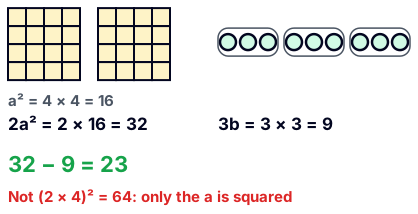
a² is 4 × 4 = 16, so 2a² is 2 × 16 = 32. 3b is 3 × 3 = 9. 32 − 9 = 23!
For the grown-up: in 2a² the square belongs to the a alone: 2a² means 2 × a × a, not (2a)². And 3b means 3 × b, not 33. Common wrong answer: 55, from squaring 2a: 8 × 8 = 64, then 64 − 9. Another slip is reading a² as a × 2 = 8, which gives 2 × 8 − 9 = 7.
Problem 4
Problem 4: Answer 6
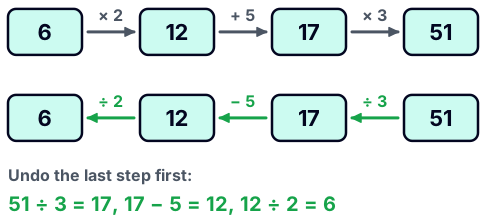
Run the machine backwards: 51 ÷ 3 = 17, then 17 − 5 = 12, then 12 ÷ 2 = 6!
For the grown-up: as an equation this is (2n + 5) × 3 = 51. The × 3 was done last, to the whole of 2n + 5, so it is undone first. Check forwards: 6 doubled is 12, add 5 is 17, times 3 is 51. Common wrong answer: 18, from leaving out the brackets: 2n + 5 × 3 = 51 gives 2n + 15 = 51, so 2n = 36.
Problem 5
Problem 5: Answer 81
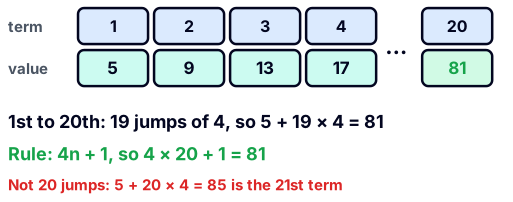
The sequence goes up by 4 each time. From the 1st term to the 20th there are 19 jumps: 19 × 4 = 76, and 5 + 76 = 81!
For the grown-up: the rule for the nth term is 4n + 1 (4 × 1 + 1 = 5, 4 × 2 + 1 = 9), so the 20th term is 4 × 20 + 1 = 81. The two ways agree, which is a check. Common wrong answer: 85, from counting 20 jumps instead of 19 (5 + 20 × 4). Another is 80, from 20 × 4 with the + 1 forgotten.
Problem 6
Problem 6: Answer triangle 7 g, circle 5 g
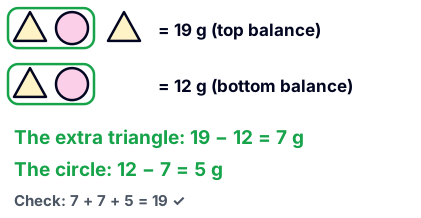
The top balance has everything on the bottom one, plus one more triangle. So that triangle weighs 19 − 12 = 7 g, and the circle weighs 12 − 7 = 5 g!
For the grown-up: this is two equations in two unknowns, 2t + c = 19 and t + c = 12, solved by taking one from the other. Check: 7 + 7 + 5 = 19 and 7 + 5 = 12. Common wrong answer: about 6.3 g each, from sharing 19 g between three shapes as if they all weighed the same. Another is to stop at “triangle 7 g” and forget the circle.
Problem 7
Problem 7: Answer 9 and 6
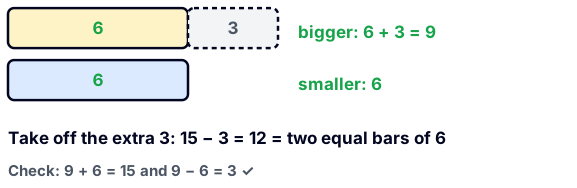
Take the extra 3 off the bigger number: 15 − 3 = 12. Now the two bars are equal, so each is 6. The bigger number is 6 + 3 = 9!
For the grown-up: the smaller number is (sum − difference) ÷ 2 and the bigger one is (sum + difference) ÷ 2 = 18 ÷ 2 = 9. Check: 9 + 6 = 15 and 9 − 6 = 3. Common wrong answer: 7.5 and 7.5, which uses the sum and ignores the difference; or 12 and 3, which adds to 15 but has a difference of 9.
Problem 8
Problem 8: Answer x = 2, y = 7; x = 4, y = 4; x = 6, y = 1
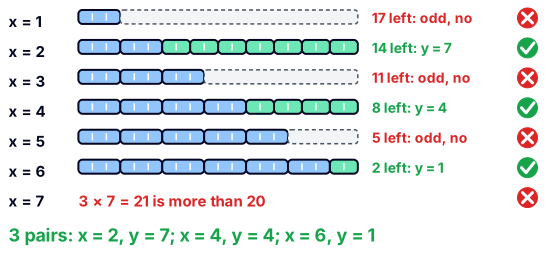
Try x = 1, 2, 3, … in order. What is left after the rods of 3 must be even, so the rods of 2 fill it. That works for x = 2, 4 and 6: three pairs!
For the grown-up: 20 − 3x must be even and greater than 0, so x must be even and 3x less than 20. x = 7 is too big (21 is more than 20). Check each pair: 6 + 14, 12 + 8 and 18 + 2 all make 20. Working through x = 1, 2, 3 in order is how you show that no pair is missing. Common wrong answer: also listing x = 0, y = 10, when the question says greater than 0; or stopping after the first pair found.
Problem 9
Problem 9: Answer 31p
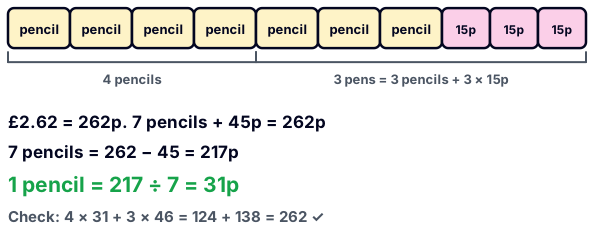
£2.62 is 262p. Each pen is a pencil and 15p more, so three pens are three pencils and 45p. Seven pencils and 45p make 262p. Seven pencils are 217p, and one pencil is 217 ÷ 7 = 31p!
For the grown-up: writing c for the cost of a pencil in pence (not p, which already means pence), 4c + 3(c + 15) = 262, so 7c + 45 = 262 and 7c = 217. Check: four pencils are 124p, three pens at 46p are 138p, and 124 + 138 = 262. Common wrong answer: 46p, which is the price of a pen, not a pencil. Adding the extra 15p only once gives 247 ÷ 7, which is not a whole number of pence: a sign to go back.
Problem 10
Problem 10: Answer 5 years old
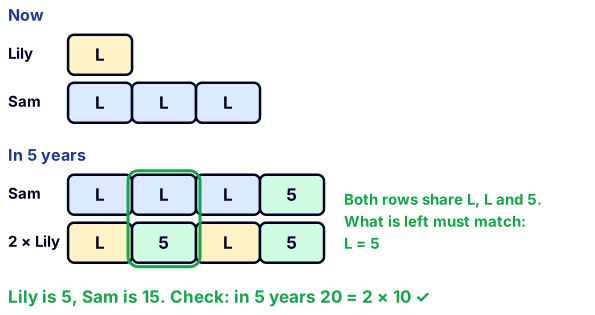
Draw Lily as 1 box and Sam as 3 boxes. In 5 years, add 5 to both. Sam’s bar must match two of Lily’s bars. They share two boxes and a 5, so Sam’s third box matches the other 5. One box is 5, so Lily is 5!
For the grown-up: with Lily L, Sam is 3L. In 5 years 3L + 5 = 2(L + 5) = 2L + 10, so L = 5 and Sam is 15. Check: in 5 years, Sam is 20 and Lily is 10, and 20 is twice 10. Common wrong answer: 10, which is Lily’s age in 5 years, not now. Adding 5 years to Lily but not to Sam (3L = 2(L + 5)) also gives 10: both people get 5 years older.
Three habits that stop algebra mistakes
- Undo in reverse order. Problems 1 and 4 both go wrong when the child undoes the first step first.
- Put the answer back in. Every answer above has a check. It takes 20 seconds and catches most slips.
- Change to one unit first. Pounds and pence in one sum (Problem 9) is a common way to lose a mark.
More practice by topic: 11 plus ratio questions, 11 plus percentage questions and our general 11 plus maths questions. For multi-step problems in the style of written independent school papers, try the hard 11 plus maths questions. If your child is sitting the Essex test, our CSSE maths past papers post explains where to find the free official papers and how to use them.
Math Explorers Club is not affiliated with or endorsed by the Consortium of Selective Schools in Essex (CSSE), St Paul’s Girls’ School or any school named here. All questions on this page are our own.