CSSE Maths Past Papers: Where to Get Them, How to Use Them
Three real CSSE maths papers are free on the CSSE website and three more cost £19 a pack. Here is where to find each one, how the answer-only marking works, and a month-by-month plan for a Year 5 child.
· 9 min read
11+ dates and scores: Essex 11+ (CSSE) 2027 CSSE pass mark Independent school dates
On this page · 7 sections
CSSE publishes six real maths past papers. The papers for 2021, 2022 and 2023 entry are free to download, with their mark schemes, from the CSSE Practice Material page. The papers for 2024, 2025 and 2026 entry are sold as printed packs at £19 each, English and maths together. Nothing else is a real CSSE paper: books and websites sell “CSSE-style” papers written by their own authors.
CSSE states that “all CSSE examination papers are protected by copyright”, so we link to them and never copy them. The three practice questions at the end of this post are our own.
Where to get CSSE maths past papers
As of November 2026. Check the CSSE website before ordering.
| Entry year (test sat the September before) | What you get | Cost | Where |
|---|---|---|---|
| 2021, 2022, 2023 entry | Real maths paper + maths mark scheme (and the English papers) | Free PDF | CSSE Practice Material |
| 2024 entry | Printed pack: the real English and maths papers sat for 2024 entry | £19 incl. UK postage; free for families receiving free school meals by virtue of household income (send a letter from your child’s primary school) | Order Practice Packs |
| 2025 entry | Printed pack, as above | £19 incl. UK postage | same |
| 2026 entry | Printed pack, as above | £19 incl. UK postage | same |
How ordering works: you choose packs on the online form, CSSE emails you a payment link, and the pack goes out by second-class post. CSSE says to allow up to ten days. Overseas postage is extra.
The free papers have appeared in May each year (the 2021-entry paper in May 2024, 2022 in May 2025, 2023 in May 2026). If that pattern holds, the next one will go up in May 2027.
What the CSSE maths paper looks like
- 60 minutes, 60 marks.
- One mark for each correct answer, almost always. The mark scheme lists answers only, with no marks for working. The free papers have a few exceptions: one 2023-entry spatial question is worth 2 marks (1 mark for a partly right answer), and the 2021-entry scheme gives a later part its mark when it follows correctly from the child’s own earlier answer.
- Some answers need two or three boxes for one mark (hours and minutes, a pair of numbers), while others give one mark per box, such as each co-ordinate.
- Almost every answer is written in. Each paper also has a few marks (about 4 to 6) where the child picks: true or false, always / sometimes / never true, choose statement A, B or C, or the odd one out of five cube nets.
- No calculator, and no smartwatch. Your child brings a pen, pencil, ruler and eraser.
- CSSE says the test is based on Key Stage 2. The real papers sometimes go further: decimal × decimal, fraction ÷ fraction, equations with the unknown on both sides, upper and lower bounds. The test is sat in September of Year 6, so Year 6 topics such as algebra, ratio and the mean have usually not been taught at school yet.
- The free papers have 20 or 21 numbered questions, most split into parts (a, b, c…), which is how 60 marks fit into an hour.
The English paper is the other half of the score. Both papers are standardised and weighted equally.
How answer-only marking works
Because marks go to the final answer, working earns nothing on its own. A child who sets up a problem perfectly and then slips on 7 × 8 scores the same as a child who left it blank. Four habits follow from that:
- Answer in the form asked. If the question wants minutes, write a number of minutes, not hours and minutes. If it wants centimetres, give centimetres: one real CSSE mark scheme turns down an answer given in mm where the box asks for cm.
- Check the units on the answer line before writing anything in.
- Leave time to check. One quick estimate per answer (“is £10 sensible out of £24?”) catches most slips.
- Fill every box of a multi-part question. A later part can still earn its mark, so never leave it blank because an earlier part went wrong.
What one mark is worth: for 2027 entry, the maths raw marks had a mean of 25.8 out of 60 and a spread (standard deviation) of 12.8, across 4,994 children. Using CSSE’s published formula, one raw maths mark added about 1.8 points to the total score (our calculation from the 2027 Entry Standardisation Report). An average child scores 300, and CSSE makes no offer below 303, so three careless slips cost about 5 points. Our CSSE pass mark page has every school’s last-place score.
The CSSE also warns that commercial practice books are “at a similar level but are not of the same format as the 11+ papers”. That is the main reason to use the six real papers well.
A study timeline for a Year 5 child
Today’s Year 5 children sit the test in September 2027 for entry in September 2028. CSSE says the exact date will be published by Easter 2027 and that registration opens in May 2027 (see our CSSE 11+ 2027 hub). For reference, the last test was on Saturday 19 September 2026.
| When | What to do | Papers |
|---|---|---|
| November to February | Topic work, 15–20 minutes a day: arithmetic without a calculator, fractions, measures, then the topics that come up | None yet |
| March | One free paper untimed, to see which topics are missing. Mark it with the mark scheme | 2021 entry |
| April | Fill the gaps from March. Ratio and algebra are Year 6 curriculum, so school may not have taught them yet | None |
| May | Register. Order the £19 packs. A new free paper may appear | 2022 entry (timed, 60 min) |
| June and July | One timed paper every two to three weeks, marked the same day. Redo every wrong answer a week later | 2023, 2024 entry |
| August | Two timed papers, with a full check of units and the form of each answer | 2025 entry |
| Early September | The newest paper as a final rehearsal, at the time of day of the real test | 2026 entry |
That is six papers over six months, which matches the CSSE’s own advice that “children only need a limited amount of practice to familiarise themselves with the types of questions and timing”. Keep the newest paper for last, because it is closest to the test your child will sit.
For a full list of the topics in the curriculum, see our 11+ maths syllabus.
Three CSSE-style practice questions
These are original questions in the CSSE style: write-in answers, one mark per answer (Problem 2 has two answers, so two marks), no calculator. Give your child about six minutes for all three. Problem 1 tests the form of the answer, Problem 2 the units, and Problem 3 a fraction of what is left: the three slips that cost the most marks on answer-only papers. Each solution names the most common wrong answer.
The problems
Problem 1
A train leaves at 10:47 and arrives at 13:12. How long is the journey? Give your answer in minutes.
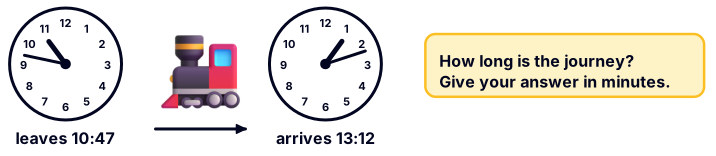
Watch out: An hour has 60 minutes, not 100, so you can’t subtract times like ordinary numbers. Count on to the next o’clock.
Problem 2
A ribbon 4 metres long is cut into as many 45 cm pieces as possible.
(a) How many pieces are there?
(b) How many centimetres of ribbon are left over?
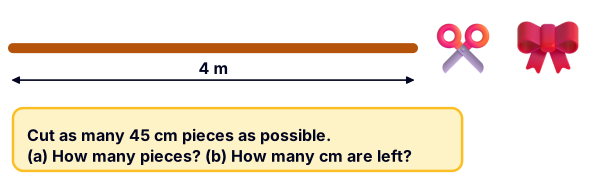
Tip: Change the metres into centimetres first, so both lengths are in the same unit.
Problem 3
Priya has £24. She spends 3/8 of it on a book, then 1/3 of what is left on lunch. How much money does she have now?
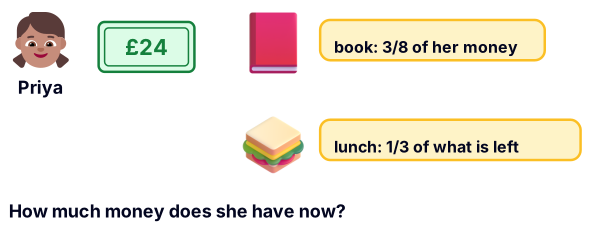
Watch out: “What is left” means the money after the book, not the £24 she started with.
Solutions
Problem 1
Problem 1: Answer 145 minutes
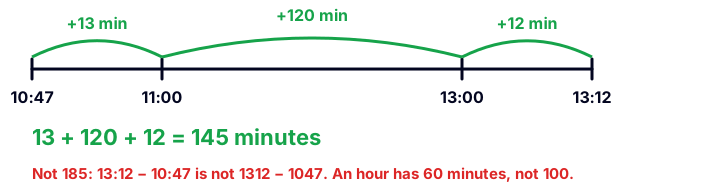
Count on: 10:47 to 11:00 is 13 minutes, 11:00 to 13:00 is 120 minutes, 13:00 to 13:12 is 12 minutes. 13 + 120 + 12 = 145 minutes!
For the grown-up: counting on through the o’clock times avoids the 60-minute trap completely. Check: 145 minutes is 2 hours 25 minutes, and 10:47 + 2 h = 12:47, + 25 min = 13:12. The answer is asked for in minutes, so write 145, not “2 h 25 min”: only the answer is marked, and one real CSSE mark scheme turns down an answer given in mm where the box asks for cm. Common wrong answer: 185, from subtracting like ordinary numbers (1312 − 1047 = 265, read as “2 hours 65 minutes”), or 265 itself.
Problem 2
Problem 2: Answer (a) 8 pieces; (b) 40 cm
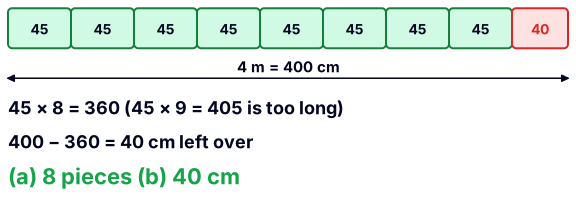
4 m = 400 cm. 45 × 8 = 360, and 45 × 9 = 405 is too long. So 8 pieces, and 400 − 360 = 40 cm is left over!
For the grown-up: this is 400 ÷ 45 with a remainder: the quotient answers (a) and the remainder answers (b), and each part is its own mark. Check: 8 × 45 + 40 = 400. Common wrong answer: 9 pieces (rounding 8.9 up: a ninth piece would be 5 cm short), or a muddle from working in metres and centimetres at once (4 ÷ 45).
Problem 3
Problem 3: Answer £10
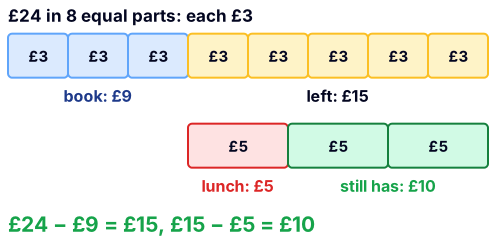
1/8 of £24 is £3, so the book costs 3 × £3 = £9 and £15 is left. 1/3 of £15 is £5 for lunch. £15 − £5 = £10!
For the grown-up: the second fraction is of a new whole, the £15 left after the book, which is why a bar model helps: draw the £24, shade the book, then split only what is left. Check: £9 + £5 + £10 = £24. Common wrong answer: £7, from taking 1/3 of the original £24 (£8) instead of 1/3 of what was left; or £5, the cost of lunch rather than the money she still has.
If your child got all three, try our harder 11+ maths questions. For a longer run before the real papers, our 10 free Essex 11+ maths practice questions are 22 marks in about 20 minutes, with every answer explained and a printable PDF.
Math Explorers Club is not affiliated with or endorsed by the Consortium of Selective Schools in Essex (CSSE) or any school named here. CSSE papers are the copyright of the CSSE; we link to them and do not reproduce them.