11 Plus Maths Questions: Topics and Worked Examples
The ten maths topics that 11+ papers draw on, each with one original worked example, the answer and the wrong answer children most often give.
· 12 min read
11+ dates and scores: Essex 11+ (CSSE) 2027 CSSE pass mark Independent school dates
On this page · 6 sections
11+ maths questions come from Key Stage 2 maths, the part of the national curriculum in England taught in Years 3 to 6. The difference is timing and depth: 11+ tests are sat early in Year 6, so they include Year 6 topics (ratio, algebra) that school may not have reached yet, and they ask for two or three steps where a school test asks for one.
Below is a map of the ten topics, then one question for each, with a worked answer. Every question is our own, written in the style of 11+ papers. None is copied from a real paper.
The 11+ maths topic map
| Topic | What 11+ questions ask | Curriculum year |
|---|---|---|
| Place value | Reading, ordering and rounding large numbers and decimals | Years 5–6 |
| Four operations | Long multiplication and division, order of operations, missing digits | Years 5–6 |
| Fractions, decimals, percentages | Converting and ordering, fractions of amounts | Years 5–6 |
| Percentages | Percentages of amounts, increases and discounts | Years 5–6 |
| Ratio and proportion | Sharing in a ratio, scaling recipes | Year 6 |
| Algebra | Simple formulae, sequences, missing numbers | Year 6 |
| Measurement | Units, time, perimeter, area, volume | Years 5–6 |
| Geometry | Angles, properties of shapes, coordinates | Years 5–6 |
| Statistics | Tables, charts, the mean | Year 6 (mean) |
| Multi-step word problems | Two or three topics in one question | All |
The curriculum years come from the national curriculum mathematics programmes of study, where ratio and proportion and algebra first appear as their own sections in Year 6.
Ten questions, one per topic
Each question below matches a row of the map, in the same order: Problem 1 is place value and Problem 10 is a multi-step word problem. Every question has a picture, and every solution shows the working, the answer and the wrong answer children most often give. Try each question before reading the solutions. No calculator.
The problems
Problem 1
Place value. What is 1,000 less than 40,205?

Watch out: The thousands digit is 0. Look at which digit really has to change.
Problem 2
Order of operations. Work out 20 − 12 ÷ 4 × 2.
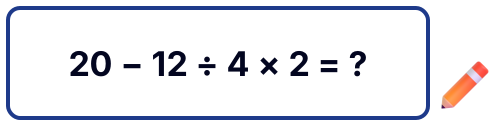
Tip: Division and multiplication come before subtraction. Between ÷ and ×, go left to right.
Problem 3
Fractions, decimals and percentages. Put these in order, smallest first: 5/8, 0.6, 62%.
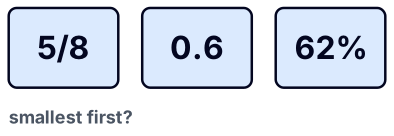
Trick: Change all three into the same kind of number before you compare them.
Problem 4
Percentages. What is 35% of 240?

Tip: Find 10% first. Every other percentage can be built from 10% and 5%.
Problem 5
Ratio. Sweets are shared between Ali and Ben in the ratio 2 : 5. Ben gets 12 more sweets than Ali. How many sweets are there altogether?
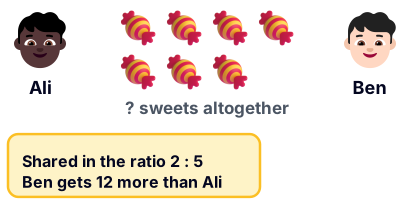
Watch out: 12 is the difference between the two shares, not one share and not one part.
Problem 6
Sequences. The sequence 5, 8, 11, 14, … goes up by 3 each time. What is the 20th term?
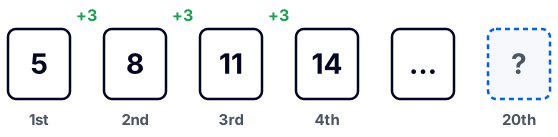
Watch out: From the 1st term to the 20th term, how many jumps of 3 are there?
Problem 7
Perimeter and area. A rectangle has a perimeter of 30 cm and a length of 9 cm. What is its area?
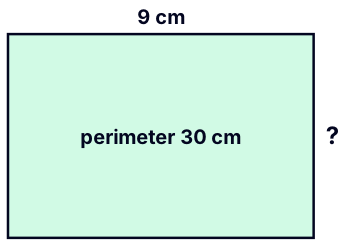
Tip: Sketch the rectangle and label all four sides. The perimeter goes all the way round.
Problem 8
Angles. In an isosceles triangle, the angle between the two equal sides is 40°. What size is each of the other two angles?
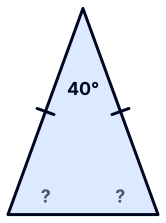
Watch out: Read which angle you are given: it is the one between the equal sides.
Problem 9
The mean. The mean of five numbers is 12. Four of them are 10, 15, 8 and 14. What is the fifth number?
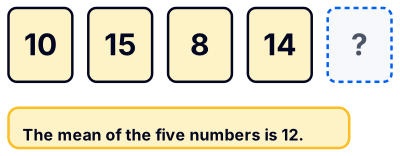
Trick: A mean is a total shared out equally. Find the total first.
Problem 10
★ Multi-step word problem. Adult tickets cost £7 and child tickets cost £4. A group buys 9 tickets and pays £45 in all. How many adult tickets did they buy?
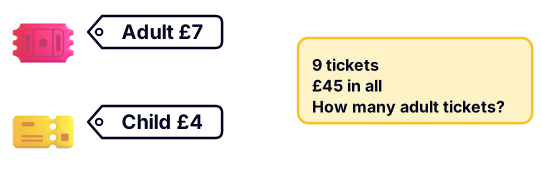
Watch out: Underline what the question asks for: adult tickets, not child tickets.
Solutions
Problem 1
Problem 1: Answer 39,205
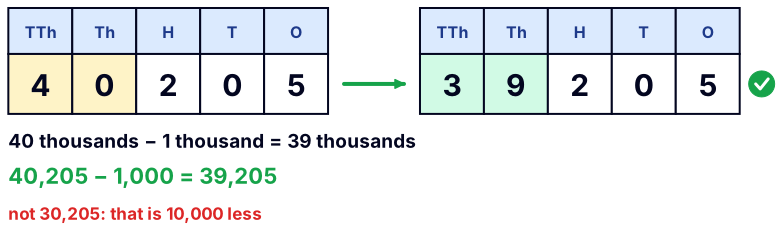
40,205 is 40 thousands and 205. Take away 1 thousand: 39 thousands and 205. That is 39,205!
For the grown-up: the thousands digit is 0, so there is no thousand to take from that column alone: one of the 10,000s is exchanged for ten 1,000s, so the ten thousands digit changes too. Reading the first two digits together as “40 thousands” avoids the exchange altogether. Check: 39,205 + 1,000 = 40,205. Common wrong answer: 30,205, from taking 1 off the ten thousands digit instead of the thousands; or 41,205, from adding.
Problem 2
Problem 2: Answer 14
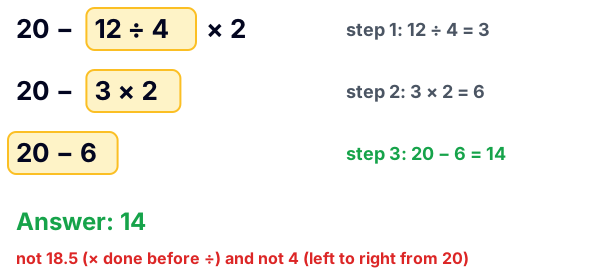
Do the ÷ and × first, from left to right: 12 ÷ 4 = 3, then 3 × 2 = 6. Last, 20 − 6 = 14!
For the grown-up: division and multiplication have the same rank, so they are worked in the order they appear, left to right, and both come before the subtraction. Check by putting the brackets in: 20 − ((12 ÷ 4) × 2) = 20 − 6 = 14. Common wrong answer: 18.5, from doing 4 × 2 first (12 ÷ 8 = 1.5); or 4, from working left to right from 20 (20 − 12 = 8, 8 ÷ 4 = 2, 2 × 2 = 4).
Problem 3
Problem 3: Answer 0.6, 62%, 5/8
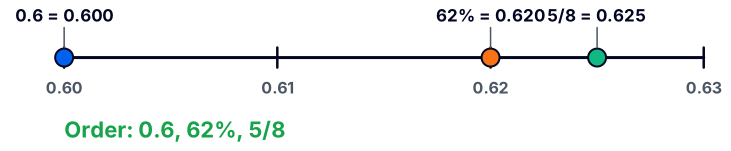
Make them all decimals: 5/8 = 0.625, 0.6 = 0.600 and 62% = 0.620. Smallest first: 0.6, 62%, 5/8!
For the grown-up: 5/8 = 1/2 + 1/8 = 0.5 + 0.125 = 0.625 (or work out 5 ÷ 8); a percentage becomes a decimal by dividing by 100. Writing every decimal to three places (0.600, 0.620, 0.625) makes the comparison a simple one. Common wrong answer: putting 5/8 first because 5 and 8 look small, or putting 0.6 last because 62 and 625 look bigger than 6 (forgetting that 0.6 = 0.600).
Problem 4
Problem 4: Answer 84
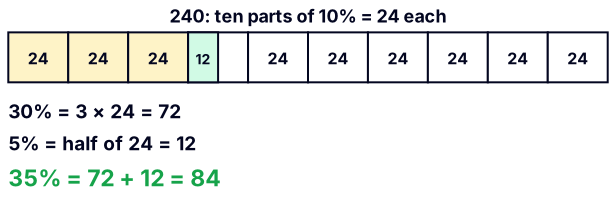
10% of 240 is 24. 30% is 3 × 24 = 72. 5% is half of 10%: 12. 35% = 72 + 12 = 84!
For the grown-up: 10% means dividing by 10, and 5% is half of that, so any multiple of 5% can be built without a calculator. Check another way: 35% is just over a third, and a third of 240 is 80, so 84 is about right. Common wrong answer: 72 (stopping at 30%), or 96 (taking 5% as another 24 instead of half of it).
Problem 5
Problem 5: Answer 28 sweets
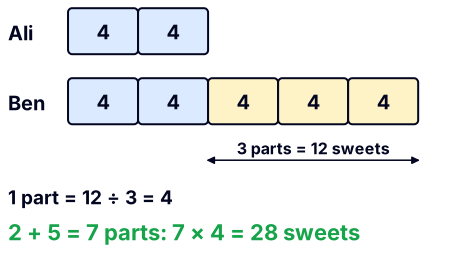
Ali has 2 parts and Ben has 5 parts. Ben has 3 parts more, and that is 12 sweets, so 1 part is 4. 2 + 5 = 7 parts: 7 × 4 = 28 sweets!
For the grown-up: a ratio counts equal parts; the difference between the shares is a number of parts too (5 − 2 = 3), which turns the 12 into the size of one part. Check: Ali 8, Ben 20, 20 − 8 = 12 and 8 : 20 = 2 : 5. Common wrong answer: 84 (12 × 7, without finding one part first), 20 (Ben’s share only), or 17 (2 + 5 + 12, adding the numbers in the question).
Problem 6
Problem 6: Answer 62
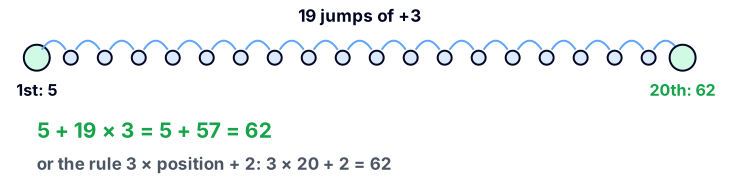
From the 1st term to the 20th there are 19 jumps, not 20. 19 × 3 = 57, and 5 + 57 = 62!
For the grown-up: the nth term is 3n + 2 (the 1st term is 3 × 1 + 2 = 5), so the 20th is 3 × 20 + 2 = 62: two routes to the same answer, which is a good check. Common wrong answer: 65, from 5 + 3 × 20, which counts one jump too many; or 60, from 3 × 20 without the + 2.
Problem 7
Problem 7: Answer 54 cm²
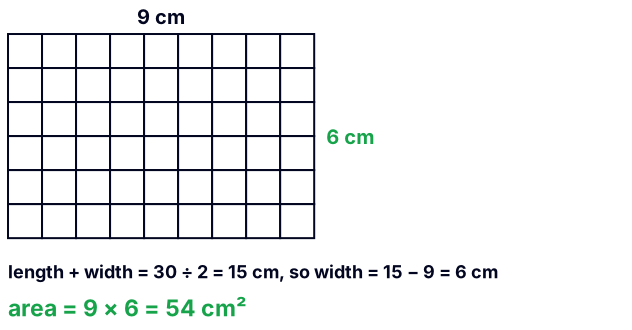
Going round, you walk one length and one width twice. So length + width = 30 ÷ 2 = 15 cm. The width is 15 − 9 = 6 cm. Area = 9 × 6 = 54 cm²!
For the grown-up: the perimeter is 2 lengths + 2 widths, so half of it is one length + one width. Check: 9 + 6 + 9 + 6 = 30. Common wrong answer: 189 cm², from a width of 30 − 9 = 21 (forgetting that the perimeter goes round all four sides); or 6, the width, not the area.
Problem 8
Problem 8: Answer 70° each
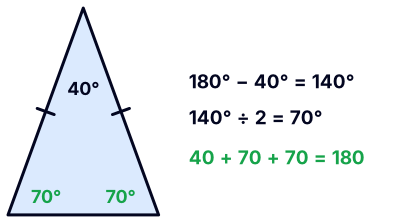
The three angles make 180°. 180° − 40° = 140° is left for the two base angles, and they are equal: 140° ÷ 2 = 70° each!
For the grown-up: in an isosceles triangle the two angles opposite the equal sides are equal; here they are the base angles. Check: 40 + 70 + 70 = 180. Common wrong answer: 40° and 100°, from taking the 40° angle as one of the two equal ones; or 140°, from forgetting to share between two angles.
Problem 9
Problem 9: Answer 13
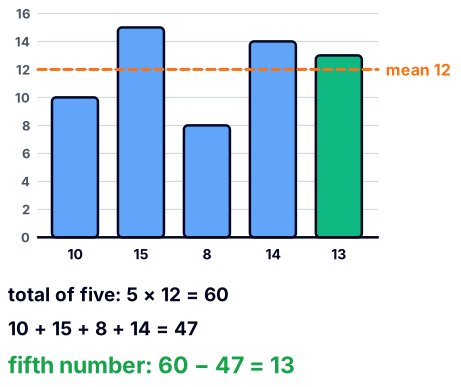
A mean of 12 for five numbers means they add up to 5 × 12 = 60. The four you know make 10 + 15 + 8 + 14 = 47. The fifth is 60 − 47 = 13!
For the grown-up: mean = total ÷ how many, so total = mean × how many. Check: 10 + 15 + 8 + 14 + 13 = 60 and 60 ÷ 5 = 12. Common wrong answer: 11.75, the mean of the four known numbers, which answers a different question; or 12, the mean itself.
Problem 10
Problem 10: Answer 3 adult tickets
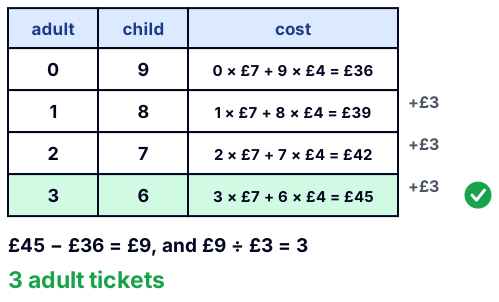
If all 9 were child tickets: 9 × £4 = £36. That is £9 short of £45. Each child ticket swapped for an adult ticket adds £7 − £4 = £3. £9 ÷ £3 = 3 swaps: 3 adult tickets!
For the grown-up: start from an easy guess (all child tickets) and see how much each change moves the total; the table shows the same pattern step by step. Check: 3 × £7 + 6 × £4 = £21 + £24 = £45. Common wrong answer: 6, the number of child tickets (the question asks for adults); or 9, from £45 − £36 = £9 without dividing by the £3 each swap adds.
More questions on the three topics children find hardest: 11+ percentage questions (Problem 4), 11+ ratio questions (Problem 5) and 11+ algebra questions (Problem 6).
How 11+ maths papers differ
The topics above are shared, but the papers are not. Some are written papers where every answer is written in, and others are online or multiple choice. The Essex test, for example, marks the answers only (almost always one mark each, nothing for working) and allows no calculator (see CSSE maths past papers and the CSSE 11+ 2027 hub). Find your own test before choosing practice papers:
- Independent schools: independent school 11+ dates and the ISEB Pre-Test maths
- Sutton grammar schools: Sutton SET stage 2 maths
- Reading School and other FSCE schools: FSCE 11+ maths
Using these questions at home
- One topic a day, 15–20 minutes. Five questions on one topic teach more than twenty mixed ones at the start.
- Ask for the common wrong answer. “Why might someone say 65?” (the trap in Problem 6) is a quick way to see whether your child understands the method.
- Mixed papers come later, once each topic is secure. Then move on to past papers and harder 11+ questions.
The full list of what to cover is in our 11+ maths syllabus.
Math Explorers Club is not affiliated with or endorsed by the Consortium of Selective Schools in Essex (CSSE), the Independent Schools Examinations Board (ISEB), the Sutton SET schools, Future Stories Community Enterprise (FSCE) or any school named here.