Free practice
Free Essex 11+ (CSSE) Maths Practice Questions with Answers
Ten original Essex 11+ (CSSE) style maths questions, 22 marks in about 20 minutes, with every answer explained and the mark for each part. Free to read here or print as a PDF.
11+ dates and scores: Essex 11+ (CSSE) 2027 CSSE pass mark Independent school dates
Printable PDF: all 10 questions with space for every answer, then every answer explained.
On this page · 3 sections
Ten original maths questions for the Essex 11+, written by us in the style of the CSSE maths paper. None of them comes from a real CSSE paper: those are CSSE’s copyright, and the papers for 2021, 2022 and 2023 entry are free on the CSSE website (link at the end). These ten are free to try here and to print as a PDF, and every answer is explained with the common wrong answer and how the marks are given.
The real maths paper is one hour, 60 marks, about 20 questions, with no calculator. Your child writes each answer in a box, and only the answer is marked: no marks for working. Most boxes are worth 1 mark, but some answers need two or three boxes right for a single mark. Each paper also has one or two questions where your child chooses an answer instead of working one out, such as true or false, or “always, sometimes or never true”.
This set is about a third of the real paper: 10 questions, 22 marks, about 20 minutes, with a mix of the topics that come up on the real papers. It starts with a written calculation and fractions, moves through percentages, time, a function machine, missing-number algebra, an “always, sometimes or never” question and averages, and ends with an angle question and a longer problem in three steps. Several questions go a little past what most Year 5 children have met at school, as the real paper does.
How to use it: print the PDF, give your child a pencil, a ruler and 20 minutes, and no calculator. Then mark it together with the answers below. The “common wrong answer” notes are the useful part: a mark lost to a slip (pm instead of am, a missed carry) is fixed differently from a mark lost to a method your child hasn’t learnt yet.
The 10 questions
Question 1
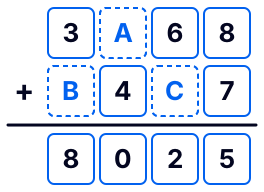
(a) Calculate 6043 − 2768. (b) In the column sum 3A68 + B4C7 = 8025, the letters A, B and C stand for missing digits. Find A, B and C (1 mark for all three).
Question 2
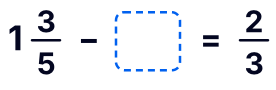
Fill in the missing number to make this true: one and three fifths, take away the missing number, equals two thirds.
Question 3
A bike shop takes 15% off every price in its sale. (a) A helmet cost £36 before the sale. What is its sale price? (b) A bike costs £255 in the sale. What did it cost before the sale?
Question 4
A coach leaves Harbridge at 9.50pm. The journey takes 3 hours 35 minutes. (a) At what time does it arrive? (b) The coach back arrives in Harbridge at 2.10am after a journey of 4 hours 45 minutes. At what time did it set off?
Question 5
A function machine takes away 5, then squares the answer, then halves it. So, for example, 9 goes in, 4 squared is 16, and 8 comes out. (a) What comes out when 11 goes in? (b) A positive number goes in and 98 comes out. What went in? (c) A negative number goes in and 98 comes out. What went in?

Question 6
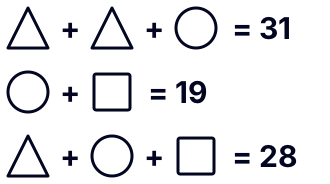
Each shape stands for a number. ▲ + ▲ + ● = 31, ● + ■ = 19, and ▲ + ● + ■ = 28. Find the number each shape stands for.
Question 7
Say whether each statement is always true, sometimes true or never true. (a) When you multiply two whole numbers that are next to each other, the answer is even. (b) A multiple of 4 is also a multiple of 8. (c) When you add two prime numbers that are both bigger than 2, the answer is a prime number.
Question 8
Seven children did a sponsored walk. They raised £4, £9, £7, £12, £5, £8 and £11. (a) What is the average (mean) amount they raised? (b) Three more children did the walk later. Their mean was £13. What is the mean for all ten children?
Question 9
The triangle is isosceles, so its two base angles are equal. The top angle is x degrees and each base angle is (2x − 15) degrees. The diagram is not to scale. Find x.
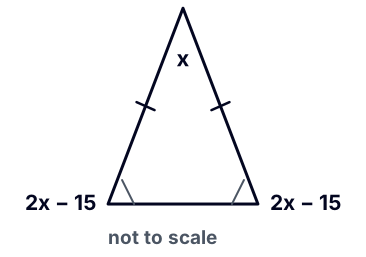
Question 10
At a coconut shy, each hit scores 4 and each miss takes 3 off the score. (a) Nina has 12 throws: 9 hits and 3 misses. What is her score? (b) Omar has 20 throws and scores 52. How many were hits? (c) Zara also has 20 throws. Her score is more than 0. What is the smallest score she can have?
Answers and explanations
Question 1
Question 1: Answer (a) 3275 (b) A = 5, B = 4, C = 5
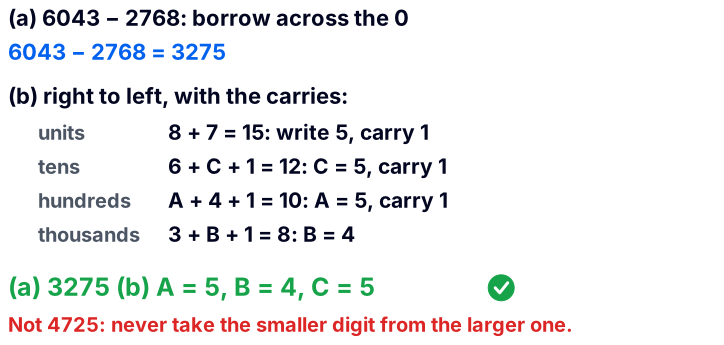
(a) Borrow across the 0: 6043 − 2768 = 3275. (b) Work from the right and keep the carries: 6 + C + 1 must end in 2, so C = 5; A + 4 + 1 must end in 0, so A = 5; 3 + B + 1 = 8, so B = 4.
Why it works: in a column sum, every column that makes 10 or more carries 1 into the next column, so each missing digit is found from the digit it must make and the carry coming in. Check: 3568 + 4457 = 8025. Common wrong answer: 4725 for (a), from taking the smaller digit from the larger one in each column (3 − 8 becomes 8 − 3); or A = 6, B = 5, C = 6 for (b), from forgetting the carries. Marking: 1 mark for (a); 1 mark for (b) only when all three digits are right.
Question 2
Question 2: Answer 14/15
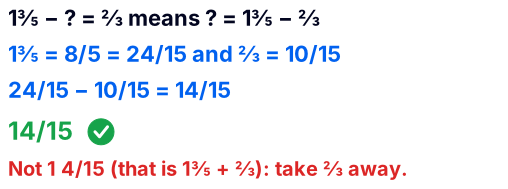
The missing number is 1 3/5 − 2/3. Change both to fifteenths: 24/15 − 10/15 = 14/15.
Why it works: if 1⅗ take away a number leaves ⅔, that number is the gap between them, 1⅗ − ⅔. Fifteenths are the smallest pieces that both fifths and thirds fit into. Check: ⅔ + 14/15 = 10/15 + 14/15 = 24/15 = 1⅗. Common wrong answer: 1 4/15, from adding ⅔ to 1⅗ instead of taking it away. Marking: 1 mark; any equal form such as 28/30 is also right.
Question 3
Question 3: Answer (a) £30.60 (b) £300
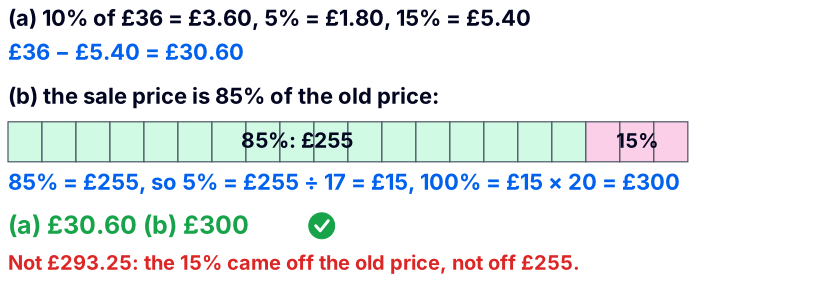
(a) 10% of £36 is £3.60 and 5% is £1.80, so 15% is £5.40 and the helmet costs £30.60. (b) £255 is 85% of the old price: 5% is £255 ÷ 17 = £15, so 100% is £300.
Why it works: a sale price is what is left after the cut, 100% − 15% = 85% of the old price. To go back, find what 1% (or 5%) is worth, then scale up to 100%. Check: 15% of £300 is £45, and £300 − £45 = £255. Common wrong answer: £293.25, from adding 15% of £255: the 15% was taken off the old price, which is bigger than £255. Marking: 1 mark each; £30.6 is accepted.
Question 4
Question 4: Answer (a) 1.25am (b) 9.25pm
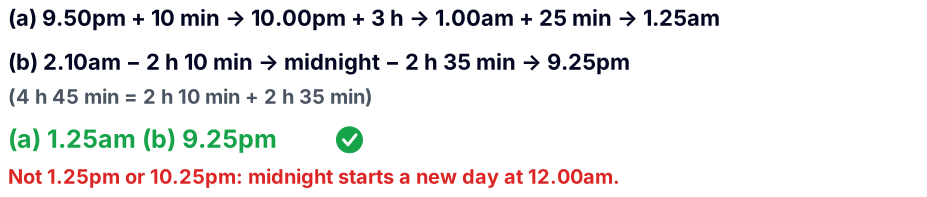
(a) 9.50pm + 10 minutes = 10.00pm, + 3 hours = 1.00am, + 25 minutes = 1.25am. (b) Back from 2.10am: 2 hours 10 minutes reach midnight, and the other 2 hours 35 minutes go back to 9.25pm.
Why it works: jump to a whole hour or to midnight first, then count the rest; midnight is where pm turns into am. Check (b): 9.25pm + 4 hours = 1.25am, + 45 minutes = 2.10am. Common wrong answer: 1.25pm for (a), from forgetting that the day changes at midnight; or 10.25pm for (b), from going back only 3 hours 45 minutes. Marking: 1 mark each; 01:25 and 21:25 are also right.
Question 5
Question 5: Answer (a) 18 (b) 19 (c) −9
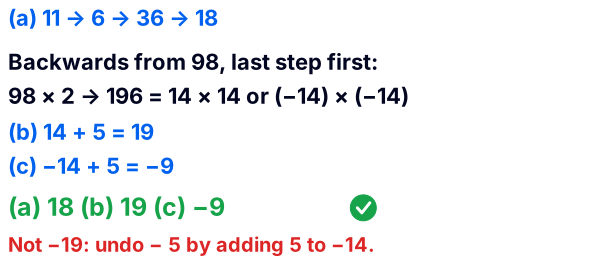
(a) 11 − 5 = 6, 6 squared = 36, half is 18. Backwards from 98: double it to 196, which is 14 × 14 and also (−14) × (−14). (b) 14 + 5 = 19. (c) −14 + 5 = −9.
Why it works: to run a machine backwards, undo the last step first: halving is undone by doubling, and taking away 5 is undone by adding 5. Squaring is the one step with two ways back, because a negative number times itself is positive: (−14) × (−14) = 196. Check: −9 − 5 = −14, squared 196, half 98. Common wrong answer: −19 for (c), from putting a minus sign on the answer to (b) instead of adding 5 to −14. Marking: 1 mark each.
Question 6
Question 6: Answer ▲ = 9 ● = 13 ■ = 6
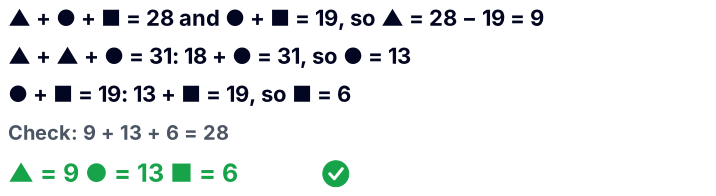
▲ + ● + ■ = 28 and ● + ■ = 19, so ▲ = 9. Then 9 + 9 + ● = 31, so ● = 13. Then 13 + ■ = 19, so ■ = 6.
Why it works: look for two sums that share most of their shapes: what is left over when you take one from the other is the missing shape. Each new value then unlocks the next sum. Check: 9 + 9 + 13 = 31. Common wrong answer: ● = 22, from taking 9 from 31 only once: there are two triangles in the first sum. Marking: 1 mark for each shape.
Question 7
Question 7: Answer (a) always (b) sometimes (c) never
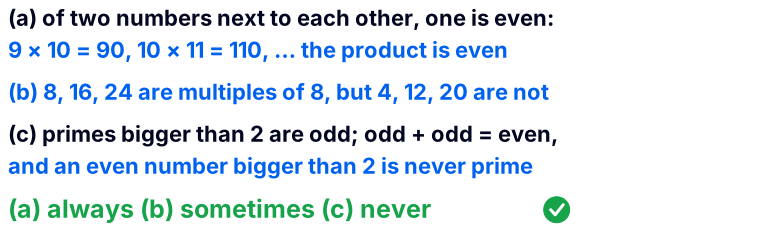
(a) One of two numbers next to each other is even, so the product is even: always. (b) 8 and 16 are multiples of 8, but 4 and 12 are not: sometimes. (c) Primes bigger than 2 are odd, odd + odd is even, and an even number bigger than 2 is not prime: never.
Why it works: “always” needs a reason that works for every number; “sometimes” needs one example where it works and one where it doesn’t; “never” needs a reason it can’t work. One counterexample is enough to rule out “always”. Common wrong answer: “sometimes” for (c), from thinking of 2 + 3 = 5: but 2 is not bigger than 2. Marking: 1 mark each.
Question 8
Question 8: Answer (a) £8 (b) £9.50
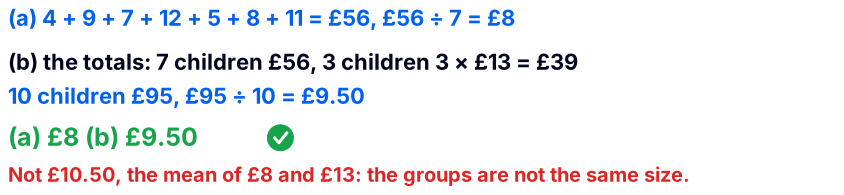
(a) The seven amounts add to £56, and £56 ÷ 7 = £8. (b) The three later children raised 3 × £13 = £39. All ten raised £95, and £95 ÷ 10 = £9.50.
Why it works: a mean is a total shared out equally, so to join two groups, join their totals and their numbers of children. The bigger group pulls the mean closer to its own mean. Common wrong answer: £10.50, the mean of £8 and £13: that would only be right if both groups had the same number of children. Marking: 1 mark each; £9.5 is accepted.
Question 9
Question 9: Answer x = 42 degrees
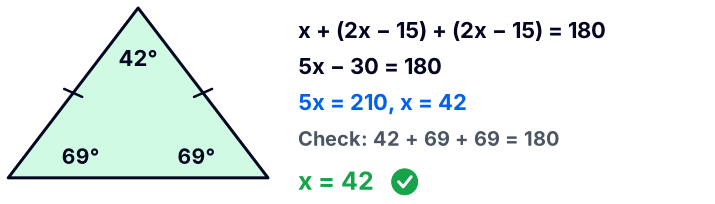
The three angles add to 180°: x + (2x − 15) + (2x − 15) = 5x − 30 = 180. So 5x = 210 and x = 42.
Why it works: every triangle’s angles add to 180°, and in an isosceles triangle the two base angles are equal, so 2x − 15 is counted twice. Check: 42 + 69 + 69 = 180. Common wrong answer: 65, from x + (2x − 15) = 180 with only one base angle; or 69, the base angle instead of x. Marking: 1 mark.
Question 10
Question 10: Answer (a) 27 (b) 16 (c) 3
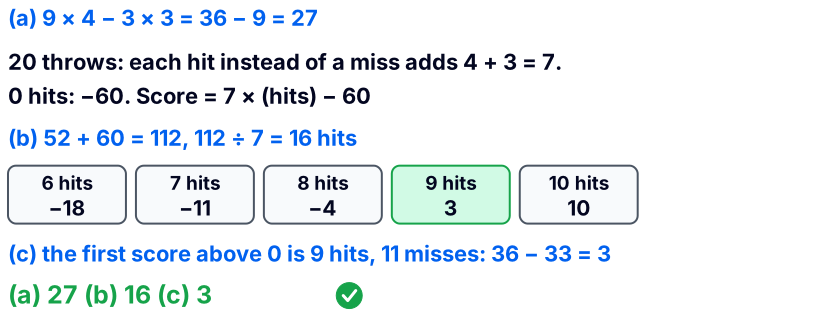
(a) 9 × 4 − 3 × 3 = 36 − 9 = 27. With 20 throws, 0 hits scores −60, and each hit instead of a miss adds 4 + 3 = 7. (b) 52 + 60 = 112 and 112 ÷ 7 = 16. (c) 8 hits score −4 and 9 hits score 3: the smallest score above 0 is 3.
Why it works: when the number of throws is fixed, swapping one miss for a hit gains the 4 points and also stops the 3 being lost. So the scores go up in 7s from −60: −60, −53, …, −4, 3, 10, … Check (b): 16 × 4 − 4 × 3 = 64 − 12 = 52. Common wrong answer: 13 for (b), from 52 ÷ 4, forgetting the misses; or 4 for (c), from one hit and no misses: Zara had all 20 throws. Marking: 1 mark each.
After the set: the real CSSE papers
As of November 2026. Check the CSSE website before you rely on any of this.
| The CSSE maths paper | |
|---|---|
| Length | 60 minutes, 60 marks, 20 or 21 questions |
| Marking | Answer only: 1 mark per correct answer, no marks for working; some answers need every box right for the mark |
| Equipment | Pen, pencil, ruler and eraser; no calculator |
| Free real papers | 2021, 2022 and 2023 entry, with mark schemes, on the CSSE Practice Material page |
| Average maths score | 25.8 out of 60 in the test for 2027 entry |
| Next test (2028 entry) | September 2027, in Year 6; CSSE publishes the dates by Easter 2027 and opens registration in May 2027 |
A short set like this is only a rough signal, but as a guide: about 10 out of 22 is close to the average child’s score on the real paper, and about 14 out of 22 is in line with roughly 39 out of 60, which with an average English score clears the 303 minimum for a place comfortably. Our CSSE pass mark page explains how raw marks become the total score.
When the topics here feel secure, move on to the real papers: our CSSE maths past papers guide explains where each one is, how to mark it and a month-by-month plan for a Year 5 child. For more questions by topic, try 11+ ratio questions, 11+ percentage questions and 11+ algebra questions. Dates, schools and how places are given are on our Essex 11+ (CSSE) 2027 page.
Math Explorers Club is not affiliated with or endorsed by the Consortium of Selective Schools in Essex (CSSE) or any school named here. CSSE papers are the copyright of the CSSE; we link to them and do not reproduce them. All ten questions on this page are our own.