FSCE 11 Plus Maths: What the Test Looks Like
What the FSCE 11+ entrance test is, which grammar schools use it, how the maths questions are answered and marked, and 6 original everyday maths questions with answers.
· 12 min read
11+ dates and scores: Essex 11+ (CSSE) 2027 CSSE pass mark Independent school dates
On this page · 10 sections
The FSCE 11 plus is the Year 7 entrance test written by Future Stories Community Enterprise Ltd (FSCE) and used by several grammar schools, including Reading School, Chelmsford County High School for Girls and Heckmondwike Grammar School. It mixes multiple-choice and short written answers, tests Key Stage 2 content taught up to the end of Year 5, and changes every year. This post sets out what the schools and FSCE publish about it, with a focus on the maths.
FSCE and its schools say plainly that no tutoring is needed. We agree that a child doesn’t need a course for this test. The six questions below are everyday maths of the kind FSCE suggests practising at home, not a copy of the test.
What FSCE is and which schools use it
- Who: Future Stories Community Enterprise Ltd, a company registered at Reading School’s address, which provides 11+ and in-year tests “written by Grammar Schools, for Grammar Schools”.
- Schools confirmed on their own admissions pages for Year 7 entry: Reading School (boys, Berkshire), Chelmsford County High School for Girls (Essex), Heckmondwike Grammar School (West Yorkshire).
- Each school’s test is different. FSCE says it works “with many different schools, each with different test specifications”, so read the admissions page of every school you apply to.
In Essex, Chelmsford County High School for Girls runs its own FSCE test, with its own registration on the school website. It is a separate test and registration from the CSSE 11+ that the other Essex grammar schools use (CSSE’s list includes Colchester County High School for Girls, a different school with the same initials). Read both, and register for each test you need.
How the test is built
The papers have names rather than subjects. Two schools’ versions, from their 2026 Familiarisation Guides:
| Paper | Reading School | Heckmondwike Grammar |
|---|---|---|
| Adventure | Multiple choice, any subject | Multiple choice, English and maths |
| Beacon | Short written answers, any subject | Short written answers, English and maths |
| Compass | Multiple choice, any subject | Not used |
| Discovery | A creative response | A creative writing task |
At Reading School, “any subject” means questions may come from art and design, computing, design and technology, English, geography, history, languages, maths, music, PE or science. Heckmondwike’s version tests English and maths only, plus the creative task. Maths appears in every version.
All instructions, including the time allowed for each section, are given by a voice recording. Clocks are on the wall; children may not bring a digital watch or a timer.
What the maths covers
FSCE’s parent guide lists the skills it tests, all from the Key Stage 2 National Curriculum up to the end of Year 5, with no calculator:
- Number: reading, ordering and rounding numbers past 1,000,000, including negative numbers.
- Calculation: multi-step adding and subtracting with large numbers, long multiplication, short division with remainders, decimals.
- Number facts: multiples, factors, primes, square and cube numbers.
- Fractions, decimals and percentages: converting, ordering and calculating.
- Measures: converting units; perimeter, area and volume.
- Geometry: angles (acute, obtuse, reflex), properties of rectangles, regular and irregular polygons, cuboids.
- Statistics: line graphs, tables and timetables.
Where a question needs something not every child will have met, FSCE says the paper gives the information needed.
How answers are marked
- Multiple choice: shade one oval per question. Only one answer is correct.
- Short written answers: one digit (or capital letter) per box. Neatness matters, because the papers are marked by computer.
- Black pen only (Heckmondwike provides the pens). No pencils, rulers, protractors, scrap paper or calculators.
- No negative marking: “You will NOT lose any marks for incorrect answers!” So a child should always put an answer.
- Marked and standardised: computer-marked papers are age-standardised. At Reading School a child must be “of the standard” in each element; at Heckmondwike the creative task is assessed only for children with an eligible score on English and maths.
FSCE practice papers: what exists
- The Familiarisation Guides for children and for parents, free on each school’s admissions page. FSCE calls them “the only genuine resource produced for the FSCE Ltd Entrance Test”. The children’s guide includes sample questions and answer sheets to practise on.
- No past papers. FSCE doesn’t issue them, and the content changes every year.
- No commercial papers. Reading School: “there are no commercially available practice test papers for the FSCE Ltd tests.”
Download the guide from your school’s own page (Reading School, CCHS, Heckmondwike), because each school’s version differs.
Six everyday maths questions
Our own questions, at Year 5 level, with no calculator. Each answer is a whole number, a time or a short list, so it would fit in a row of answer boxes. They cover the strands above: division (Problem 1), negative numbers (Problem 2), time on the 24-hour clock (Problem 3), fractions, decimals and percentages (Problem 4), area (Problem 5) and multiples (Problem 6). Each solution names the slip children most often make, which tells you what to look at if an answer comes out wrong.
The problems
Problem 1
A bakery bakes 1,248 bread rolls and packs them in bags of 6. How many bags does it fill?
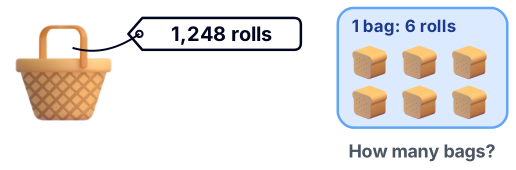
Tip: Check a division by multiplying back: the number of bags times 6 must make 1,248.
Problem 2
At 6 am the temperature is −4 °C. By noon it has risen by 11 degrees. By midnight it has fallen by 9 degrees from the noon temperature. What is the temperature at midnight?
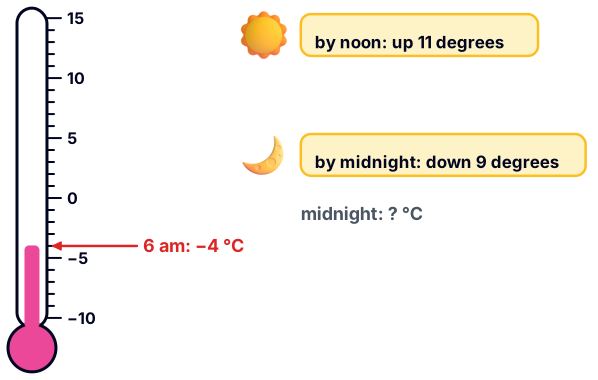
Tip: Draw a number line with 0 in the middle. Up means a jump to the right, down a jump to the left.
Problem 3
A bus leaves at 08:35. The journey takes 47 minutes. At what time does the bus arrive? Give the time on the 24-hour clock.
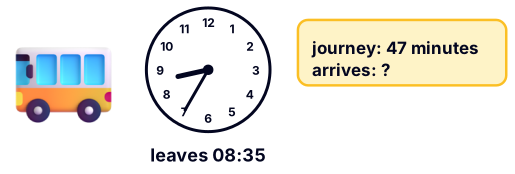
Trick: Jump to the next o’clock first, then add the minutes that are left.
Problem 4
Put these three numbers in order, smallest first: 0.7, 2/3, 68%.
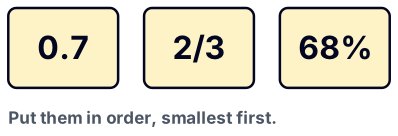
Watch out: 0.7 and 0.70 are the same number. Write all three with two decimal places before you compare.
Problem 5
A rectangular garden is 9 m long and 6 m wide. A path 1 m wide runs all the way round the inside edge of the garden, and the rest is lawn. What is the area of the path?
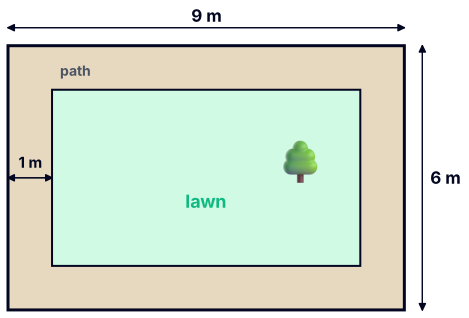
Tip: Find the area of the whole garden, then take away the lawn in the middle.
Problem 6
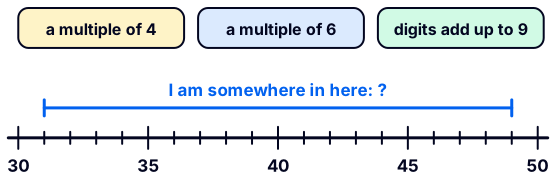
I am a number between 30 and 50. I am a multiple of 4 and a multiple of 6. My digits add up to 9. What number am I?
Solutions
Problem 1
Problem 1: Answer 208 bags
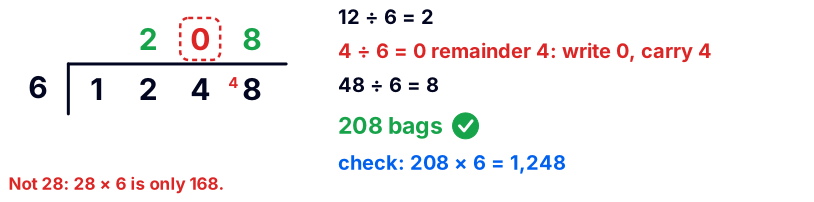
12 ÷ 6 = 2. Next, 4 ÷ 6 won’t go, so write 0 and carry the 4. Then 48 ÷ 6 = 8. That’s 208 bags!
For the grown-up: in short division every digit of 1,248 after the first group needs a digit in the answer, even when the divisor doesn’t go and that digit is 0. Check: 208 × 6 = 1,248. Common wrong answer: 28, from skipping the 0 when 4 ÷ 6 doesn’t go (28 × 6 is only 168, a quick way to see it can’t be right).
Problem 2
Problem 2: Answer −2 °C
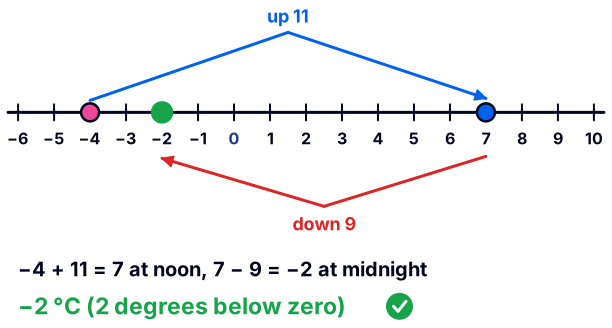
Start at −4. Up 11: −4 + 11 = 7 degrees at noon. Down 9: 7 − 9 = −2. It is 2 degrees below zero at midnight!
For the grown-up: rising 11 from −4 takes 4 degrees to reach 0 and 7 more beyond it; falling 9 from 7 passes 0 after 7 degrees and goes 2 further. Check: −2 is 2 degrees above the 6 am reading, and the day went up 11 and down 9, a net rise of 2. Common wrong answer: 2 °C, from losing the minus sign; or 6 °C, from starting at 4 instead of −4 (4 + 11 = 15, then 15 − 9 = 6).
Problem 3
Problem 3: Answer 09:22
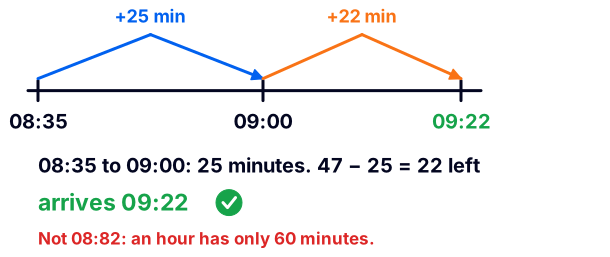
From 08:35 it is 25 minutes to 09:00. 47 − 25 = 22 minutes left. 09:00 + 22 minutes = 09:22!
For the grown-up: an hour has 60 minutes, not 100, so time is added by bridging through the o’clock rather than in columns. Check: 25 + 22 = 47 minutes. Common wrong answer: 08:82, from adding 35 + 47 as if minutes were a decimal; or 09:32, from counting 15 minutes instead of 25 from 08:35 to 09:00.
Problem 4
Problem 4: Answer 2/3, 68%, 0.7
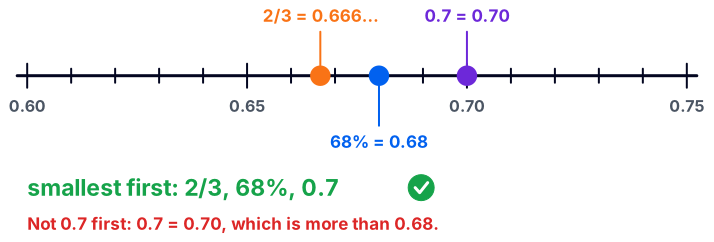
Make them all decimals. 2/3 = 0.666…, 68% = 0.68, and 0.7 = 0.70. So 2/3 is smallest, then 68%, then 0.7!
For the grown-up: a fraction, a decimal and a percentage compare easily once they are in the same form; hundredths work here because a percentage is already in hundredths. 2/3 is 0.666…, which is below 0.67. Check: 0.666… < 0.68 < 0.70. Common wrong answer: 0.7, 2/3, 68%, from thinking 0.7 is small because 7 is less than 68; writing 0.7 as 0.70 fixes it.
Problem 5
Problem 5: Answer 26 m²
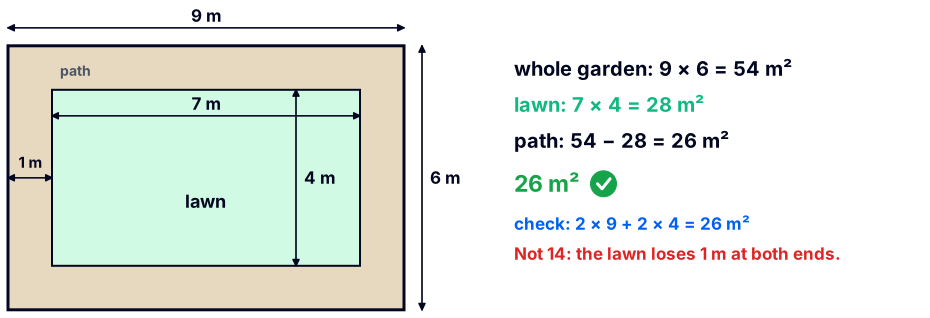
The whole garden is 9 × 6 = 54 m². The path takes 1 m off both ends, so the lawn is 7 m by 4 m: 28 m². The path is 54 − 28 = 26 m²!
For the grown-up: the path runs along both ends of each side, so the lawn is 2 m shorter and 2 m narrower than the garden. Check another way: the two long strips are 9 × 1 each (18 m²) and the two short strips between them are 4 × 1 each (8 m²), and 18 + 8 = 26. Common wrong answer: 14 m², from taking 1 m off only one end of each side (lawn 8 m by 5 m = 40 m²); or 30 m², from adding the four sides 9 + 9 + 6 + 6 and counting the corners twice.
Problem 6
Problem 6: Answer 36
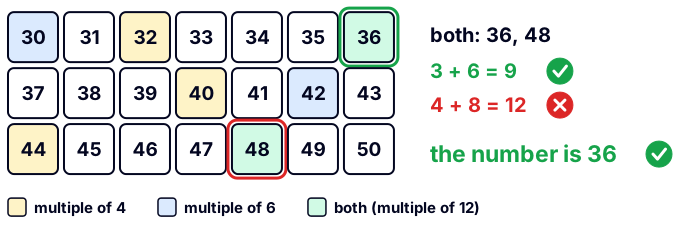
A multiple of both 4 and 6 is a multiple of 12. Between 30 and 50 that is 36 or 48. 3 + 6 = 9 and 4 + 8 = 12. The number is 36!
For the grown-up: the smallest number that both 4 and 6 go into is 12, so every common multiple is a multiple of 12; listing those first leaves only two to test. Check: 36 = 4 × 9 = 6 × 6. Common wrong answer: 48, from stopping after the multiple clues; or 45, from using only the digit clue (45 is not a multiple of 4 or of 6).
How to help at home
FSCE’s own advice is to read widely, keep up with primary school and practise maths “through real life day to day examples”. In practice that can be:
- Shopping maths: totals, change, and “is the bigger pack cheaper per 100 g?”
- Timetables: let your child work out arrival times and journey lengths on real trips, the way Problem 3 does for a bus.
- Five-minute number talks: one question at dinner, like the six above, explained out loud.
- The answer sheet: practise the guide’s sample questions on its answer sheets once, so one digit per box is familiar.
- Topic practice if you want more: 11 plus maths questions and 11 plus percentage questions. The 11 plus maths syllabus explains what Key Stage 2 covers by year.
For the written two-stage test in Sutton, see Sutton SET stage 2 maths.
Dates and deadlines
As of November 2026. These are the dates each school published for September 2027 entry (the round that has just been sat). Dates for 2028 entry are not out yet; expect a similar pattern and check each school’s page in spring 2027.
| School | Registration | Test | Results |
|---|---|---|---|
| Reading School | 27 March – 17 May 2026 | 16 July 2026 (out-of-catchment day applicants: 25 September 2026) | Mid-October 2026 |
| Chelmsford County High School for Girls | 13 April – 3 June 2026 | 3 September 2026 | Emailed 12 October 2026 |
| Heckmondwike Grammar | 11 May – 22 June 2026 | 14 September 2026 | Online, target 17 October 2026 |
The Common Application Form deadline is 31 October. Reading School’s test falls in July of Year 5, much earlier than most, so its registration opens in March of Year 5.
Math Explorers Club is not affiliated with or endorsed by Future Stories Community Enterprise Ltd (FSCE), Reading School, Chelmsford County High School for Girls, Heckmondwike Grammar School or any school named here. All practice questions on this page are our own.