
Sutton SET Stage 2 Maths: Format and How to Prepare
How the Sutton grammar schools' two-stage 11+ works, what the written stage 2 maths paper is like, which free papers exist, and 6 original practice questions with answers.
· 12 min read
11+ dates and scores: Essex 11+ (CSSE) 2027 CSSE pass mark Independent school dates
On this page · 8 sections
Sutton SET stage 2 is the written second round of the 11+ for the Sutton grammar schools. A child first sits the Selective Eligibility Test (SET), which is multiple choice. Those who pass are invited to a second stage with an English paper and a maths paper that are not multiple choice. This post explains both stages using the schools’ own admissions pages, then gives six original practice questions in the written style.
The two stages at a glance
| Stage 1: SET | Stage 2, boys (shared) | Stage 2, girls (NWSSEE) | |
|---|---|---|---|
| Who sits it | Everyone registered | Boys who pass the SET | Girls who pass the SET |
| Schools | All six SET schools | Sutton Grammar, Wallington County Grammar, Wilson’s | Nonsuch, Wallington High School for Girls |
| Papers | Maths and English | Maths and English | Maths and English |
| Answer style | Multiple choice, A to E on an answer sheet | Written, not multiple choice | Written, not multiple choice |
| Length | 40–50 minutes per paper | Around 45 minutes to 1 hour per paper | 40–50 minutes per paper |
| Reasoning tests | None | None | None |
| Calculator | Not allowed | Not allowed | Not allowed |
Content is “broadly based on the Key Stage 2 curriculum” at both stages, in the schools’ words. There is no verbal or non-verbal reasoning anywhere in the process.
Which schools use the SET
The six “participating schools” are:
- Boys: Sutton Grammar School, Wallington County Grammar School, Wilson’s School.
- Girls: Nonsuch High School for Girls, Wallington High School for Girls.
- Mixed: Greenshaw High School, which uses the SET for its 60 ability places and has no second stage.
One registration covers every school. Passing a test is not an offer: the schools are oversubscribed, and places are given on National Offer Day after you name the schools on your Common Application Form (CAF).
What the stage 2 maths paper is like
- Written answers. Your child writes the answer, so there are no options to check against or rule out. A wrong unit or a misread question costs the mark.
- No rough paper. Working goes in the spare space on the question paper.
- Pencils. Boys bring pencils and a rubber. Girls use pencil for the maths paper and cross mistakes through neatly instead of rubbing them out.
- How working is marked. For the girls’ NWSSEE the FAQ is explicit: “There are no marks for working out, only the final answer is marked.” The boys’ schools don’t say either way, so train your child to set out the steps clearly and still check the final answer.
- Marked by teachers. The schools note that stage 2 papers “have to be marked by teaching professionals”, which is why they ask families to register only if they want a place.
No sample papers exist for stage 2. Both the boys’ and girls’ FAQs say so.
How the scores combine
Each school weights the SET and stage 2 differently, which is why a boy can pass for one school and not another:
| School | How the final score is built |
|---|---|
| Sutton Grammar | SET English, SET maths, stage 2 English, stage 2 maths in the ratio 2:2:3:3, plus an age allowance. No separate stage 2 pass mark |
| Wilson’s | SET : stage 2 English : stage 2 maths in the ratio 1:2:2. Must pass both stage 2 papers and the overall mark |
| Wallington County Grammar | Set out on the school’s own website |
| Nonsuch and Wallington High School for Girls | SET (re-standardised, then halved) + stage 2 English + stage 2 maths. Must pass both stage 2 papers |
At Sutton Grammar and Wilson’s, stage 2 counts for more than the SET, so the written maths paper carries real weight. Scores are age-standardised, and pass marks are set only after marking.
Sutton SET test papers: what is free
- SET maths sample questions: a short official PDF on the Sutton Grammar School SET FAQs page, with worked examples. It is the only official practice material, and it covers stage 1 only.
- English sample questions: on the same page.
- Stage 2: none. The schools “do not make sample tests available”.
So anything sold as “Sutton SET past papers” or “real stage 2 papers” was not published by the schools. Practice books in the style of the test are fine, as long as you know that’s what they are.
Because the schools publish nothing for stage 2, the six questions below are our own, written to Key Stage 2 content in the style of a written grammar school paper. Each needs more than one step, and none needs a calculator. Ask your child to write the working, then the answer with its unit, before looking at the solutions. Each solution names the most common wrong answer, because on a written paper there are no options to warn you that you slipped.
The problems
Problem 1
A school hires 8 coaches. Each coach has 52 seats. 349 pupils and 18 adults go on the trip, one person to a seat. How many seats are empty?
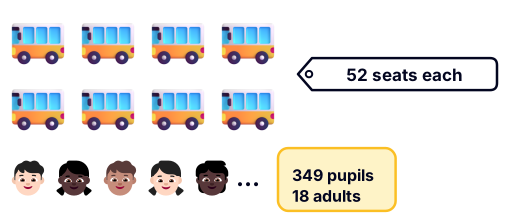
Watch out: The adults need seats too.
Problem 2
Mia spends 1/4 of her money on a book. Then she spends 2/3 of the money she has left on a game. She has £6 left. How much money did she start with?

Watch out: ‘2/3 of what is left’ is not 2/3 of all her money.
Problem 3
Tom’s age and his mum’s age add up to 48. In 4 years’ time, his mum will be three times as old as Tom. How old is Tom now?
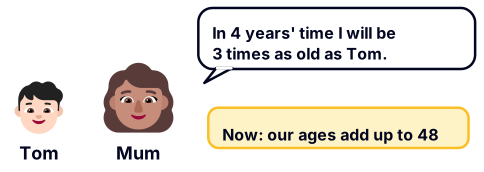
Tip: In 4 years both of them are 4 years older, so their total grows by 8.
Problem 4
A rectangle of card measures 12 cm by 8 cm. A square of side 3 cm is cut from each corner. The four sides are then folded up to make an open box. What is the volume of the box?
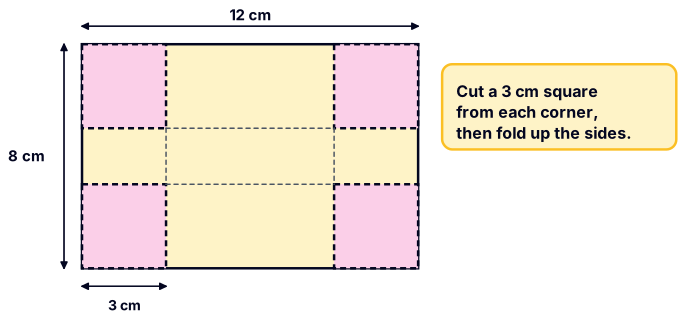
Tip: Every side of the card loses 3 cm at both ends.
Problem 5
A train leaves at 09:47 and arrives at 11:22. It travels 114 km. (a) How long is the journey? (b) What is the train’s average speed in km per hour?
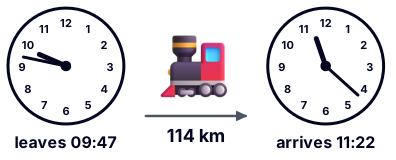
Watch out: 1 hour 35 minutes is not 1.35 hours. An hour has 60 minutes, not 100.
Problem 6
★ Challenge. One angle of an isosceles triangle is 40°. What could the other two angles be? Give every possibility.
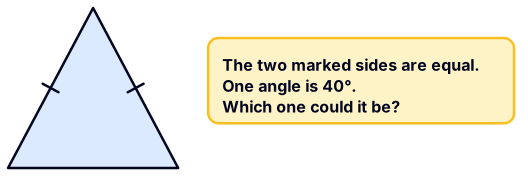
Trick: ‘Every possibility’ tells you there is more than one answer. Try 40° in each place it could go.
Solutions
Problem 1
Problem 1: Answer 49 seats
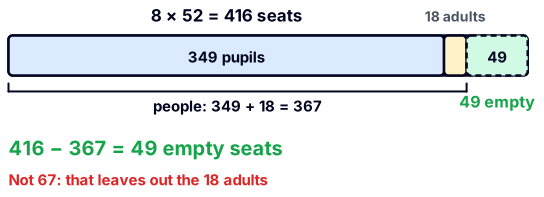
Seats: 8 × 52 = 416. People: 349 + 18 = 367. Empty: 416 − 367 = 49 seats!
For the grown-up: find everything there is (seats), then everyone who needs one (pupils and adults), and subtract. Check: 367 + 49 = 416, and 416 ÷ 8 = 52. Common wrong answer: 67 (416 − 349, forgetting the 18 adults), or 416 (the number of seats, not the empty ones).
Problem 2
Problem 2: Answer £24
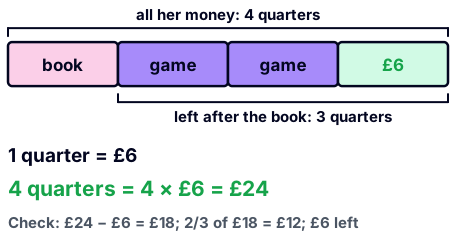
Split her money into 4 quarters. The book takes 1, so 3 are left. The game takes 2 of those 3, so 1 quarter is left: £6. 4 quarters: 4 × £6 = £24!
For the grown-up: a bar model turns ‘2/3 of what is left’ into whole parts: 2/3 of 3 quarters is 2 quarters. Check: the book costs £6, leaving £18; 2/3 of £18 is £12 for the game, leaving £6. Common wrong answer: £72 (taking 2/3 of all her money, so £6 looks like 1/12), or £18 (undoing the game but forgetting the book).
Problem 3
Problem 3: Answer 10 years old
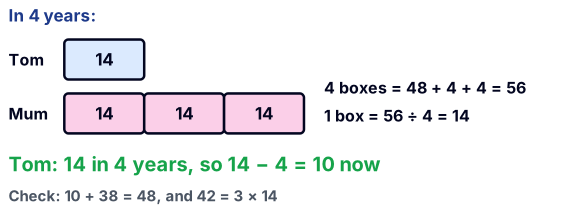
In 4 years they are both 4 years older: 48 + 4 + 4 = 56. Then Mum is 3 boxes and Tom is 1 box, so 4 boxes = 56 and 1 box = 14. Tom will be 14, so he is 10 now!
For the grown-up: the ‘3 times’ is true only in 4 years, so build the bar model at that time, then go back. Check: now 10 + 38 = 48; in 4 years 14 and 42, and 42 = 3 × 14. Common wrong answer: 9 (adding 4 only once: 52 ÷ 4 = 13), 12 (sharing today’s 48 in the ratio 1 : 3), or 14 (Tom’s age in 4 years, not now).
Problem 4
Problem 4: Answer 36 cm³
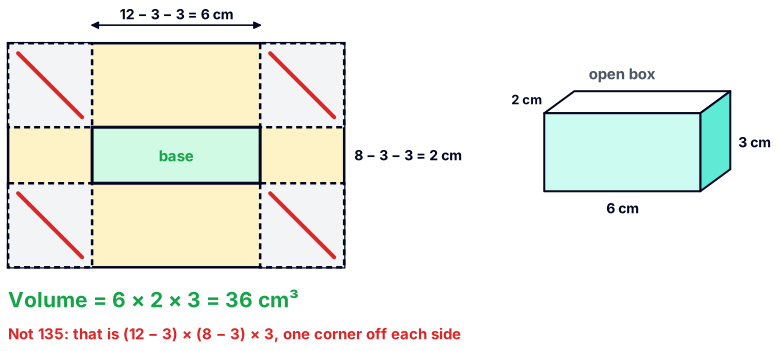
Each side loses 3 cm at both ends: 12 − 6 = 6 cm and 8 − 6 = 2 cm. The flaps fold up 3 cm high. Volume: 6 × 2 × 3 = 36 cm³!
For the grown-up: the base is what is left between the corner squares, and the corner square’s side becomes the height. Check: the base is 6 × 2 = 12 cm², and 12 × 3 = 36. Common wrong answer: 135 cm³ (9 × 5 × 3, taking 3 cm off each side only once), 288 cm³ (12 × 8 × 3, not cutting the base), or 96 (the area of the card).
Problem 5
Problem 5: Answer (a) 1 hour 35 minutes, (b) 72 km/h
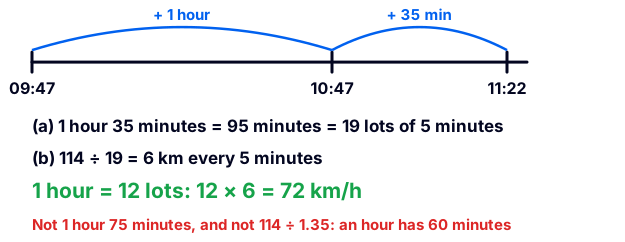
09:47 to 10:47 is 1 hour. 10:47 to 11:22 is 35 minutes. That is 95 minutes, or 19 lots of 5 minutes. 114 ÷ 19 = 6 km in every 5 minutes. An hour is 12 lots: 12 × 6 = 72 km/h!
For the grown-up: count on to the next hour instead of subtracting the times like decimals. Splitting into 5-minute blocks keeps the speed sum whole and calculator-free. Check: 72 km/h for 95 minutes is 72 × 95 ÷ 60 = 114 km. Common wrong answer: 1 hour 75 minutes (11.22 − 9.47 done as a decimal), or about 84 km/h (114 ÷ 1.35, treating 1 hour 35 minutes as 1.35 hours).
Problem 6
Problem 6: Answer 70° and 70°, or 40° and 100°
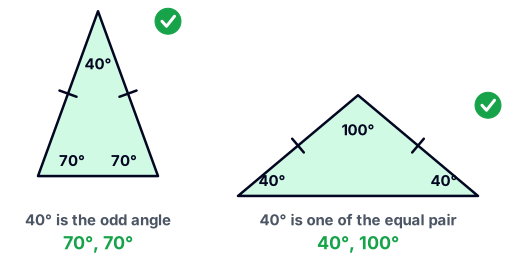
If 40° is the odd angle, the other two share 180° − 40° = 140°: 70° and 70°. If 40° is one of the equal pair, the other is 40° too, and the last angle is 180° − 80° = 100°!
For the grown-up: the 40° angle could be the top angle or one of the two equal base angles, so try both. Both work: 40 + 70 + 70 = 180 and 40 + 40 + 100 = 180. Common wrong answer: only one of the two cases, or 140° (forgetting to share it between two angles).
How to prepare
This is our advice, not the schools’.
- Year 5 autumn and spring: secure Key Stage 2. Fractions of amounts, ratio, area and volume, time and angle facts. Our 11 plus maths syllabus lists the topics, and 11 plus maths questions gives practice by topic.
- From spring: practise written answers. Three multi-step problems a session, about 20 minutes, with the working set out and a final answer with units. Mark the answer first, then look at the working together. Units and time are where marks go: Problem 4 wants cm³, and Problem 5’s 1 hour 35 minutes is not 1.35 hours.
- Check every answer with a second method or by substituting back, as each solution above does (Problem 3 checks both ages, Problem 5 works the distance back from the speed). On a written paper that is the only check there is.
- Summer before the test: timed practice. Multiple choice for the SET (the free sample questions show the layout), then written papers of 45 minutes to an hour for stage 2.
- Stretch with harder problems once the basics are solid: hard 11 plus maths questions and 11 plus ratio questions.
Dates and deadlines
As of November 2026. Dates for 2028 entry are from Sutton Grammar School’s admissions page (checked 4 November 2026), which still marks the test dates “expected”; check the SGS admissions page before you plan.
| Step | For September 2028 entry (today’s Year 5) |
|---|---|
| SET registration opens | 1 May 2027 |
| SET registration closes | 31 July 2027 |
| SET | 14 September 2027 (expected) |
| Boys’ shared stage 2 | 2 October 2027 (expected) |
| Girls’ NWSSEE | Not yet published (it was 26 September for 2027 entry) |
| Stage 2 results | Before the CAF deadline of 31 October |
| Offers | National Offer Day in March (it was 1 March 2027 for 2027 entry) |
For independent schools that set their own written maths paper, see independent school 11+ dates. Grammar schools outside Sutton use different tests: see FSCE 11 plus maths for Reading School and others.
Math Explorers Club is not affiliated with or endorsed by Sutton Grammar School, Wallington County Grammar School, Wilson’s School, Nonsuch High School for Girls, Wallington High School for Girls, Greenshaw High School or any school named here. All practice questions on this page are our own.